• Home
  • About Us
  • Toolkit
  • Archives
  • Advertise
  • Privacy Policy

Kids Ain't Cheap

But They Sure Are Worth It

  • Parenting
    • Baby Stuff
    • Books and Reading
      • Aesops Fables
      • Comic Books
    • Education
    • Family Time
    • Green Living
    • Growing Up
    • Healthy Living & Eating
    • Holidays
    • Parenting
    • Random Musings
    • Shopping
    • Stuff to Do
  • Money
  • Product Reviews
    • Books and Magazines
    • Discount Sites
    • Furniture
    • House Keeping
    • Reviews News
    • Toys and Games
  • Contact Us
  • Our Editorial Commitment
  • Search

Free Online Games to Teach Kids about the Environment

May 14, 2020 | Leave a Comment

If you’re a mom of kids under 12, you know that one of the best ways to teach kids so that they actually remember information is to play games.  Games are fun, so kids are eager to play, not knowing (or caring) that they’re actually learning something.  If you have science minded kids, there are many free online games to teach kids about the environment.

Free Online Games to Teach Kids about the Environment

Free Online Games to Teach Kids about the Environment

There are so many games and so many ways you can teach kids about the environment!

Games for Ages 4 to 7

Even your little children can learn about the environment with these fun games.

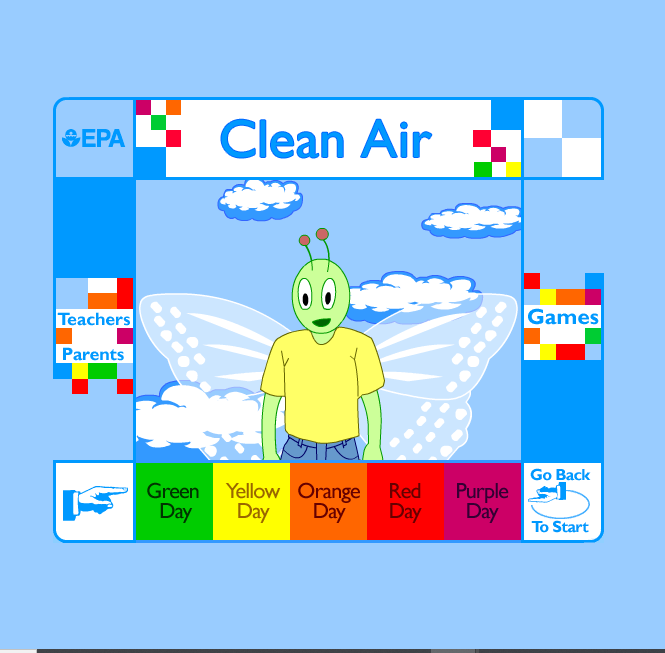
Environmental Protection Agency
Free Online Games to Teach Kids about the Environment

Choose one of three games for ages 4 to 7 to teach them about air pollution and what the various colors mean—green day, red day, etc.

National Institute of Environmental Health Sciences

There are many, many games on the Kids Environment Kids Health page from the National Institute of Environmental Health Sciences.  These games are for kids in 1st to 4th grade.  The free online games to teach kids about the environment include:

Climates of the World

Kids match children in a variety of clothes with the climate and country that they live in.

Matching Game

In one of the matching games, kids can match bird songs with the birds that make them.

Do check this site out as there is so much here young kids would like include many different games, jokes, riddles, and songs.

Energy Star

Calling all Dr. Seuss fans!  The Energy Star website has a fun game called Join the Lorax.  Games include coloring the Lorax characters, completing a word search, and a picture search for energy efficient items.

Games for Ages 8 to 12

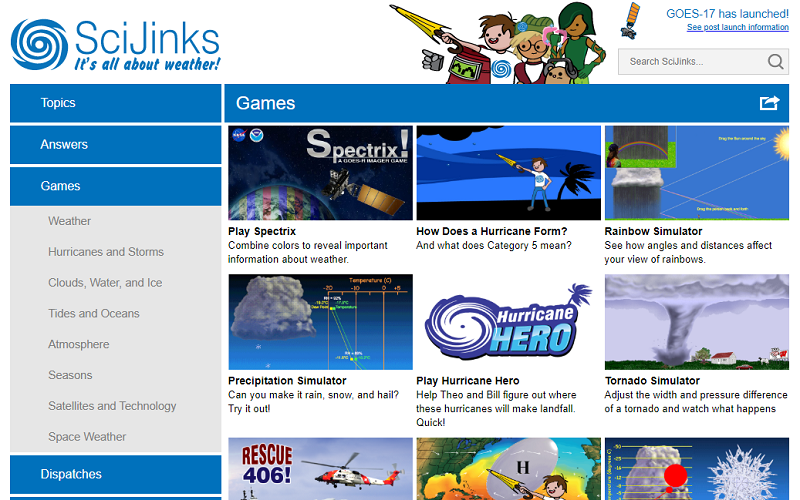
SciJinks
Free Online Games to Teach Kids about the Environment

The SciJinks site has many different games for kids from grades 3 to 7.  This site has 23 games including a hurricane simulator and a tornado simulator (kids will probably enjoy seeing the flying cow spinning around when the tornado hits).  Game topics include:

  • Weather,
  • Hurricanes and Storms,
  • Clouds, Water, and Ice,
  • Tides and Oceans,
  • Atmosphere,
  • Seasons,
  • Satellites and Technology,
  • Space Weather

EPA

For those who prefer more scholarly free games to teach kids about the environment, the EPA has an ozone science crossword puzzle.  This puzzle would be perfect for 5th to 7th graders.  There are 17 clues and 17 answers to choose from.

Energy Kids

The U.S. Energy Information Administration has all sorts of activities for kids on the part of their website called Energy Kids.

They have fun energy-related riddles such as, “How do energy-conscious people feel about wind power?  Answer—they’re blown away.”  When my son was in 3rd grade, he would have loved riddles like this.

They also have energy slang terms as well as puzzles (Sudoko, slider puzzles, crosswords and word searches).

For students who love participating in science fairs, the site has science fair experiment ideas for all ages, K-12.

Lastly, the site has suggestions for energy-based field trips as well as a brief description of each site.

NASA Science

For your kids in grades 6-9, Nasa Science has a game to teach your kids about energy flow called Go with the Flow.  Kids get to experiment with how salt and heat affect the weather and the water currents.

If your child is interested in learning about space weather, there is also a game for that on the site called Shields Up!

Smithsonian Science Education Center

If you want to teach your kids about the environment, the Smithsonian Science Education Center site has games for kids in grades 3 to 6.

In the game Habitats, children are given a picture of a habitat (habitats range from desert, coral reef, jungle and marsh.)  They then can choose from images of three animals to decide what animal belongs in that particular habitat.

Similarly, they also have a game, Home on the Range, that corresponds with 2nd grade learning standards.  Kids try to find animals and plants that exist in certain habitats around the United States.  If they don’t know the answer, they can click on each animal or plant that is a possible answer and read more about that particular one.

Smokey for Kids

Teach your kids about the dangers of wild fires with the Smokey for Kids site.  Not only do kids learn how to prevent wildfires, but they also can play games to reinforce what they learn.  Kids might find it especially fun to play the Storymaker Game.  They first fill out quite a bit of information personalized to them, and then a story is created using that information.

Water Sense

In the Water Sense game, created by the EPA, lead the water drop through a maze, being careful to avoid water wasters.  This game is great for late elementary and early middle school students.

Smithsonian’s National Zoo & Conservation Biology Institute

In the Migration Game, students answer questions about migration.  Each question that they answer correctly gets Wanda the Wood Thrush closer to her summer home in Maryland from her winter home in Costa Rica.

Sample multiple choice questions include, “When do Wood Thrushes fly when they are migrating?” and “How long does it take a Wood Thrush to migrate from Costa Rica to Maryland?”

Recycle City

Another site created by the EPA, Recycle City offers two activities for kids.  First, there is the Recycle City Challenge, where kids can answer questions about actions people can take to reduce waste and energy use.  They can earn points and jump on the leader board.

They can also play the Dumptown Game.  The player is in charge of Dumptown and must start programs to reduce waste and encourage recycling.  Players will be able to see the financial differences based on the programs they implement.

Final Thoughts

Most kids love playing games, all the better if they’re electronic games.  Why not use these free online games to teach kids about the environment to both entertain and educate your children?  I’m guessing your kids, if they’re like mine, would be happy to try out these games and learn new jokes and riddles to add to their repertoire.

Melissa Batai
Melissa Batai

Melissa is a writer and virtual assistant. She earned her Master’s from Southern Illinois University, and her Bachelor’s in English from the University of Michigan. When she’s not working, you can find her homeschooling her kids, reading a good book, or cooking. She resides in Arizona where she dislikes the summer heat but loves the natural beauty of the area.

Read More
  • A Toddlers Rules of Possession
    A Toddlers Rules of Possession

    I stumbled across this on the UC Berkeley Parents web site and thought it was…

  • Getting Rid of All That Unwanted Stuff
    Getting Rid of All That Unwanted Stuff

    One of the biggest things I was unprepared for when I had kids was the…
  • Teen using phone while parent looks on.
    Is It Ever Okay to Snoop Through Your Teen’s Phone?

    Image Source: Unsplash In a world where your teen’s entire social life can unfold through…

  • 5 Tips to Get Your Business Off the Ground This Year
    5 Tips to Get Your Business Off the Ground This Year

    Today there are so many businesses you can start for very little money. This has…

  • Disney Princesses -- Dethroned?
    Disney Princesses -- Dethroned?

    The other day I was on Facebook - which truth be told - is a…

  • 5 Signs Your Teen Is Secretly Overwhelmed—And How to Help

    Image source: Unsplash Teenagers are masters of disguise. They can slam doors, crack jokes, scroll…

Filed Under: Education, Green Living, Parenting Blog at KidsAintCheap, Stuff to Do Tagged With: educational games, environmentally friendly, Learning

Leave a Reply Cancel reply

Your email address will not be published. Required fields are marked *

This site uses Akismet to reduce spam. Learn how your comment data is processed.

  • Facebook
  • Pinterest
  • RSS
  • Twitter
Best Parenting Blogs

Most Popular

Baby names

Teachers Admit: These 6 Baby Names Create Instant Bias in the Classroom

Latrice Perez
6 Baby Names That Sound Cute Now but Cause Problems Later

6 Baby Names That Sound Cute Now but Cause Problems Later

Brandon Marcus
11 Ways Kids Are Outsmarting Parental Controls 1. Using Alternate Devices One common trick is simply turning to another device. If a child’s main phone or tablet is restricted, they may borrow a sibling’s, friend’s, or even a school laptop. This instantly gives them access to content outside of parental oversight. Parents often focus on one device, forgetting that others in the household can serve as loopholes. Knowing this tactic helps families tighten controls across all electronics. 2. Clearing Browsing Histories Many kids quickly learn that clearing browsing history hides evidence of restricted activity. With just a few clicks, they can erase any trace of websites visited. This makes it harder for parents to notice when rules are being broken. Parents may assume no history means no browsing, but the reality is often the opposite. Kids are outsmarting parental controls by making it seem like nothing happened at all. 3. Using Private Browsing Modes Most browsers offer “incognito” or private browsing features. Kids use this mode to access websites without leaving a record in the history. To parents checking later, everything looks clean and safe. This simple trick is often one of the first ways kids discover how to bypass restrictions. Conversations about private browsing can help close this gap. 4. Guessing or Resetting Passwords Children who are persistent may try to guess passwords to parental control apps or accounts. Others may find ways to reset them through email prompts or security questions. Once inside, they can disable restrictions entirely. Parents may not even realize controls have been altered until much later. Stronger, less predictable passwords can make this more difficult. 5. Using VPNs to Hide Activity Virtual private networks, or VPNs, let kids disguise their online locations. With one downloaded app, they can bypass geographic or parental restrictions. Some children learn about VPNs through friends or even social media. This makes it easy for them to reach content that should be blocked. Parents often underestimate just how simple it is for kids to use these tools. 6. Creating Fake Accounts When parents monitor social media, kids may create hidden accounts. These “finstas” or fake profiles allow them to interact freely without parental oversight. While their main account appears harmless, the secondary one tells a different story. Kids are outsmarting parental controls by playing both sides at once. Checking for duplicate accounts can help parents stay more aware. 7. Exploiting Time Zone Settings Some kids change the time zone on their devices to bypass screen time limits. This trick allows them to gain extra hours of usage undetected. Parents may assume controls are working, but in reality, the child is bending the clock. It’s a clever loophole that highlights just how resourceful kids can be. Monitoring device settings regularly can catch this tactic. 8. Disabling or Uninstalling Apps Parental control apps can be deleted or disabled with surprising ease. Some kids even reinstall them before a parent checks, making it seem like nothing changed. Others may simply restrict permissions to prevent apps from functioning properly. When apps aren’t monitored closely, parents may not notice they’ve been tampered with. This shows the importance of consistent follow-up. 9. Turning to Friends for Access If a child can’t get past restrictions on their own, they may rely on friends. Visiting a friend’s house or borrowing their phone can give them a free pass. Parents often forget that peer environments can override restrictions set at home. This kind of social workaround is especially common with gaming or social media. Open conversations about trust and responsibility are essential. 10. Hiding Apps in Plain Sight Kids sometimes download apps that look innocent but serve as gateways to hidden activity. These apps may disguise themselves as calculators or utilities. In reality, they allow file storage, private messaging, or browser access. Parents glancing at a home screen may overlook them entirely. Learning to recognize these disguised apps can help parents stay informed. 11. Outpacing Parents’ Tech Knowledge Finally, kids often know more about devices than their parents do. Whether through YouTube tutorials, TikTok hacks, or peer groups, they quickly learn advanced workarounds. This knowledge gap means controls can be bypassed before parents even realize the loophole exists. Staying informed and continually learning about new technology is the best defense. Kids are outsmarting parental controls because they adapt faster than most adults. The Real Solution Lies Beyond Restrictions While controls and filters are important, no system is perfect. Kids will always find creative ways around barriers, making communication the strongest safeguard. Setting clear expectations, building trust, and having ongoing conversations about online behavior matter more than apps alone. Parents who combine technology with open dialogue create a safer digital environment. The goal isn’t to win a battle of wits but to build a relationship that keeps kids both safe and honest. Do you think kids are outsmarting parental controls faster than parents can keep up? Share your experiences in the comments below. What to Read Next... 6 Parenting Tech Shortcuts That Can Expose Your Child to Strangers How Much Screen Time Is Too Much—Legally Speaking? Is Your Child’s School Quietly Tracking Their Location Without Your Consent? How Much Screen Time Is Quietly Reshaping Childhood Behavior? Why Some Parents Are Being Investigated Over Homeschooling Records

11 Ways Kids Are Outsmarting Parental Controls

Catherine Reed
Smiling grandfather holding a happy baby indoors.

Why Grandparents Shouldn’t Babysit Their Grandkids Every Week – The Unspoken Issue

Samantha
birthday gifts

7 Birthday Gifts Your Child Should Never Bring to a Party

Latrice Perez

All content on Kids Ain’t Cheap is for entertainment purposes only. By reading this blog, you agree that Kids Ain’t Cheap is not responsible for any actions taken after reading this blog. For the full disclaimer, see our privacy policy.

Please note that Kids Ain’t Cheap has financial relationships with some of the merchants mentioned here. Kids Ain’t Cheap is funded by banner advertising, commission sales and search optimization consulting.

Copyright © 2006–2026 | District Media | All Rights Reserved | Privacy Policy

Copyright © 2026 Runway Pro Theme by Viva la Violette