• Home
  • About Us
  • Toolkit
  • Archives
  • Advertise
  • Privacy Policy

Kids Ain't Cheap

But They Sure Are Worth It

  • Parenting
    • Baby Stuff
    • Books and Reading
      • Aesops Fables
      • Comic Books
    • Education
    • Family Time
    • Green Living
    • Growing Up
    • Healthy Living & Eating
    • Holidays
    • Parenting
    • Random Musings
    • Shopping
    • Stuff to Do
  • Money
  • Product Reviews
    • Books and Magazines
    • Discount Sites
    • Furniture
    • House Keeping
    • Reviews News
    • Toys and Games
  • Contact Us
  • Our Editorial Commitment
  • Search

Free-Range Parenting: Is it Too Scary to Consider?

March 9, 2011 | Leave a Comment

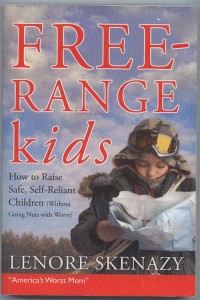
Free Range Kids by Lenore SkenazyHow would you feel about letting your child go to a neighborhood park to play on their own? Do you allow your children the freedom you had growing up? I think we would all like to do that – but realistically speaking – isn’t it too dangerous? Some people say — no. As I was doing research for my last post, I stumbled upon a few articles that included thoughts and opinions, on Free-Range parenting. I had heard about it, but didn’t know the specifics.

What I did know, was that columnist Lenore Skenazy, made the decision to let her 9 year old son navigate the New York City subway all on his own. This of course was after she made sure that he knew about the subway system and could read a map. Skenazy then wrote about it in the New York Sun. Some people – I’m going to guess there were quite a few – thought she was crazy and that she was taking a huge gamble with her child’s life. At first, I thought so too and it had a lot to do with something that happened last summer.

When a child wanders off

While the actual event only lasted a few minutes, it felt like an eternity. It terrified me and left me shaken for the rest of the day. I took the boys – who had just turned 3 – to a nice park on the other side of town. It’s one of our favorites, has wide open spaces, and a really fun playground.

When we got there I heard music. There was a man playing a guitar and singing. He was located in the covered picnic area, which is right next to the playground. Right away my “mom radar” went off. I told myself that I shouldn’t be so judgmental and I just needed to relax a little. I sort of did —  but I was careful to kept an eye on the guy and an even closer eye on the boys.

The boys were playing and having a great time. There weren’t too many people there, so they had free run of the place. A. had climbed a little too high for his comfort and asked me to come help him get down — so I did. When I turned around to look for N. he was no where to be seen. No where!

I tried not to panic. I kept one hand on A. and began calling for N. I looked all over.  I looked on slides, on the swings, in tunnels and nothing. Then I saw something that made my heart sink and almost brought me to tears. The man – the one playing the guitar – was gone too. Suddenly, every episode I had ever watched of America’s Most Wanted and Dateline NBC – relating to abducted children –  flooded my mind. I imagined that man had grabbed my son, and slipped away unnoticed.  I tried to stop thinking about it, but I couldn’t. Now —  I was frantically calling. A. began asking where N. was and started to call for him too.

All of a sudden, from around a corner, came my sweet- faced darling boy. I’m getting teary just reliving this again; that’s how much it frightened me. I grabbed N. and hugged him and thanked God that he was okay.

Free-range parenters believe risks over over-stated

So after that experience – and the panic and fear that I felt – how could I even think of (eventually) giving them the kind of freedom Skenazy advocates? Well, she and others like her, think that shows – like the ones I just mentioned – are what keep us over parenting our children. Skenazy also notes in her book Free-Range Kids: How to Rise Safe, Self-Reliant Children (without going nuts) that the occurrence of children who are abducted, is actually quite rare. Rare or not, I think I would be a nervous wreck if I allowed the boys – at age 9 – to ride their bikes to the library all on their own. Would they be fine? Probably, but what if they weren’t? I would never ever forgive myself if something happened to them.

I have been reading Skenazy’s blog and I really like it. I didn’t think I would. I thought I’d be outraged by everything she posted, and I’m just not. She is right that hovering and trying to remove all of the potential dangers and disappointments in life — isn’t doing anything for our kids. So what if they fall down and get scraped knees or a broken bone? It’s going to happen but they will heal and they might learn to be more careful next time.

Look — I spent my summers climbing trees and riding my bike around the neighborhood (often times doing dare-devil maneuvers like standing on the seat). Sure I fell, but I have some really fun childhood memories – and impressive scars – because I got to do that. I don’t think I would ever be able to allow the boys to navigate the subway system at age 9 but I’ll be reading Skenazy’s book. I’ll probably still feel the same about a lot of things, but it will definitely give me some food for thought. I certainly don’t want to take anything away from my kids, but their safety is my first concern! I think the book is worth a read! I’ll keep you posted 🙂

So what are your thoughts? Are you for or against Free-Range parenting?

Brian
Brian

Brian is the founder of Kids Ain’t Cheap and is now sharing his journey through parenthood.

 
Email • Google + • Facebook • Twitter

Read More

  • 9 Cool Toys for Your Kids in the 2000s

    123rf The 2000s brought a wave of innovative and exciting toys that captured the imaginations…

  • interview topics that invade privacy
    13 Interview Topics That Invade Privacy and How to Avoid Them

    Job interviews can sometimes feel like you're under a microscope, but there's a fine line between…

  • money apps for kids
    Top 5 Personal Finance Apps for Kids

    In today's digital age, teaching kids about money management from an early age is crucial…

  • Single Parenthood and Home Schooling
    Single Parenthood and Home Schooling

    Single parenting is hard. If you are a couple with kids, think of how tough…

  • Teach Kids about Money
    What Age Should Kids Learn About Money?

    What age should kids learn about money?  That’s a difficult question because kids learning about…

  • Teach Kids to Count Money
    How To Teach a Child To Count Money

    Counting money is one of the most foundational skills children must learn. Counting and making…

Filed Under: Books and Magazines, Parenting, Safety Tagged With: Free-Range Parenting, Free-Ranke Kids, Skenazy

Leave a Reply Cancel reply

Your email address will not be published. Required fields are marked *

This site uses Akismet to reduce spam. Learn how your comment data is processed.

  • Facebook
  • Pinterest
  • RSS
  • Twitter
Best Parenting Blogs

Most Popular

11 Ways Kids Are Outsmarting Parental Controls 1. Using Alternate Devices One common trick is simply turning to another device. If a child’s main phone or tablet is restricted, they may borrow a sibling’s, friend’s, or even a school laptop. This instantly gives them access to content outside of parental oversight. Parents often focus on one device, forgetting that others in the household can serve as loopholes. Knowing this tactic helps families tighten controls across all electronics. 2. Clearing Browsing Histories Many kids quickly learn that clearing browsing history hides evidence of restricted activity. With just a few clicks, they can erase any trace of websites visited. This makes it harder for parents to notice when rules are being broken. Parents may assume no history means no browsing, but the reality is often the opposite. Kids are outsmarting parental controls by making it seem like nothing happened at all. 3. Using Private Browsing Modes Most browsers offer “incognito” or private browsing features. Kids use this mode to access websites without leaving a record in the history. To parents checking later, everything looks clean and safe. This simple trick is often one of the first ways kids discover how to bypass restrictions. Conversations about private browsing can help close this gap. 4. Guessing or Resetting Passwords Children who are persistent may try to guess passwords to parental control apps or accounts. Others may find ways to reset them through email prompts or security questions. Once inside, they can disable restrictions entirely. Parents may not even realize controls have been altered until much later. Stronger, less predictable passwords can make this more difficult. 5. Using VPNs to Hide Activity Virtual private networks, or VPNs, let kids disguise their online locations. With one downloaded app, they can bypass geographic or parental restrictions. Some children learn about VPNs through friends or even social media. This makes it easy for them to reach content that should be blocked. Parents often underestimate just how simple it is for kids to use these tools. 6. Creating Fake Accounts When parents monitor social media, kids may create hidden accounts. These “finstas” or fake profiles allow them to interact freely without parental oversight. While their main account appears harmless, the secondary one tells a different story. Kids are outsmarting parental controls by playing both sides at once. Checking for duplicate accounts can help parents stay more aware. 7. Exploiting Time Zone Settings Some kids change the time zone on their devices to bypass screen time limits. This trick allows them to gain extra hours of usage undetected. Parents may assume controls are working, but in reality, the child is bending the clock. It’s a clever loophole that highlights just how resourceful kids can be. Monitoring device settings regularly can catch this tactic. 8. Disabling or Uninstalling Apps Parental control apps can be deleted or disabled with surprising ease. Some kids even reinstall them before a parent checks, making it seem like nothing changed. Others may simply restrict permissions to prevent apps from functioning properly. When apps aren’t monitored closely, parents may not notice they’ve been tampered with. This shows the importance of consistent follow-up. 9. Turning to Friends for Access If a child can’t get past restrictions on their own, they may rely on friends. Visiting a friend’s house or borrowing their phone can give them a free pass. Parents often forget that peer environments can override restrictions set at home. This kind of social workaround is especially common with gaming or social media. Open conversations about trust and responsibility are essential. 10. Hiding Apps in Plain Sight Kids sometimes download apps that look innocent but serve as gateways to hidden activity. These apps may disguise themselves as calculators or utilities. In reality, they allow file storage, private messaging, or browser access. Parents glancing at a home screen may overlook them entirely. Learning to recognize these disguised apps can help parents stay informed. 11. Outpacing Parents’ Tech Knowledge Finally, kids often know more about devices than their parents do. Whether through YouTube tutorials, TikTok hacks, or peer groups, they quickly learn advanced workarounds. This knowledge gap means controls can be bypassed before parents even realize the loophole exists. Staying informed and continually learning about new technology is the best defense. Kids are outsmarting parental controls because they adapt faster than most adults. The Real Solution Lies Beyond Restrictions While controls and filters are important, no system is perfect. Kids will always find creative ways around barriers, making communication the strongest safeguard. Setting clear expectations, building trust, and having ongoing conversations about online behavior matter more than apps alone. Parents who combine technology with open dialogue create a safer digital environment. The goal isn’t to win a battle of wits but to build a relationship that keeps kids both safe and honest. Do you think kids are outsmarting parental controls faster than parents can keep up? Share your experiences in the comments below. What to Read Next... 6 Parenting Tech Shortcuts That Can Expose Your Child to Strangers How Much Screen Time Is Too Much—Legally Speaking? Is Your Child’s School Quietly Tracking Their Location Without Your Consent? How Much Screen Time Is Quietly Reshaping Childhood Behavior? Why Some Parents Are Being Investigated Over Homeschooling Records

11 Ways Kids Are Outsmarting Parental Controls

Catherine Reed

10 Children’s Games From the ’60s That Need to Make a Comeback

Samantha
Girl getting makeup done, referencing psychologist-approved age.

Wearing Makeup: Here Is the Age That Psychologists Agree It’s Okay for Girls to Wear Makeup

Samantha
birthday gifts

7 Birthday Gifts Your Child Should Never Bring to a Party

Latrice Perez

Babysitting Without Cash: 10 Ways to Barter Your Way Out of Childcare Costs

Ashleigh Clyde

All content on Kids Ain’t Cheap is for entertainment purposes only. By reading this blog, you agree that Kids Ain’t Cheap is not responsible for any actions taken after reading this blog. For the full disclaimer, see our privacy policy.

Please note that Kids Ain’t Cheap has financial relationships with some of the merchants mentioned here. Kids Ain’t Cheap is funded by banner advertising, commission sales and search optimization consulting.

Copyright © 2006–2026 | District Media | All Rights Reserved | Privacy Policy

Copyright © 2026 Runway Pro Theme by Viva la Violette