
• Home
  • About Us
  • Toolkit
  • Archives
  • Advertise
  • Privacy Policy

Kids Ain't Cheap

But They Sure Are Worth It

  • Parenting
    • Baby Stuff
    • Books and Reading
      • Aesops Fables
      • Comic Books
    • Education
    • Family Time
    • Green Living
    • Growing Up
    • Healthy Living & Eating
    • Holidays
    • Parenting
    • Random Musings
    • Shopping
    • Stuff to Do
  • Money
  • Product Reviews
    • Books and Magazines
    • Discount Sites
    • Furniture
    • House Keeping
    • Reviews News
    • Toys and Games
  • Contact Us
  • Our Editorial Commitment
  • Search

Indoor Fitness Hacks for Kids When Snow and Ice Cancel Outside Plans

December 31, 2025 | Leave a Comment

Indoor Fitness Hacks for Kids When Snow and Ice Cancel Outside Plans
Image source: shutterstock.com

When the driveway is a skating rink and the playground is buried, kids still have the same energy they’d normally burn outside—maybe more. That’s when the house starts feeling smaller by the minute, and every couch cushion becomes a launchpad. The good news is you don’t need pricey equipment, a big basement, or a Pinterest-perfect routine to get everyone moving. A few simple indoor fitness hacks can turn a “stuck inside” day into a reset for bodies and moods. Here are easy, low-cost ways to help kids move, sweat, and laugh without wrecking your home.

1. Create A “Hallway Olympics” With Safe, Simple Events

Pick a clear stretch of hallway or living room space and set two rules: no running near breakables and shoes stay off. Then set up events like “speed walking relay,” “crab-walk race,” or “bear crawl to the finish line.” Use painter’s tape or a scarf to mark start and finish lines, and let kids take turns being the “announcer.” Keep rounds short so they stay fun, and rotate events before anyone gets bored. These indoor fitness hacks work because they feel like play, but they still burn energy fast.

2. Try The “Clean-Up Cardio” Game That Multitasks

Write quick chores on slips of paper, like “put five toys away,” “wipe the table,” or “match three socks.” Then pair each chore with a movement burst, like ten jumping jacks, five squats, or a 20-second dance break. Kids draw a slip, do the task, then do the movement, and they earn a point or a sticker if you want to track it. You can keep it light and silly without turning it into a power struggle. This is one of the best indoor fitness hacks because your house gets cleaner while kids stay active.

3. Set Up A DIY Obstacle Course Using What You Already Have

Grab couch pillows, a laundry basket, a couple chairs, and a roll of tape, then build a course in five minutes. Kids can jump over a “lava pillow,” crawl under a chair bridge, and toss a soft ball into a basket to finish. Let them redesign the course once or twice so they feel ownership and don’t lose interest. If you’re short on space, make it a single loop they can run one at a time. Obstacle courses are classic indoor fitness hacks because they mix strength, balance, and coordination without feeling like exercise.

4. Use “Movement Menus” So Kids Can Choose Their Workout

Kids push back when they feel forced, but they lean in when they get to pick. Make a simple menu with options like “dance,” “yoga,” “animal moves,” “stretching,” and “strength,” then let them choose two. Keep each choice short, like five minutes, so the whole thing doesn’t feel endless. If you have multiple kids, each kid gets one pick, and you alternate. Indoor fitness hacks work better when kids feel like partners instead of passengers.

5. Turn Commercial Breaks Into Mini Workout Challenges

If kids are watching something while stuck inside, you can still build movement into the day. During every break, do a quick challenge: plank for 20 seconds, march in place, or do a silly “freeze dance” round. If you don’t want to link it to screens, you can do the same idea with a timer that goes off every 15 minutes. Keep it short so it feels doable and doesn’t derail the day. This is one of those indoor fitness hacks that sneaks movement into the routine without a big setup.

6. Make A “Stuffed Animal Boot Camp” That Feels Like Storytime

Pick a few stuffed animals and assign them roles, like “Coach Bear” or “Captain Bunny.” Kids do moves to “train” the animals: hop like a rabbit, stomp like a dinosaur, or stretch like a cat. You can add a simple story, like training for a winter rescue mission or a superhero academy. This works especially well for younger kids who love pretend play more than “exercise.” Indoor fitness hacks like this keep the mood playful, which is half the battle on long indoor days.

7. Use Balloon Games for Low-Impact, High-Fun Movement

A balloon is cheap, safe, and surprisingly exhausting when you try to keep it from touching the floor. Play “balloon volleyball” over a string, “keep it up” with a countdown, or “balloon tennis” with paper plate paddles. You can add rules like “only use elbows” or “must spin once before hitting” to make it harder. Because balloons move slowly, kids can play without slamming into furniture as much. Balloon games are underrated indoor fitness hacks because they build coordination and keep kids moving without chaos.

8. Do A Short Family “Workout Playlist” Instead of a Full Workout

You don’t need a 30-minute routine to change the energy in your house. Pick three songs and make it a mini playlist that happens once or twice a day. Song one is dancing, song two is strength moves like squats or wall sits, and song three is stretching or slow movement to calm down. Kids love routines that repeat because they know what’s coming. This is one of the simplest indoor fitness hacks, and it often improves behavior for the next hour.

The Snow-Day Movement Plan That Keeps Everyone Sane

When you’re trapped inside, the goal isn’t perfect fitness—it’s getting enough movement to help kids regulate their bodies and moods. Choose one high-energy option like obstacle courses, one steady option like balloon games, and one calm-down option like stretching or yoga. Keep sessions short and repeatable so you can do them without dread. Rotate the activities so kids stay interested, but don’t overcomplicate it with too many rules. If you lean on a handful of indoor fitness hacks, snow and ice won’t ruin your day, and your home will feel a lot more peaceful.

What’s your go-to “stuck inside” activity that burns the most energy without causing the most chaos?

What to Read Next…

How to Build a Family Emergency Fun Jar for Unexpected Winter Activities

Winter Craft Materials You Probably Already Have and Kids Will Love

8 Exercises You Can Do With Your Child for Fun and Fitness

Ways to Reuse Holiday Wrapping Materials to Save on Crafts with Kids

How to Turn Snow Days Into Learning Days That Don’t Cost a Cent

Catherine Reed
Catherine Reed

Catherine is a tech-savvy writer who has focused on the personal finance space for more than eight years. She has a Bachelor’s in Information Technology and enjoys showcasing how tech can simplify everyday personal finance tasks like budgeting, spending tracking, and planning for the future. Additionally, she’s explored the ins and outs of the world of side hustles and loves to share what she’s learned along the way. When she’s not working, you can find her relaxing at home in the Pacific Northwest with her two cats or enjoying a cup of coffee at her neighborhood cafe.


Filed Under: Healthy Living & Eating Tagged With: budget parenting, family routines, gross motor play, indoor activities for kids, kids fitness, screen-free activities, snow day activities, winter parenting

9 Ways to Encourage Creativity in Kids

June 16, 2025 | Leave a Comment

9 Ways to Encourage Creativity in Kids
123rf.com

Creativity isn’t just for artists—it’s a powerful life skill that helps kids solve problems, express emotions, and explore their world with confidence. Whether your child is building a fort out of couch cushions or inventing a game with made-up rules, these moments of imagination shape how they learn and grow. The best part? You don’t need expensive tools or a special curriculum to encourage creativity in kids. With a few intentional choices, you can foster an environment where new ideas are welcomed, mistakes are celebrated, and imagination runs wild. Let’s dive into nine practical ways to help your child’s creativity shine every day.

1. Give Them Time to Be Bored

One of the easiest ways to encourage creativity in kids is to give them space without constant stimulation. Boredom often leads to imaginative play when children are left to their own devices. When every minute is scheduled, there’s no room for spontaneous ideas. Resist the urge to fill silence with screens or structured activities. Let their minds wander and you’ll be amazed at what they come up with.

2. Make Art Supplies Easy to Access

Creativity loves convenience. Instead of storing crayons, paper, and glue in a closet, try keeping them within reach so kids can create whenever inspiration strikes. Having a “creativity station” sends the message that making things is always an option. It also fosters independence and self-directed play. When art becomes part of everyday life, kids feel empowered to explore it on their own.

3. Celebrate Process Over Product

Focusing too much on how something turns out can stifle creativity. Instead, praise the effort, curiosity, and bravery it takes to try something new. Ask questions like “What did you enjoy about making that?” rather than “What is it supposed to be?” This approach takes the pressure off and encourages kids to experiment freely. The goal is growth, not perfection.

4. Encourage Open-Ended Play

Open-ended toys like blocks, clay, and dress-up clothes allow kids to create stories, structures, and characters with no right or wrong way to play. These kinds of materials stimulate the imagination much more than toys with fixed outcomes or step-by-step instructions. Open-ended play also builds problem-solving and decision-making skills. The more flexible the toy, the more flexible the thinking.

5. Ask Creative Questions

Instead of asking factual questions, try ones that spark creative thinking. Ask, “What would happen if animals could talk?” or “How would you build a playground on the moon?” These kinds of prompts help kids think outside the box and use their imaginations in new ways. There are no wrong answers—just opportunities to stretch their minds. Plus, it’s a fun way to connect and giggle together.

6. Let Them Lead Sometimes

Children often have wild, unpredictable ideas—and that’s a good thing. Let them lead playtime or storytelling sessions, even if it means going off track. Follow their lead when they invent new games or decide how to build something unusual. It shows them their ideas matter and helps develop confidence. Giving kids control over their creativity teaches them to trust their instincts.

7. Introduce Different Forms of Expression

Not every child is drawn to paint or playdough. Some prefer music, dance, building, or storytelling. Try offering a variety of creative outlets and let them explore what lights them up. This helps uncover hidden talents and keeps things exciting. The goal is to show that creativity comes in many shapes and doesn’t fit in just one box.

8. Show Your Own Creativity

Kids learn by watching. When they see you doodling, writing, baking, or trying something new, it sends the message that creativity is valuable at any age. You don’t need to be good at it—you just need to enjoy it. In fact, watching you make mistakes and try again is even more powerful. Your example sets the tone for how they approach their own creativity.

9. Limit Screen Time—But Use It Intentionally

Screens aren’t the enemy, but overuse can dull creativity. Be mindful of how much passive content your child is consuming. When used wisely, technology can inspire new ideas—think drawing tutorials, coding apps, or stop-motion animation tools. Use screen time as a springboard, not a substitute, for hands-on creativity. The real magic happens when kids take inspiration and make something of their own.

Let Imagination Take the Lead

The ability to think creatively gives kids an incredible advantage in life—academically, socially, and emotionally. By carving out time for imagination, offering the right tools, and encouraging experimentation, you help build a strong foundation for problem-solving and self-expression. Every drawing, wild story, or Lego invention is a reminder that your child’s creativity is alive and thriving. Give it room to grow, and you’ll be amazed where it leads.

What’s your child’s favorite way to express creativity? Share their quirkiest creations or imaginative ideas in the comments!

Read More:

12 Ways to Encourage Independence in Kids

The Best Ways to Encourage a Growth Mindset in Children

Catherine Reed
Catherine Reed

Catherine is a tech-savvy writer who has focused on the personal finance space for more than eight years. She has a Bachelor’s in Information Technology and enjoys showcasing how tech can simplify everyday personal finance tasks like budgeting, spending tracking, and planning for the future. Additionally, she’s explored the ins and outs of the world of side hustles and loves to share what she’s learned along the way. When she’s not working, you can find her relaxing at home in the Pacific Northwest with her two cats or enjoying a cup of coffee at her neighborhood cafe.
Filed Under: Parenting Tagged With: child development, creative play, encourage creativity in kids, imagination, kids art ideas, open-ended play, parenting tips, raising creative children, screen-free activities

DIY Water Games That Keep Kids Busy for Hours

May 3, 2025 | Leave a Comment

Image by Aaron Burden

When summer hits, and the kids are out of school, staying cool and entertained becomes a daily challenge. While screen time might be the easy fallback, outdoor play is where the real magic happens, especially when water is involved.

The best part? You don’t need a fancy pool or expensive water toys to make it happen. With just a hose, a few household items, and a little creativity, you can create hours of laughter, teamwork, and pure summertime joy. These DIY water games are simple enough for toddlers to teens, and they’ll keep kids moving, giggling, and off the couch.

Why Water Play Is Worth the Mess

Water games aren’t just a fun way to cool off. They also provide key developmental benefits. Splashing around helps kids strengthen motor skills, practice coordination, and even learn problem-solving as they create new ways to play. It encourages sensory exploration, teamwork, and physical activity in a low-pressure environment. Plus, there’s just something about water that makes kids more willing to stay outside for hours.

Even better, many of these games involve minimal setup and clean-up. Whether you’re hosting a backyard playdate or looking for an easy way to break up a long afternoon, a good water game can save the day.

1. Sponge Toss Challenge

Instead of water balloons (which can leave tiny bits of rubber all over your yard), use big, absorbent sponges. Set up two buckets—one filled with water and one empty—at opposite ends of the yard. Kids soak their sponge in the full bucket, run across the yard, and try to squeeze as much water into the empty bucket as they can. Whoever fills their bucket first wins!

It’s active, competitive, and endlessly replayable.

Image by Kelly Sikkema

2. DIY Slip ‘n Slide

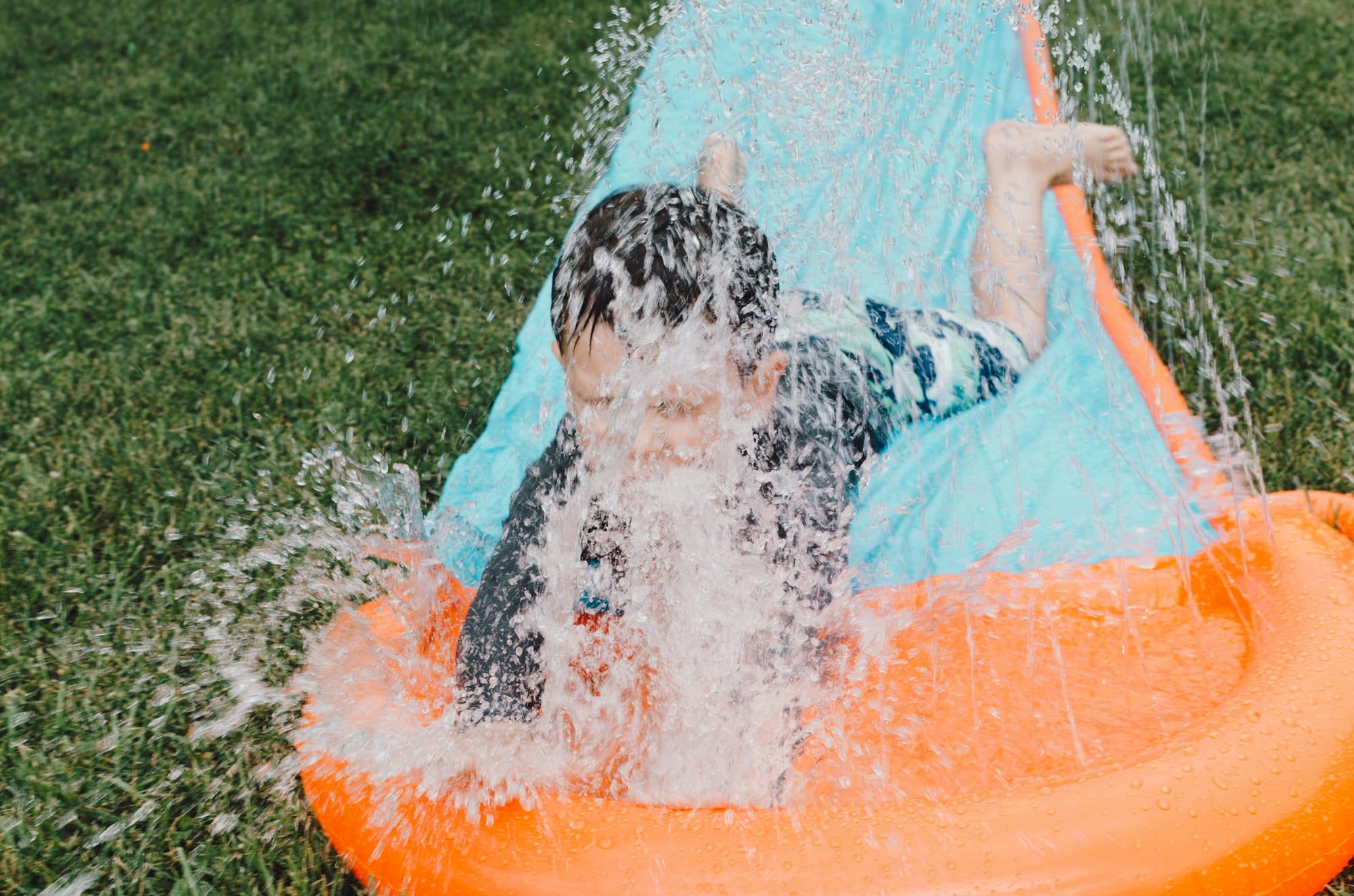
You don’t need to buy a plastic slide from the store. A simple tarp or painter’s plastic sheeting laid out on the grass with a bit of dish soap and a garden hose can make the ultimate backyard slip ‘n slide. For extra safety, set it on a soft hill or grassy area, and make sure there are no rocks or hard edges underneath.

Kids can take turns running and sliding, or you can make it a race with starting and ending points.

3. Cup-Over-Head Relay

Each player fills a plastic cup with water, holds it over their head, and tries to dump it backward into the cup of the person behind them without turning around. Laughter is guaranteed as the group tries to transfer water down the line with as little spillage as possible. It’s great for groups or family games, and the water-soaked chaos is half the fun.

4. Water Balloon Piñata

Hang several water balloons from a clothesline or tree branch. Blindfold each child, spin them around, and give them a small stick or bat to try and burst the balloons. It’s a safe way to enjoy the thrill of a piñata (no candy required) and even more fun when it turns into a full-on splash zone.

This game is ideal for birthdays or backyard parties and adds just the right level of challenge.

5. Water Obstacle Course

Get creative with sprinklers, buckets, hula hoops, kiddie pools, and any other items you have on hand. Set up a timed course where kids have to crawl under spray arcs, fill and carry water between stations, or complete tasks like fishing for floating toys in a tub with only their toes.

This kind of open-ended play allows kids to invent new ways to compete or work together.

6. Ice Block Excavation

This is a perfect slow-paced activity for when the sun is blazing. Freeze small toys (like figurines, coins, or even glow sticks) inside large blocks of ice using containers or balloons. Give kids plastic tools, eye droppers, or water squirters to slowly “excavate” their treasures.

It’s cool, sensory-rich, and keeps kids engaged for surprisingly long stretches.

7. Drip, Drip, Splash!

A warm-weather spin on Duck, Duck, Goose—except the “goose” gets soaked! In this version, one child walks around the circle, dripping water from a sponge or cup onto each player’s head, until finally yelling “splash!” and pouring the rest of the water on their chosen target. Then, the chase begins.

It’s lighthearted, giggle-inducing, and perfect for younger kids who love surprises.

Keep It Safe, Keep It Fun

While water play is generally safe, it’s important to supervise younger children, especially around buckets or kiddie pools. Remind kids to walk (not run) on slippery surfaces and use soft, age-appropriate objects when possible.

Stay sun-safe with hats, sunscreen, and shaded breaks, and don’t forget to hydrate with water (the kind you drink, not toss!).

Letting kids cool off and burn energy doesn’t require anything fancy. Just a little planning, a few supplies, and a willingness to get wet right along with them. These DIY water games create lasting summer memories, and they just might buy you a few hours of peace, too.

Which water game will your kids try first? Or do you have a go-to favorite that always works?

Read More:

10 Screen-Free Activities to Keep Kids Entertained

Unplug and Thrive: 12 Screen-Free Activities to Supercharge Your Child’s IQ and EQ

Filed Under: Parenting Tagged With: backyard play ideas, DIY water games, fun family ideas, kid-friendly summer games, outdoor fun for kids, screen-free activities, splash games for kids, summer kids activities, water games for children, water play benefits

  • Facebook
  • Pinterest
  • RSS
  • Twitter

Basic Principles Of Good Parenting

Here some basic principles for good parenting:

  1. What You Do Matters: Your kids are watching you. So, be purposeful about what you want to accomplish.
  2. You Can’t be Too Loving: Don’t replace love with material possessions, lowered expectations or leniency.
  3. Be Involved Your Kids Life: Arrange your priorities to focus on what your kid’s needs. Be there mentally and physically.
  4. Adapt Your Parenting: Children grow quickly, so keep pace with your child’s development.
  5. Establish and Set Rules: The rules you set for children will establish the rules they set for themselves later.  Avoid harsh discipline and be consistent.
  6. Explain Your Decisions: What is obvious to you may not be evident to your child. They don’t have the experience you do.
  7. Be Respectful To Your Child: How you treat your child is how they will treat others.  Be polite, respectful and make an effort to pay attention.
Best Parenting Blogs

Most Popular

Baby names

Teachers Admit: These 6 Baby Names Create Instant Bias in the Classroom

Latrice Perez
These Are 6 Baby Names Inspired by Vintage TV and Movies

6 Baby Names Inspired by Vintage TV and Movies

Brandon Marcus
6 Baby Names That Sound Cute Now but Cause Problems Later

6 Baby Names That Sound Cute Now but Cause Problems Later

Brandon Marcus
11 Ways Kids Are Outsmarting Parental Controls 1. Using Alternate Devices One common trick is simply turning to another device. If a child’s main phone or tablet is restricted, they may borrow a sibling’s, friend’s, or even a school laptop. This instantly gives them access to content outside of parental oversight. Parents often focus on one device, forgetting that others in the household can serve as loopholes. Knowing this tactic helps families tighten controls across all electronics. 2. Clearing Browsing Histories Many kids quickly learn that clearing browsing history hides evidence of restricted activity. With just a few clicks, they can erase any trace of websites visited. This makes it harder for parents to notice when rules are being broken. Parents may assume no history means no browsing, but the reality is often the opposite. Kids are outsmarting parental controls by making it seem like nothing happened at all. 3. Using Private Browsing Modes Most browsers offer “incognito” or private browsing features. Kids use this mode to access websites without leaving a record in the history. To parents checking later, everything looks clean and safe. This simple trick is often one of the first ways kids discover how to bypass restrictions. Conversations about private browsing can help close this gap. 4. Guessing or Resetting Passwords Children who are persistent may try to guess passwords to parental control apps or accounts. Others may find ways to reset them through email prompts or security questions. Once inside, they can disable restrictions entirely. Parents may not even realize controls have been altered until much later. Stronger, less predictable passwords can make this more difficult. 5. Using VPNs to Hide Activity Virtual private networks, or VPNs, let kids disguise their online locations. With one downloaded app, they can bypass geographic or parental restrictions. Some children learn about VPNs through friends or even social media. This makes it easy for them to reach content that should be blocked. Parents often underestimate just how simple it is for kids to use these tools. 6. Creating Fake Accounts When parents monitor social media, kids may create hidden accounts. These “finstas” or fake profiles allow them to interact freely without parental oversight. While their main account appears harmless, the secondary one tells a different story. Kids are outsmarting parental controls by playing both sides at once. Checking for duplicate accounts can help parents stay more aware. 7. Exploiting Time Zone Settings Some kids change the time zone on their devices to bypass screen time limits. This trick allows them to gain extra hours of usage undetected. Parents may assume controls are working, but in reality, the child is bending the clock. It’s a clever loophole that highlights just how resourceful kids can be. Monitoring device settings regularly can catch this tactic. 8. Disabling or Uninstalling Apps Parental control apps can be deleted or disabled with surprising ease. Some kids even reinstall them before a parent checks, making it seem like nothing changed. Others may simply restrict permissions to prevent apps from functioning properly. When apps aren’t monitored closely, parents may not notice they’ve been tampered with. This shows the importance of consistent follow-up. 9. Turning to Friends for Access If a child can’t get past restrictions on their own, they may rely on friends. Visiting a friend’s house or borrowing their phone can give them a free pass. Parents often forget that peer environments can override restrictions set at home. This kind of social workaround is especially common with gaming or social media. Open conversations about trust and responsibility are essential. 10. Hiding Apps in Plain Sight Kids sometimes download apps that look innocent but serve as gateways to hidden activity. These apps may disguise themselves as calculators or utilities. In reality, they allow file storage, private messaging, or browser access. Parents glancing at a home screen may overlook them entirely. Learning to recognize these disguised apps can help parents stay informed. 11. Outpacing Parents’ Tech Knowledge Finally, kids often know more about devices than their parents do. Whether through YouTube tutorials, TikTok hacks, or peer groups, they quickly learn advanced workarounds. This knowledge gap means controls can be bypassed before parents even realize the loophole exists. Staying informed and continually learning about new technology is the best defense. Kids are outsmarting parental controls because they adapt faster than most adults. The Real Solution Lies Beyond Restrictions While controls and filters are important, no system is perfect. Kids will always find creative ways around barriers, making communication the strongest safeguard. Setting clear expectations, building trust, and having ongoing conversations about online behavior matter more than apps alone. Parents who combine technology with open dialogue create a safer digital environment. The goal isn’t to win a battle of wits but to build a relationship that keeps kids both safe and honest. Do you think kids are outsmarting parental controls faster than parents can keep up? Share your experiences in the comments below. What to Read Next... 6 Parenting Tech Shortcuts That Can Expose Your Child to Strangers How Much Screen Time Is Too Much—Legally Speaking? Is Your Child’s School Quietly Tracking Their Location Without Your Consent? How Much Screen Time Is Quietly Reshaping Childhood Behavior? Why Some Parents Are Being Investigated Over Homeschooling Records

11 Ways Kids Are Outsmarting Parental Controls

Catherine Reed
Smiling grandfather holding a happy baby indoors.

Why Grandparents Shouldn’t Babysit Their Grandkids Every Week – The Unspoken Issue

Samantha

All content on Kids Ain’t Cheap is for entertainment purposes only. By reading this blog, you agree that Kids Ain’t Cheap is not responsible for any actions taken after reading this blog. For the full disclaimer, see our privacy policy.

Please note that Kids Ain’t Cheap has financial relationships with some of the merchants mentioned here. Kids Ain’t Cheap is funded by banner advertising, commission sales and search optimization consulting.

Copyright © 2006–2026 | District Media | All Rights Reserved | Privacy Policy

Copyright © 2026 Runway Pro Theme by Viva la Violette