
• Home
  • About Us
  • Toolkit
  • Archives
  • Advertise
  • Privacy Policy

Kids Ain't Cheap

But They Sure Are Worth It

  • Parenting
    • Baby Stuff
    • Books and Reading
      • Aesops Fables
      • Comic Books
    • Education
    • Family Time
    • Green Living
    • Growing Up
    • Healthy Living & Eating
    • Holidays
    • Parenting
    • Random Musings
    • Shopping
    • Stuff to Do
  • Money
  • Product Reviews
    • Books and Magazines
    • Discount Sites
    • Furniture
    • House Keeping
    • Reviews News
    • Toys and Games
  • Contact Us
  • Our Editorial Commitment
  • Search

8 Child and Dependent Care Credit Rules Parents Should Recheck

July 17, 2026 | Leave a Comment

Parent And Child
A parent should review childcare receipts and tax documents while calculating potential child and dependent care credit savings before filing a tax return. (Pexels).

Parents often spend thousands of dollars each year on daycare, after-school programs, and summer camps, making every available tax break worth revisiting. The child and dependent care credit can reduce your tax bill if you qualify, but many families miss out because they misunderstand the rules or overlook key details. With tax laws continuing to evolve, it’s smart to review the latest requirements before filing your return. Here are eight child and dependent care credit rules every parent should recheck to avoid costly mistakes.

1. Make Sure Your Child Still Qualifies

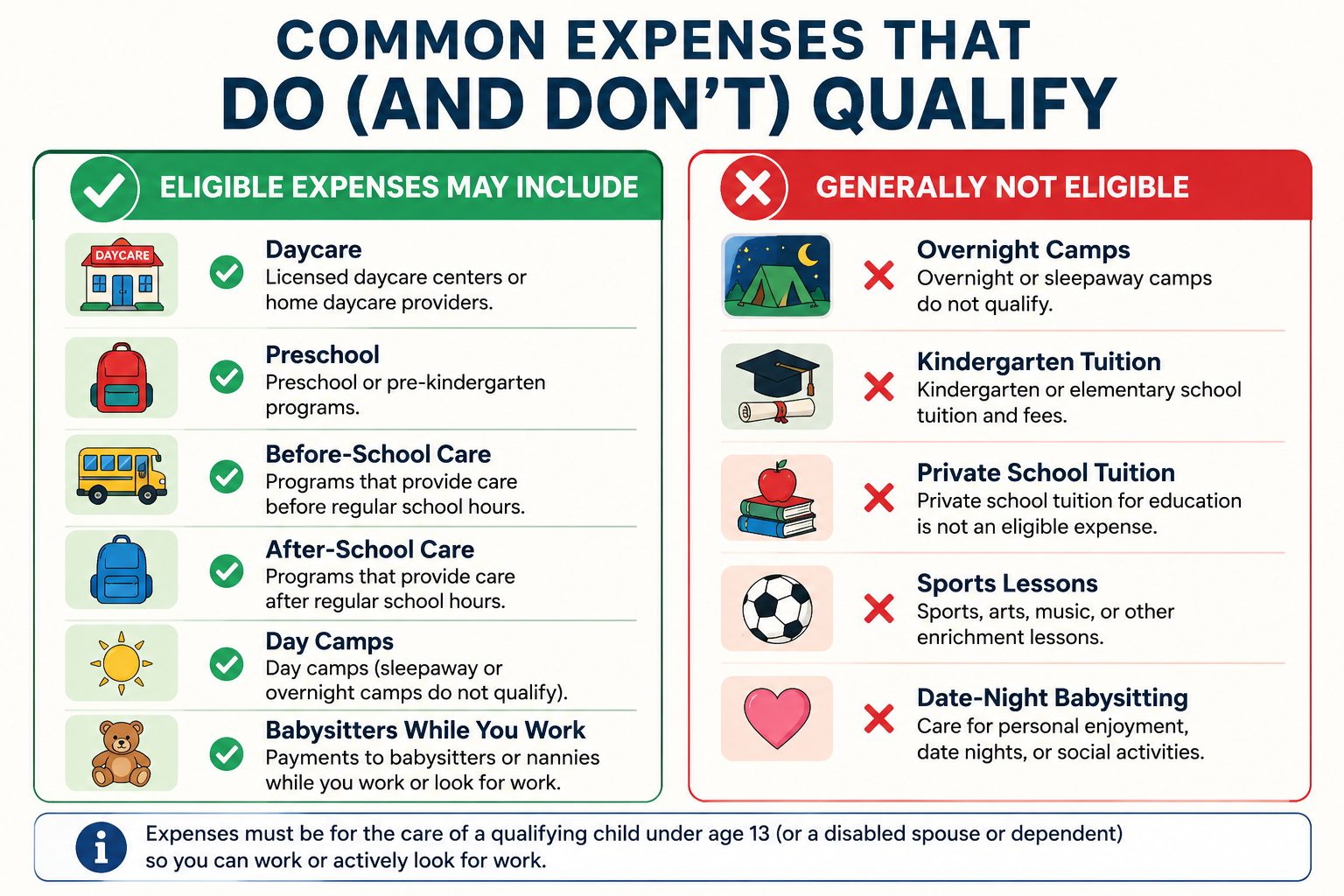
The child and dependent care credit generally applies to children under age 13 who need care while you work or actively look for work. It may also apply to a disabled spouse or dependent who cannot care for themselves. For example, if your child turned 13 during the year, only qualifying expenses incurred before their birthday may count. Double-check your dependent’s eligibility before assuming all childcare costs qualify. This simple review can prevent filing errors and unexpected IRS questions.

2. Your Care Expenses Must Be Work-Related

The credit is designed to help working parents, not reimburse every childcare expense. You must pay for care so you, and your spouse if filing jointly, can work or actively seek employment. A parent paying for daycare while attending a job interview or working full-time generally meets this requirement. Hiring a babysitter for a date night or personal errands, however, does not qualify. Understanding this distinction is one of the most important child and dependent care credit rules.

3. Not Every Care Provider Is Eligible

Many parents assume they can pay any relative and claim the credit, but that’s not always true. Payments made to your spouse, your child’s other parent, a dependent you claim, or your child under age 19 generally don’t qualify. Professional daycare centers, licensed providers, and many unrelated caregivers typically do qualify if they meet IRS reporting requirements. Keep the provider’s taxpayer identification number because you’ll need it when filing.

Day camps can qualify if they’re work-related childcare expenses, but overnight camps do not qualify for the credit—even if the camp allows parents to work during the week.

4. Know the Dollar Limits Before Filing

Many families are surprised to learn the credit is calculated using up to $3,000 in qualifying expenses for one dependent or $6,000 for two or more qualifying dependents. The actual credit equals a percentage of those expenses based on your adjusted gross income. Even if your daycare costs exceeded $20,000 during the year, only the eligible expense limits are used in the calculation. Reviewing these caps helps set realistic expectations about your tax savings.

If you spent $12,000 on childcare for one qualifying child during the year, you generally can’t calculate the credit using the full amount. The IRS limits qualifying expenses to $3,000 for one child or $6,000 for two or more, with your actual credit depending on your income and the applicable percentage.

5. Keep Detailed Records All Year

Good recordkeeping can make tax season much less stressful. Save receipts, invoices, canceled checks, electronic payment confirmations, and annual daycare statements. If the IRS ever requests documentation, organized records can support your claim quickly. Many parents also find it helpful to keep a spreadsheet tracking payments throughout the year. Spending a few minutes organizing paperwork now could save hours later.

6. Coordinate the Credit With Your Dependent Care FSA

If your employer offers a Dependent Care Flexible Spending Account, you may already be using pre-tax dollars to cover childcare costs. However, you generally cannot claim the child and dependent care credit on the same expenses used for your FSA benefit. Families with high annual childcare costs may still qualify for both by applying different eligible expenses to each benefit. Reviewing your payroll deductions before filing can help maximize your overall tax savings.

Families using both a Dependent Care FSA and the Child and Dependent Care Credit should coordinate carefully because the same childcare expense generally can’t be used for both tax benefits. However, households with childcare expenses that exceed their FSA benefits may still qualify to claim the credit on additional eligible expenses.

7. Married Couples Should Review Filing Requirements

Most married couples must file a joint return to claim the credit. There are limited exceptions for certain spouses who live apart and meet specific IRS requirements, but they are relatively uncommon. Couples should also remember that both spouses generally need earned income unless one is a full-time student or incapable of self-care. Reviewing these rules early can prevent unpleasant surprises when preparing your return. Filing status remains one of the most overlooked child and dependent care credit requirements.

8. Don’t Assume Last Year’s Rules Are Enough

Beginning with the 2026 tax year, Congress increased the maximum credit percentage for many eligible families while keeping the qualifying expense limits at $3,000 for one qualifying person and $6,000 for two or more. Because the credit percentage now varies under updated income thresholds, families who qualified in previous years may want to revisit their expected tax savings rather than assuming the credit works exactly the same way it did before.
Programs that qualify

Your Next Tax Return Could Be More Valuable

The child and dependent care credit remains one of the most valuable tax breaks available to working families, but only if you understand how it works. Reviewing eligibility, provider requirements, filing status, expense limits, and documentation can reduce mistakes and improve your chances of claiming every dollar you deserve. A little preparation before tax season often makes filing faster and less stressful.

Have you claimed the child and dependent care credit before, or did one of these rules surprise you? Share your experience or questions in the comments and join the conversation.

What to Read Next

Why Gentle Parenting Doesn’t Meet Every Neurodivergent Child’s Needs

Child Tax Credit: Many Families Expected It to Fall to $1,000 in 2026—Here’s What Actually Happened

10 Popular Discipline Techniques That Have Been Quietly Discredited

Evan Morgan

Evan Morgan has been a full-time freelance writer and editor for 10+ years. When not working, he enjoys catching the latest true crime documentary or getting lost in a good book.

Filed Under: Finance Tagged With: Child and Dependent Care Credit, childcare expenses, family finances, Parenting, personal finance, tax credit, tax tips

The Unexpected Expense: 11 Tax Breaks For Parents You Didn’t Know Existed

July 25, 2025 | Leave a Comment

The Unexpected Expense 11 Tax Breaks For Parents You Didn't Know Existed
Image source: 123rf.com

Raising kids is expensive, and sometimes it feels like the bills never end. Between school supplies, medical expenses, and never-ending grocery trips, your bank account can take a serious hit. But what if you could put some of that money back in your pocket—legally? While most parents know about the Child Tax Credit, there are several lesser-known tax breaks for parents that often go unused. If you’re looking for ways to ease the financial burden of parenting, these 11 tax benefits could give your budget the boost it needs.

1. Child and Dependent Care Credit

If you pay for childcare while you work or look for work, you may be eligible for the Child and Dependent Care Credit. This includes daycare, preschool, summer camps, and even babysitters in certain cases. The amount of credit depends on your income and how much you spend on care, but it can be up to 35% of your qualifying expenses. Make sure your provider gives you a receipt with their tax ID number to claim it. Many parents miss this opportunity because they assume it only applies to daycare centers.

2. Earned Income Tax Credit (EITC)

The Earned Income Tax Credit is one of the most valuable tax breaks for parents, yet it often goes unclaimed. Designed to help low- to moderate-income families, this credit can reduce your tax bill or even result in a refund. The more children you have, the higher the credit. Income thresholds change each year, so it’s worth checking eligibility even if you didn’t qualify previously. Filing taxes with a software that screens for credits can help you avoid missing it.

3. Adoption Tax Credit

Adopting a child is a big emotional and financial commitment, but the government offers some relief through the Adoption Tax Credit. This credit covers up to a set amount of qualified adoption expenses, including court costs, attorney fees, and travel. Even adoptions through foster care may qualify. It’s not refundable, but it can be carried forward for up to five years if you don’t use the full credit in one year. It’s one of the more overlooked tax breaks for parents navigating adoption.

4. American Opportunity Tax Credit (AOTC)

If you have older kids in college, the AOTC can cover up to $2,500 per student for tuition, books, and other school-related expenses. The credit applies to the first four years of higher education and is partially refundable. That means you could get money back even if you owe zero taxes. Just make sure your student is enrolled at least half-time in a degree program. Keep those tuition and supply receipts organized for tax time.

5. Lifetime Learning Credit

Not just for your kids—if you or your spouse are taking college courses, you could qualify for the Lifetime Learning Credit. It’s worth up to $2,000 per return and applies to nearly all post-secondary education. There’s no limit to how many years you can claim it, unlike the AOTC. You don’t need to pursue a degree either—just take qualified courses from an eligible institution. If you’re furthering your education while parenting, this tax break can help offset the cost.

6. Student Loan Interest Deduction

Paying off student loans while raising kids? You may be able to deduct up to $2,500 in interest paid on qualified student loans each year. This deduction is available even if you don’t itemize your deductions. It phases out at higher income levels, so double-check your eligibility based on your adjusted gross income. It’s a small win, but every little bit helps when juggling education and parenting expenses.

7. Flexible Spending Accounts (FSAs)

FSAs aren’t a credit or deduction, but they are one of the most useful tax breaks for parents. By contributing pre-tax dollars to a dependent care FSA through your employer, you can set aside up to $5,000 per year for childcare expenses. This reduces your taxable income, which can lower your overall tax bill. Just be careful—FSAs are use-it-or-lose-it accounts, so plan your yearly contributions wisely. Check with your HR department during open enrollment to see if it’s available to you.

8. Head of Household Filing Status

If you’re a single parent, filing as Head of Household instead of Single gives you a higher standard deduction and more favorable tax brackets. To qualify, you must pay more than half the cost of maintaining your home and have a qualifying child who lives with you more than half the year. This status can significantly reduce what you owe. It’s one of the easiest ways to maximize your return as a single parent. Yet many eligible filers don’t take advantage simply because they don’t realize they qualify.

9. Child’s Investment Income

If your child earns investment income, you may need to report it on your tax return under the “kiddie tax” rules. However, you can also use IRS Form 8814 to include their interest and dividends with your own return, potentially simplifying the process. While this won’t reduce your tax bill, it’s helpful to know how to avoid penalties and report the income correctly. It’s also a good opportunity to teach older kids about taxes. Understanding this rule can keep you compliant while minimizing stress.

10. State-Specific Credits and Deductions

Many states offer their own tax breaks for parents, from back-to-school tax holidays to credits for private school tuition or dependent care. These vary widely, so be sure to check your state’s Department of Revenue website. Some states mirror federal credits, while others provide additional benefits. Even renters or foster parents may qualify in certain locations. Don’t overlook what your state may be offering just because it’s not on your federal return.

11. Saver’s Credit

If you’re contributing to a retirement account while earning a modest income, you could qualify for the Saver’s Credit. This credit rewards you for saving money—something many parents put off during the child-rearing years. You can claim up to 50% of your contributions to an IRA or 401(k), depending on your income. It’s not just about the future—it helps now, too. It’s one of those long-game tax breaks for parents that builds toward financial stability.

Take What You’re Owed Without Leaving Money Behind

Parenting is expensive enough without missing out on savings that are legally yours. These lesser-known tax breaks for parents can add up to hundreds or even thousands of dollars each year, if you know where to look. A little research, a few smart questions at tax time, and the right paperwork could make your refund a lot more satisfying. Don’t assume you’ve claimed everything just because you checked the basic boxes. The IRS may not remind you—but your wallet will thank you.

Which of these tax breaks for parents were you most surprised to learn about? Have you used any of them already? Let us know in the comments!

Read More:

10 Financial Habits Keeping Parents Stressed

9 Money Mistakes That Cost New Parents Fortunes

Catherine Reed
Catherine Reed

Catherine is a tech-savvy writer who has focused on the personal finance space for more than eight years. She has a Bachelor’s in Information Technology and enjoys showcasing how tech can simplify everyday personal finance tasks like budgeting, spending tracking, and planning for the future. Additionally, she’s explored the ins and outs of the world of side hustles and loves to share what she’s learned along the way. When she’s not working, you can find her relaxing at home in the Pacific Northwest with her two cats or enjoying a cup of coffee at her neighborhood cafe.

Filed Under: Money and Finances Tagged With: budgeting for families, child tax credit, Family Finance, hidden tax benefits, IRS credits, money-saving tips, parenting expenses, tax breaks for parents, tax tips

The Benefits of Doing Your Own Taxes

April 13, 2016 | Leave a Comment

This post is part of the TaxAct #DIYtaxes blog tour which empowers you to take ownership of your finances by doing your own taxes. TaxAct provides the tools and guidance to help you confidently file your taxes easy and fast. Do your own taxes today at TaxAct.com. You got this.

Taxes can be stressful. However, if you choose to look at doing your own taxes in a different light you’ll see that there really are some major benefits and that filing yourself is not as hard as you may think.For many people taxes are a total pain. I get it. Once a year you’ve got to scramble to gather up all of your  documents, then sit down and sift through numbers and try to figure out what’s going on. Just the thought of it can stress you out.

However, if you choose to look at doing your own taxes in a different light you’ll see that there really are some major benefits and that filing yourself is not as hard as you may think.

Here are the biggest benefits of doing your own taxes.

You’ll Get a Closer Look at Your Finances

Would you be shocked to learn that only 40% of US adults keep a written budget or track their expenses and almost two-thirds of American families live paycheck to paycheck?

Having a better awareness of your financial situation is the first step in making improvements to your personal finances. Doing your own taxes can help you get a closer look at where you stand.

When you file your own taxes you’ll be taking a good hard look at how much you and your spouse earned last year, the investments you’ve made and any capital gains you’ve earned or lost, how much you’ve paid in interest on your mortgage or student loans and so much more.

You can get a big picture of where you stand in one day by simply doing the work yourself. This is an enormous benefit.

You’ll Learn A Lot and Be More Prepared for Next Year

Tax software these days is pretty great. It walks you through the tax filing process step-by-step all while teaching what you need to know to make the most out of your tax situation. You’ll learn about credits and deductions and will be more prepared when it comes to do your taxes next year.

You’ll also know exactly what you need to file your taxes and will be able to prepare accordingly.

As a bonus most tax software comes with maximum refund guarantees and accuracy guarantees if you’ve entered in all of your information correctly.

You’ll Save Money

Hands down, it’s cheaper to file taxes yourself than to pay an accountant to do it for you. You can save yourself a few hundred dollars by preparing your own taxes. (And who doesn’t like to save money?!)

It’s Easy

Filing taxes yourself is a very simple process thanks to tax software.

With good tax software, like TaxAct, you’ll be given prompts that will tell you exactly what to enter from each of your tax forms. When you’re done you’ll be able to run alerts which will scan through your information and look for any potential problems.

If you’ve got a simple tax situation filing taxes yourself is a very straightforward process. Even if your situation is slightly more complex you can still easily do taxes yourself by following the prompts and answering the questions.

Tips for Getting Started

If you’re ready to started here a few tips to make the filing process go smoothly:

Collect Everything You Need – Before you sit down to do your taxes gather up all of your documents so that they’re right in front of you. This includes things like income documentation, interest and investment tax forms and personal information of any dependents you’ll be claiming.

Choose the Right Software – Look at all options on the tax software you’ll be using and select the one that is most applicable to your situation right from the start. This will save you from having to upgrade half way through the process.

Check Your Numbers and Run Alerts – After you’ve entered all of your information go back through and double check your numbers and then run all alerts. Fix any problem areas and then file.

After that you’ll be done with your taxes and can walk away with a better understanding of your financial situation and the sense of satisfaction that comes from doing something yourself.

Beating the tax deadline doesn’t have to be stressful. With TaxAct, everything you need to confidently prepare and e-file your taxes is right at your fingertips. You got this. File your simple federal and state return FREE today with TaxAct.

Brian
Brian

Brian is the founder of Kids Ain’t Cheap and is now sharing his journey through parenthood.

 
Email • Google + • Facebook • Twitter

Filed Under: Money and Finances Tagged With: benefits of doing your own taxes, tax tips

  • Facebook
  • Pinterest
  • RSS
  • Twitter

Basic Principles Of Good Parenting

Here some basic principles for good parenting:

  1. What You Do Matters: Your kids are watching you. So, be purposeful about what you want to accomplish.
  2. You Can’t be Too Loving: Don’t replace love with material possessions, lowered expectations or leniency.
  3. Be Involved Your Kids Life: Arrange your priorities to focus on what your kid’s needs. Be there mentally and physically.
  4. Adapt Your Parenting: Children grow quickly, so keep pace with your child’s development.
  5. Establish and Set Rules: The rules you set for children will establish the rules they set for themselves later.  Avoid harsh discipline and be consistent.
  6. Explain Your Decisions: What is obvious to you may not be evident to your child. They don’t have the experience you do.
  7. Be Respectful To Your Child: How you treat your child is how they will treat others.  Be polite, respectful and make an effort to pay attention.
Best Parenting Blogs

Most Popular

Baby

9 Unusual Baby Names That Sound Like They Belong to Future CEOs

Evan Morgan
Baby

10 Baby Names That Were Once Considered “Grandparent Names” but Feel Cool Again

Evan Morgan
Target Store

Choking Incident Prompts Recall of 49,000 Target Gigglescape “Under the Sea” Popping Toys

Evan Morgan
Frustrated Girl

Why Some Students on the Spectrum Are Labeled With ODD

Evan Morgan
Coke Bottles

12 Things Kids Took to School in the ’70s That Would Never Be Allowed Today

Evan Morgan

All content on Kids Ain’t Cheap is for entertainment purposes only. By reading this blog, you agree that Kids Ain’t Cheap is not responsible for any actions taken after reading this blog. For the full disclaimer, see our privacy policy.

Please note that Kids Ain’t Cheap has financial relationships with some of the merchants mentioned here. Kids Ain’t Cheap is funded by banner advertising, commission sales and search optimization consulting.

Copyright © 2006–2026 | District Media | All Rights Reserved | Privacy Policy

Copyright © 2026 Runway Pro Theme by Viva la Violette