
• Home
  • About Us
  • Toolkit
  • Archives
  • Advertise
  • Privacy Policy

Kids Ain't Cheap

But They Sure Are Worth It

  • Parenting
    • Baby Stuff
    • Books and Reading
      • Aesops Fables
      • Comic Books
    • Education
    • Family Time
    • Green Living
    • Growing Up
    • Healthy Living & Eating
    • Holidays
    • Parenting
    • Random Musings
    • Shopping
    • Stuff to Do
  • Money
  • Product Reviews
    • Books and Magazines
    • Discount Sites
    • Furniture
    • House Keeping
    • Reviews News
    • Toys and Games
  • Contact Us
  • Our Editorial Commitment
  • Search

Back-to-School Costs Are Climbing Again: Which Expenses Do Parents Forget Until August?

July 26, 2026 | Leave a Comment

Group Of Students
Hidden back-to-school costs often include technology accessories, activity fees, classroom supplies, and everyday expenses that appear after classes begin. Planning ahead for these overlooked purchases can help families stay on budget. (Pexels).

As summer winds down, many families think the biggest back-to-school purchases are already behind them. Then August arrives, and a wave of overlooked expenses begins piling onto the budget. While backpacks, notebooks, and lunchboxes usually make the shopping list, several hidden costs often catch parents off guard. According to the National Retail Federation, families with K-12 students are expected to spend an average of nearly $864 this back-to-school season, with electronics, clothing, shoes, and supplies driving much of the increase.

Classroom Requests Keep Growing After School Starts

Many parents assume the school supply list is final, but teachers frequently request additional materials once classes begin. Items like tissues, hand sanitizer, printer paper, art supplies, headphones, or specialty notebooks often appear during the first few weeks of school. In classrooms with limited budgets, teachers sometimes ask families to replenish shared supplies throughout the year. A parent who budgeted $150 for supplies may easily spend another $50 to $100 before September ends. Planning for these follow-up requests can prevent an unpleasant surprise.

Technology Costs Go Beyond Buying a Laptop

Technology has become one of the largest back-to-school costs for many families. Even if a child already owns a laptop or tablet, parents may still need to purchase headphones, chargers, software subscriptions, calculators, printer ink, or protective cases. Some schools also recommend backup batteries or cloud storage for assignments. The National Retail Federation reports that electronics remain the largest spending category for many families, reflecting how essential digital learning has become. Budgeting for accessories is just as important as budgeting for the device itself.

Activity Fees Add Up Faster Than Expected

School registration often doesn’t include every expense students will face during the year. Sports participation fees, band uniforms, field trips, club memberships, yearbooks, parking permits, and fundraising commitments frequently arrive weeks after classes begin. Families with multiple children can quickly find themselves paying several hundred dollars beyond their original budget. Even public schools often charge optional fees that become difficult to avoid once children become involved. Setting aside a separate activities fund before August can make these costs much easier to handle.

Clothing Isn’t Finished After the First Shopping Trip

Many parents buy new clothes before school starts, only to discover their child still needs additional items later. Dress code requirements, seasonal weather changes, growth spurts, and worn-out shoes can all lead to unexpected purchases. Teenagers may also need specific clothing for athletics, science labs, or school performances. Retail experts note that many families intentionally buy only essential items at first and return later for additional purchases as needs become clearer. Leaving room in the clothing budget helps reduce financial stress.

Lunches, Transportation, and Everyday Extras Stretch the Budget

Some of the biggest forgotten back-to-school costs aren’t purchased in stores at all. School lunches, after-school snacks, increased grocery bills, fuel for daily drop-offs, parking fees, and childcare during early dismissal days quietly add up over time. Families also spend more replacing reusable water bottles, lunch containers, and other everyday items that wear out during the school year. Recent surveys show many parents continue making back-to-school purchases well after classes begin, with more than half spending at least another $250 after the first day of school. Tracking these ongoing expenses helps families avoid overspending.

The Smartest Way to Prepare for Hidden Back-to-School Costs

The easiest way to reduce financial stress is to expect these hidden back-to-school costs before they happen. Instead of spending every dollar before school begins, consider reserving 15% to 20% of your budget for August and September surprises. Shopping during major summer sales, comparing prices online, reusing supplies when possible, and involving children in budgeting decisions can also help stretch every dollar. Financial experts recommend focusing first on necessities rather than trends or brand-name items that often increase spending without adding real value. A little flexibility in your budget today can prevent relying on credit cards later in the school year.

Budgeting Today Can Save Stress Tomorrow

Hidden back-to-school costs often create more financial pressure than the supplies parents plan for months in advance. Building a realistic budget that includes classroom requests, technology, activities, clothing, and daily expenses can help families stay ahead. Every household will face different priorities, but planning for the unexpected makes the school year less stressful.

Which hidden school expense has surprised your family the most? Share your experience and budgeting tips in the comments to help other parents prepare.

What to Read Next

10 Places Parents Can Find Free School Supplies Before Classes Begin

Teachers Beg Parents: Stop Buying These 7 Expensive School Supplies

Here’s Why School Supplies Continue to Cost More and More Every Year

Evan Morgan

Evan Morgan has been a full-time freelance writer and editor for 10+ years. When not working, he enjoys catching the latest true crime documentary or getting lost in a good book.


Filed Under: Finance Tagged With: back-to-school costs, education, Family Budget, Money Saving Tips, Parenting, personal finance, school shopping, school supplies

Tax Breaks Parents May Miss When Paying for Child Care

July 23, 2026 | Leave a Comment

Mom And Son
Parents who understand child care tax breaks, eligible expenses, and proper recordkeeping may save hundreds of dollars during tax season. Planning ahead can help maximize every available tax benefit. (Pexels).

Finding affordable child care is one of the biggest financial challenges many families face, with annual daycare costs exceeding $10,000 in many parts of the country. While most parents know about the Child Tax Credit, many overlook tax benefits tied directly to child care expenses. Missing these opportunities could leave hundreds or even thousands of dollars on the table when tax season arrives. Understanding which tax breaks apply to your situation can help lower your tax bill and make the cost of raising children a little more manageable.

Don’t Overlook the Child and Dependent Care Credit

The Child and Dependent Care Credit is one of the most valuable tax breaks available to working parents, yet many eligible families never claim it. If you pay for daycare, preschool, a nanny, or even a qualifying day camp so you can work or actively look for work, you may qualify for the credit. For the current tax rules, eligible expenses are generally capped at $3,000 for one qualifying child or $6,000 for two or more, with the percentage of expenses you can claim based on your income. Parents should also remember that the child must generally be under age 13, and you’ll need the care provider’s taxpayer identification number to complete your tax return. Keeping organized receipts throughout the year makes claiming this tax break much easier.

Your Dependent Care FSA Could Save More Than You Think

If your employer offers a Dependent Care Flexible Spending Account (FSA), it’s worth reviewing during open enrollment because it allows you to pay qualifying child care expenses with pre-tax dollars. That means you avoid paying federal income tax, Social Security tax, and Medicare tax on the amount you contribute, potentially saving hundreds of dollars annually. A family spending $8,000 a year on daycare could see meaningful tax savings simply by using an available FSA instead of paying entirely with after-tax income. One common mistake is assuming you can claim the same expenses for both an FSA and the Child and Dependent Care Credit. The IRS does not allow double-dipping, so careful planning helps maximize your total benefit.

Not Every Child Care Expense Qualifies

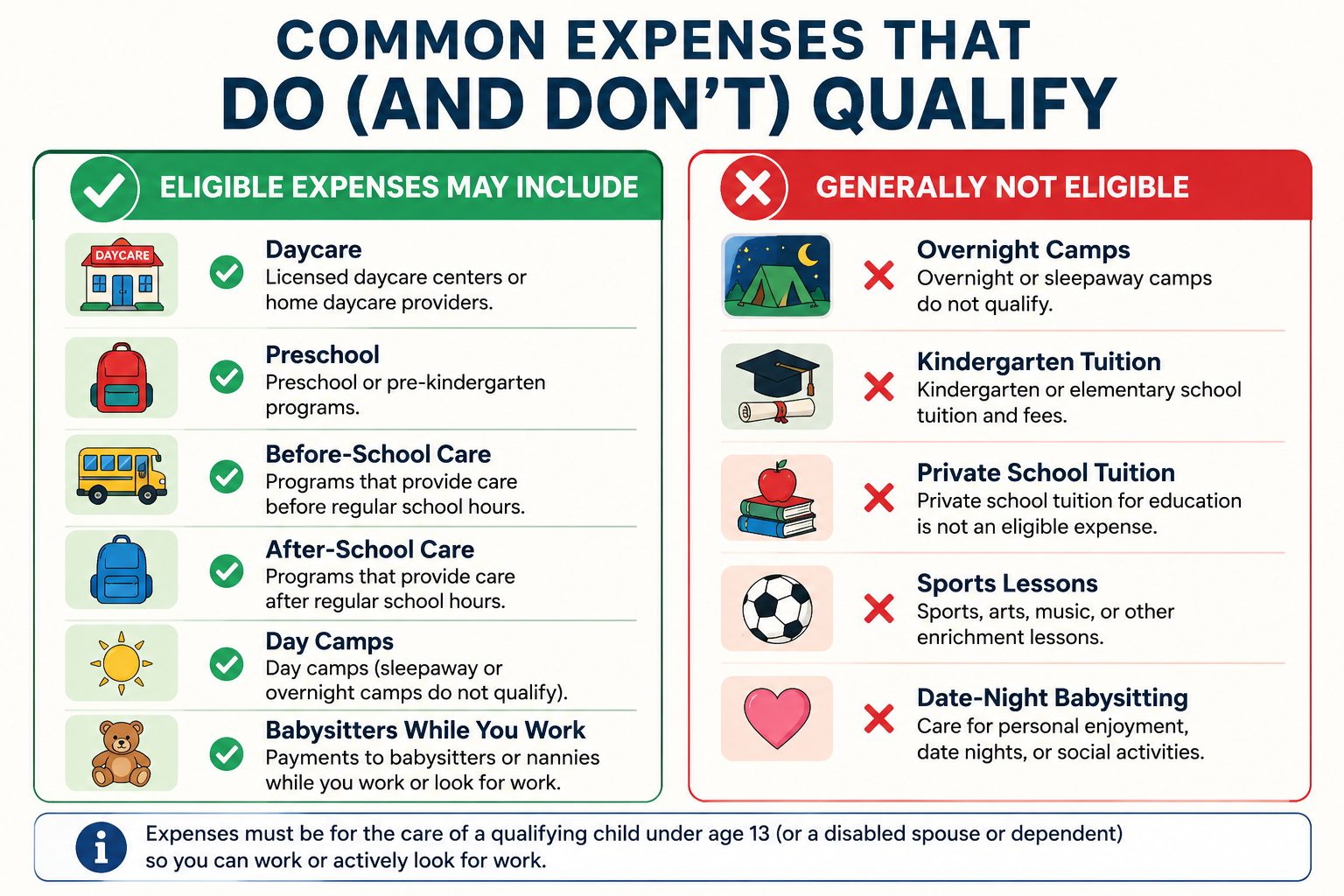
Many parents are surprised to learn that some expenses count while others do not. Daycare centers, babysitters, nursery schools, and before or after school care often qualify if they allow you to work, but overnight camps and tuition for kindergarten generally do not. Day camps may qualify because they provide care while parents are working, making them a frequently overlooked tax benefit during summer months. Even care provided inside your home can qualify if the caregiver meets IRS requirements and proper records are maintained. Reviewing eligible expenses before filing can prevent costly mistakes and reduce the chance of missing a legitimate tax break.

Keep Good Records Throughout the Year

Good recordkeeping is one of the easiest ways to protect your tax savings if the IRS ever asks questions. Save invoices, canceled checks, electronic payment confirmations, and annual statements from your child care provider. You’ll also need the provider’s name, address, and taxpayer identification number when filing your return. Families who switch daycare providers during the year should collect documentation from each one rather than scrambling for it at tax time. Spending a few minutes organizing paperwork each month can save hours of frustration later while helping ensure every eligible expense is claimed.

A Smarter Way to Lower Child Care Costs

Paying for child care is expensive, but understanding available tax breaks can make those costs easier to manage. The Child and Dependent Care Credit and employer-sponsored Dependent Care FSAs remain two of the most commonly missed opportunities for working parents. Reviewing your expenses before filing, keeping accurate records, and understanding which costs qualify can help you maximize every available dollar. If your family’s financial situation changed during the year, consider consulting a qualified tax professional to ensure you’re claiming every credit you’re entitled to.

Which child care tax break surprised you the most, and have you ever discovered a credit you almost missed? Share your experience in the comments and join the conversation.

What to Read Next

The Unexpected Expense: 11 Tax Breaks For Parents You Didn’t Know Existed

Day Camp vs. Overnight: The $1,600 Tax Mistake

The ADHD Medication Rule Doctors Are Breaking for Preschoolers — and Why It Matters

Evan Morgan

Evan Morgan has been a full-time freelance writer and editor for 10+ years. When not working, he enjoys catching the latest true crime documentary or getting lost in a good book.

Filed Under: Finance Tagged With: child care, child care tax breaks, dependent care credit, dependent care FSA, Parenting, personal finance, tax credits

Summer EBT Facts That Could Put $120 on Your Grocery Card

July 21, 2026 | Leave a Comment

Groceries
A parent shops for fresh groceries using a Summer EBT card, highlighting how the $120 benefit can help eligible families cover nutritious food costs while school is out. (Pexels).

Families often face higher grocery bills when school cafeterias close for summer, making it harder to stretch a monthly budget. The Summer EBT program, also known as SUN Bucks in many states, was created to help bridge that gap with grocery assistance for eligible children. In most participating states, eligible families can receive a one-time $120 grocery benefit per child for the summer. But is it too late to be eligible? Here’s wht you need to know.

Not Every Family Has to Apply for Summer EBT

One of the biggest misconceptions about Summer EBT is that every family must complete an application. In many participating states, children who already receive benefits through SNAP, TANF, FDPIR, or who qualify for free or reduced-price school meals through income are automatically enrolled. That means eligible families may receive benefits without taking additional steps if their information is already current. However, families who are not automatically enrolled may still qualify and should check with their state’s Summer EBT program before application deadlines pass. Taking a few minutes to verify your status could prevent missing a valuable benefit.

The $120 Benefit Can Make a Real Difference

The standard Summer EBT benefit is $120 per eligible child in the 48 contiguous states and Washington, D.C., although benefit amounts differ in Alaska, Hawaii, and certain U.S. territories because of higher food costs. While $120 may not cover an entire summer’s groceries, it can significantly offset expenses for essentials like milk, fresh produce, bread, eggs, and lean protein. For a family with three eligible children, that could mean up to $360 toward groceries during school break. Many parents use the funds to stock healthy snacks and lunch ingredients that replace meals normally served at school. With grocery prices remaining elevated, every dollar can help reduce financial pressure.

Summer EBT Works Like a Regular Grocery Card

Summer EBT benefits are loaded onto an existing EBT card for many families or mailed on a separate card if one is needed. The funds can generally be used at authorized grocery stores, participating farmers markets, convenience stores, and many online retailers that accept SNAP benefits. Eligible purchases include fruits, vegetables, dairy products, meat, poultry, cereals, and other qualifying grocery items. Like SNAP, the benefit cannot be used for hot prepared foods, household supplies, alcohol, tobacco, or personal care products. Knowing these rules ahead of time helps families avoid confusion at checkout.

Participation Depends on Where You Live

Although Summer EBT is a federal program, each state decides whether to participate. That means eligibility alone does not guarantee benefits if your state has chosen not to operate the program for a particular year. Families should always confirm whether their state is participating instead of assuming the benefit is available nationwide. Checking early is especially important for families that recently moved or whose children changed schools.

It should also be noted that there are deadlines for applying for Sun Bucks. The deadline will depend on where you live. In North Carolina, for example, the deadline to apply for Sun Bucks is August 15. So, it’s important to check what the rules are where you are.

Making the Most of Your Summer Grocery Benefit

A little planning can make Summer EBT stretch much further than many families expect. Shopping weekly sales, buying frozen fruits and vegetables, and choosing store-brand staples often allows the benefit to cover more meals. Parents also combine Summer EBT with local summer meal sites, food pantries, and farmers market incentive programs to maximize their food budget. Keeping your mailing address and school records current also helps ensure benefit cards arrive without delays. Small planning decisions today can translate into more nutritious meals throughout the summer.

The Bottom Line for Families This Summer

Summer EBT offers meaningful grocery assistance for millions of eligible children when school meals are unavailable. The key is understanding whether your family qualifies, whether your state participates, and whether you need to submit an application. Spending just a few minutes reviewing your eligibility could result in $120 per child that helps ease summer grocery costs. Even families already receiving other benefits should verify their information remains up to date.

Have you received Summer EBT before, or do you have questions about qualifying? Share your experience in the comments to help other readers navigate the program.

What to Read Next

SUN Bucks 2026: How Families of Special Needs Students Can Claim Summer EBT Grocery Benefits

Texas & Florida SNAP: April 1 “High‑Sugar” EBT Ban Explained

Why Some Parents Are Going Into Debt to Hide Financial Struggles from Their Kids

Evan Morgan

Evan Morgan has been a full-time freelance writer and editor for 10+ years. When not working, he enjoys catching the latest true crime documentary or getting lost in a good book.
Filed Under: Finance Tagged With: child nutrition, EBT Benefits, family finances, Food Assistance, grocery assistance, school meals, SNAP, Summer EBT, summer grocery card, SUN Bucks

8 Child and Dependent Care Credit Rules Parents Should Recheck

July 17, 2026 | Leave a Comment

Parent And Child
A parent should review childcare receipts and tax documents while calculating potential child and dependent care credit savings before filing a tax return. (Pexels).

Parents often spend thousands of dollars each year on daycare, after-school programs, and summer camps, making every available tax break worth revisiting. The child and dependent care credit can reduce your tax bill if you qualify, but many families miss out because they misunderstand the rules or overlook key details. With tax laws continuing to evolve, it’s smart to review the latest requirements before filing your return. Here are eight child and dependent care credit rules every parent should recheck to avoid costly mistakes.

1. Make Sure Your Child Still Qualifies

The child and dependent care credit generally applies to children under age 13 who need care while you work or actively look for work. It may also apply to a disabled spouse or dependent who cannot care for themselves. For example, if your child turned 13 during the year, only qualifying expenses incurred before their birthday may count. Double-check your dependent’s eligibility before assuming all childcare costs qualify. This simple review can prevent filing errors and unexpected IRS questions.

2. Your Care Expenses Must Be Work-Related

The credit is designed to help working parents, not reimburse every childcare expense. You must pay for care so you, and your spouse if filing jointly, can work or actively seek employment. A parent paying for daycare while attending a job interview or working full-time generally meets this requirement. Hiring a babysitter for a date night or personal errands, however, does not qualify. Understanding this distinction is one of the most important child and dependent care credit rules.

3. Not Every Care Provider Is Eligible

Many parents assume they can pay any relative and claim the credit, but that’s not always true. Payments made to your spouse, your child’s other parent, a dependent you claim, or your child under age 19 generally don’t qualify. Professional daycare centers, licensed providers, and many unrelated caregivers typically do qualify if they meet IRS reporting requirements. Keep the provider’s taxpayer identification number because you’ll need it when filing.

Day camps can qualify if they’re work-related childcare expenses, but overnight camps do not qualify for the credit—even if the camp allows parents to work during the week.

4. Know the Dollar Limits Before Filing

Many families are surprised to learn the credit is calculated using up to $3,000 in qualifying expenses for one dependent or $6,000 for two or more qualifying dependents. The actual credit equals a percentage of those expenses based on your adjusted gross income. Even if your daycare costs exceeded $20,000 during the year, only the eligible expense limits are used in the calculation. Reviewing these caps helps set realistic expectations about your tax savings.

If you spent $12,000 on childcare for one qualifying child during the year, you generally can’t calculate the credit using the full amount. The IRS limits qualifying expenses to $3,000 for one child or $6,000 for two or more, with your actual credit depending on your income and the applicable percentage.

5. Keep Detailed Records All Year

Good recordkeeping can make tax season much less stressful. Save receipts, invoices, canceled checks, electronic payment confirmations, and annual daycare statements. If the IRS ever requests documentation, organized records can support your claim quickly. Many parents also find it helpful to keep a spreadsheet tracking payments throughout the year. Spending a few minutes organizing paperwork now could save hours later.

6. Coordinate the Credit With Your Dependent Care FSA

If your employer offers a Dependent Care Flexible Spending Account, you may already be using pre-tax dollars to cover childcare costs. However, you generally cannot claim the child and dependent care credit on the same expenses used for your FSA benefit. Families with high annual childcare costs may still qualify for both by applying different eligible expenses to each benefit. Reviewing your payroll deductions before filing can help maximize your overall tax savings.

Families using both a Dependent Care FSA and the Child and Dependent Care Credit should coordinate carefully because the same childcare expense generally can’t be used for both tax benefits. However, households with childcare expenses that exceed their FSA benefits may still qualify to claim the credit on additional eligible expenses.

7. Married Couples Should Review Filing Requirements

Most married couples must file a joint return to claim the credit. There are limited exceptions for certain spouses who live apart and meet specific IRS requirements, but they are relatively uncommon. Couples should also remember that both spouses generally need earned income unless one is a full-time student or incapable of self-care. Reviewing these rules early can prevent unpleasant surprises when preparing your return. Filing status remains one of the most overlooked child and dependent care credit requirements.

8. Don’t Assume Last Year’s Rules Are Enough

Beginning with the 2026 tax year, Congress increased the maximum credit percentage for many eligible families while keeping the qualifying expense limits at $3,000 for one qualifying person and $6,000 for two or more. Because the credit percentage now varies under updated income thresholds, families who qualified in previous years may want to revisit their expected tax savings rather than assuming the credit works exactly the same way it did before.

Programs that qualify

Your Next Tax Return Could Be More Valuable

The child and dependent care credit remains one of the most valuable tax breaks available to working families, but only if you understand how it works. Reviewing eligibility, provider requirements, filing status, expense limits, and documentation can reduce mistakes and improve your chances of claiming every dollar you deserve. A little preparation before tax season often makes filing faster and less stressful.

Have you claimed the child and dependent care credit before, or did one of these rules surprise you? Share your experience or questions in the comments and join the conversation.

What to Read Next

Why Gentle Parenting Doesn’t Meet Every Neurodivergent Child’s Needs

Child Tax Credit: Many Families Expected It to Fall to $1,000 in 2026—Here’s What Actually Happened

10 Popular Discipline Techniques That Have Been Quietly Discredited

Evan Morgan

Evan Morgan has been a full-time freelance writer and editor for 10+ years. When not working, he enjoys catching the latest true crime documentary or getting lost in a good book.

Filed Under: Finance Tagged With: Child and Dependent Care Credit, childcare expenses, family finances, Parenting, personal finance, tax credit, tax tips

Child Tax Credit: Many Families Expected It to Fall to $1,000 in 2026—Here’s What Actually Happened

July 3, 2026 | Leave a Comment

Young Family
The Child Tax Credit did not fall to $1,000 as many families expected. Instead, eligible taxpayers can still claim up to $2,200 per qualifying child under current law. (Pexels).

For months, many parents worried that the federal Child Tax Credit would be cut in half after 2025, dropping from $2,000 to $1,000 per qualifying child. Those concerns stemmed from the scheduled expiration of provisions from the 2017 Tax Cuts and Jobs Act. Instead, Congress took a different path by passing new tax legislation in 2025 that prevented the reduction and actually increased the maximum credit. Here’s what changed, who benefits, and what families should know before filing future tax returns.

Why So Many Families Expected the Child Tax Credit to Shrink

The Child Tax Credit was originally scheduled to revert to $1,000 per qualifying child if Congress allowed the temporary tax provisions enacted in 2017 to expire. Financial planners and tax experts spent years warning families that a smaller credit could mean higher tax bills beginning with the 2026 tax year. That possibility led many households to reconsider their budgets and savings plans. Instead of allowing the reduction to happen, lawmakers approved legislation in 2025 that permanently changed the credit. As a result, the feared $1,000 credit never became a reality for eligible families.

What Actually Happened to the Child Tax Credit

Rather than falling to $1,000, the Child Tax Credit increased to a maximum of $2,200 per qualifying child beginning with the 2025 tax year. The legislation also indexes the credit for inflation, helping preserve its value over time instead of allowing inflation to erode the benefit. For the 2026 tax year, the maximum credit remains $2,200, while up to $1,700 may be refundable through the Additional Child Tax Credit for eligible taxpayers. Income phaseout thresholds remain $200,000 for single filers and $400,000 for married couples filing jointly. Families who qualify will continue receiving substantially more tax relief than many expected just a year ago.

Who Benefits Most—and Who Should Pay Close Attention

Many middle-income families stand to benefit because the higher Child Tax Credit can directly reduce their federal tax liability. For example, a married couple with two qualifying children could potentially claim up to $4,400 in credits if they meet all eligibility requirements. However, not every family will receive the full amount because the refundable portion still depends on earned income and other qualifying rules. The updated law also tightened eligibility by requiring qualifying children and eligible parents to have valid Social Security numbers, affecting some mixed-status households. Reviewing eligibility before tax season can help families avoid surprises.

Smart Planning Can Help Families Maximize the Credit

The higher Child Tax Credit is valuable, but families should not assume they automatically qualify for the maximum amount. Keeping accurate records, ensuring dependents meet residency and age requirements, and confirming Social Security information can prevent processing delays. Parents who experience changes in income, custody arrangements, or filing status should review how those changes may affect their eligibility. Tax professionals also recommend checking whether other credits, such as the Earned Income Tax Credit or Child and Dependent Care Credit, could further reduce a family’s tax bill. Taking time to plan now can lead to a larger refund or a smaller balance due later.

The Bottom Line for Families Heading Into Tax Season

The biggest takeaway is that the widely anticipated drop to a $1,000 Child Tax Credit never happened. Instead, Congress expanded the credit to $2,200 per qualifying child and added inflation adjustments that help preserve its value in future years. While eligibility rules remain important, many families are in a stronger position than they expected when concerns about the scheduled expiration first surfaced. Staying informed and reviewing your tax situation before filing can help ensure you receive every dollar you’re entitled to.

Has the Child Tax Credit made a noticeable difference for your family, or were you expecting it to be reduced? Share your thoughts and experiences in the comments below.

What to Read Next

What’s Happening to the Child Tax Credit?

Child Savings: 11 Unexpected Taxes That Destroy Child Savings

How Does Child Support Affect Tax Return?

Evan Morgan

Evan Morgan has been a full-time freelance writer and editor for 10+ years. When not working, he enjoys catching the latest true crime documentary or getting lost in a good book.

Filed Under: Finance Tagged With: 2026 taxes, child tax credit, Family Finance, IRS, Money Saving, Parents, personal finance, tax credits, tax planning, tax refund

Grocery Store Shrinkflation Alert: The 5 Products Getting Smaller in April

April 12, 2026 | Leave a Comment

Cereal
Image Source: Pexels

If you’ve felt like your grocery bill is stretching less than it used to, you’re not imagining things. “Shrinkflation” — the practice of reducing product size while keeping prices the same — is quietly reshaping what ends up in your cart. It’s subtle, often hard to notice at first glance, but it adds up over time. April has brought another wave of these changes across everyday staples. Let’s break down the five products getting smaller and what it means for your wallet.

1. Snack Bags Are Losing Ounces Without Warning

Snack lovers may be the first to notice shrinkflation hitting hard this month. Popular chips and packaged snacks are quietly dropping an ounce or two per bag while maintaining the same shelf price. The packaging often looks identical, making it easy to miss unless you check the weight label closely. This tactic banks on brand loyalty and convenience, assuming shoppers won’t compare sizes. To stay ahead, start checking the price per ounce rather than the sticker price to see the real value.

2. Breakfast Cereals Are Slimming Down Boxes

Cereal boxes may look just as tall on the shelf, but many are getting narrower or holding less product inside. Manufacturers are redesigning packaging to maintain visual familiarity while reducing the actual quantity. This can be especially frustrating for families who rely on cereal as a quick, affordable breakfast option. You might find yourself running out sooner and restocking more often. Comparing unit prices and considering store-brand alternatives can help offset the impact.

3. Coffee Containers Are Brewing Less Per Can

Coffee is another category where shrinkflation is brewing quietly but noticeably. Many ground coffee containers have reduced their weight by a few ounces while keeping prices steady or even increasing slightly. For daily coffee drinkers, this means more frequent purchases and a higher monthly cost. Brands often justify this with rising production costs, but the end result is still less coffee for your money. Buying in bulk or switching to larger, less processed options like whole beans can provide better value.

4. Frozen Meals Are Serving Smaller Portions

Frozen dinners and ready-made meals are becoming less filling, even though their packaging hasn’t changed much. Portion sizes are shrinking, sometimes by just a few bites, but enough to leave you less satisfied. This is particularly noticeable for single-serve meals that were already modest in size. Over time, this can lead to spending more or supplementing meals with extra food. Paying attention to calorie counts and weight can help you spot these changes before they affect your routine.

5. Household Staples Like Paper Towels Are Getting Thinner

Shrinkflation isn’t limited to food — household essentials are also being affected. Paper towels, toilet paper, and similar products are reducing sheet counts or thinning out materials. The roll may look the same, but it doesn’t last as long as it used to. This subtle change can significantly increase how often you need to restock. Watching for bulk deals and comparing sheet counts rather than roll size can help you make smarter purchases.

Staying One Step Ahead of Shrinkflation

Shrinkflation can feel frustrating, especially when it’s hard to detect at first glance. The key to navigating it is becoming a more mindful shopper and focusing on value rather than appearance. Small changes like checking unit prices, reading labels, and comparing brands can make a noticeable difference over time. Retailers and manufacturers rely on subtlety, but awareness puts the power back in your hands. By staying informed, you can protect your budget and make smarter choices every time you shop.

Have you noticed any products shrinking lately while prices stay the same? What’s the most surprising example you’ve seen at your local store? Drop a comment below and join the conversation — your experience might help others shop smarter!

What to Read Next

8 Subtle Signs Someone Is Watching You at the Grocery Store

Large Family Grocery List: 12 Must-Have Items to Keep Everyone Fed and Happy

Are Grocery Delivery Services Worth It?

Evan Morgan

Evan Morgan has been a full-time freelance writer and editor for 10+ years. When not working, he enjoys catching the latest true crime documentary or getting lost in a good book.

Filed Under: Finance Tagged With: consumer awareness, food prices, grocery shopping tips, Saving Money, shrinkflation

The Direct Consolidation Trick for Parents Facing High Monthly Payments

April 7, 2026 | Leave a Comment

American Money
Image Source: Pexels

Parenting comes with countless rewards, but the financial pressure can sometimes feel overwhelming. Between childcare, groceries, housing, and education costs, monthly budgets can quickly spiral out of control. For many parents, student loan payments add another heavy layer to an already packed financial load. If you’ve ever wondered whether there’s a smarter way to manage those payments, you’re not alone. One often-overlooked solution—the direct consolidation trick—could be the relief valve you’ve been searching for.

What Is Direct Consolidation and Why It Matters

Direct consolidation is a process that allows borrowers to combine multiple federal student loans into a single loan with one monthly payment. This can simplify finances, especially for parents juggling multiple responsibilities and due dates. Instead of tracking several payments with different interest rates, consolidation streamlines everything into one manageable bill. While it doesn’t reduce your total debt, it can extend your repayment term, which often lowers your monthly payment. For parents facing tight budgets, this breathing room can make a meaningful difference in day-to-day financial stability.

How the “Trick” Works to Lower Monthly Payments

The “trick” behind direct consolidation isn’t a loophole but rather a strategic use of repayment options that become available after consolidating. Once loans are consolidated, borrowers may gain access to income-driven repayment (IDR) plans that weren’t previously available for certain loan types. These plans calculate your monthly payment based on income and family size, which is especially helpful for parents with dependents. By aligning payments with what you can realistically afford, the financial strain becomes more manageable. Over time, this approach can turn an overwhelming payment into something that fits comfortably within your budget.

Why This Strategy Works for Many Parents

Many parents find that direct consolidation creates a sense of clarity and control over their finances. Instead of juggling multiple due dates and payment amounts, everything becomes streamlined into one predictable obligation. This consistency can make it easier to plan monthly budgets and avoid missed payments or late fees. Additionally, the option to transition into income-driven repayment plans means payments can better reflect real-life financial demands. For households balancing childcare, bills, and unexpected expenses, that flexibility can be a game changer.

Potential Downsides Parents Should Consider

While direct consolidation offers clear benefits, it’s important to understand the trade-offs before moving forward. Extending your loan term can lower monthly payments, but it often increases the total interest paid over time. Additionally, once you consolidate, you may lose certain borrower benefits tied to your original loans, such as interest rate discounts or specific repayment perks. Some parents may also find that the weighted average interest rate doesn’t significantly reduce their overall costs. It’s essential to weigh short-term relief against long-term financial impact. Making an informed decision ensures that consolidation truly works in your favor.

Practical Steps to Get Started

Getting started with direct consolidation is more straightforward than many parents expect. Begin by reviewing all your existing federal student loans, including balances, interest rates, and repayment terms. Next, explore available repayment plans to understand how consolidation could change your monthly obligations. Use online calculators to estimate your new payment under an income-driven plan. Once you’re confident, submit a consolidation application through the official federal student aid platform. Taking these steps carefully helps ensure that you maximize the benefits while avoiding unnecessary surprises.

Real-Life Impact: Why This Matters for Families

For many parents, financial stress doesn’t just affect the bank account—it impacts mental health, relationships, and overall well-being. Lowering a monthly payment by even a few hundred dollars can free up funds for essentials like groceries, school supplies, or emergency savings. It can also reduce the constant anxiety that comes with living paycheck to paycheck. Over time, this financial breathing room allows families to focus on what truly matters: spending quality time together and building a secure future. The ripple effect of a single financial decision can be more powerful than it seems.

Is Direct Consolidation Right for You?

The direct consolidation trick isn’t a one-size-fits-all solution, but it can be a powerful tool for parents navigating high monthly payments. By simplifying your loans and potentially unlocking income-driven repayment options, you can regain control over your finances. However, it’s crucial to balance immediate relief with long-term costs to ensure the strategy aligns with your goals. Take the time to evaluate your situation, run the numbers, and consider your family’s financial priorities. When used wisely, consolidation can be a stepping stone toward greater financial stability and peace of mind.

Are your monthly payments stretching your budget thinner than you’d like? Have you considered whether direct consolidation could ease that burden? Share your experience or questions in the comments below—We’d love to hear how you’re navigating your financial journey.

What to Read Next

6 Ways to Teach Kids About Money Without Lectures

7 Ways to Save Money on Groceries with Picky Eaters

5 Reasons Why Allowance is a Waste of Money

Evan Morgan

Evan Morgan has been a full-time freelance writer and editor for 10+ years. When not working, he enjoys catching the latest true crime documentary or getting lost in a good book.

Filed Under: Finance Tagged With: budgeting tips, debt management, Family Finance, financial planning, income driven repayment, loan consolidation, parenting finances, student loans

  • Facebook
  • Pinterest
  • RSS
  • Twitter
Best Parenting Blogs

Most Popular

Baby

9 Unusual Baby Names That Sound Like They Belong to Future CEOs

Evan Morgan
Baby

10 Baby Names That Were Once Considered “Grandparent Names” but Feel Cool Again

Evan Morgan
Target Store

Choking Incident Prompts Recall of 49,000 Target Gigglescape “Under the Sea” Popping Toys

Evan Morgan
Frustrated Girl

Why Some Students on the Spectrum Are Labeled With ODD

Evan Morgan
Coke Bottles

12 Things Kids Took to School in the ’70s That Would Never Be Allowed Today

Evan Morgan

All content on Kids Ain’t Cheap is for entertainment purposes only. By reading this blog, you agree that Kids Ain’t Cheap is not responsible for any actions taken after reading this blog. For the full disclaimer, see our privacy policy.

Please note that Kids Ain’t Cheap has financial relationships with some of the merchants mentioned here. Kids Ain’t Cheap is funded by banner advertising, commission sales and search optimization consulting.

Copyright © 2006–2026 | District Media | All Rights Reserved | Privacy Policy

Copyright © 2026 Runway Pro Theme by Viva la Violette