
• Home
  • About Us
  • Toolkit
  • Archives
  • Advertise
  • Privacy Policy

Kids Ain't Cheap

But They Sure Are Worth It

  • Parenting
    • Baby Stuff
    • Books and Reading
      • Aesops Fables
      • Comic Books
    • Education
    • Family Time
    • Green Living
    • Growing Up
    • Healthy Living & Eating
    • Holidays
    • Parenting
    • Random Musings
    • Shopping
    • Stuff to Do
  • Money
  • Product Reviews
    • Books and Magazines
    • Discount Sites
    • Furniture
    • House Keeping
    • Reviews News
    • Toys and Games
  • Contact Us
  • Our Editorial Commitment
  • Search

Before You Give Your Child Their First Smartphone, Do These 6 Things

August 19, 2026 | Leave a Comment

Girl Using Smartphone
A child’s first smartphone brings new independence along with responsibilities involving privacy, screen time, online safety, and healthy digital habits. Setting clear expectations before handing over the device can help families avoid problems later. (Unsplash).

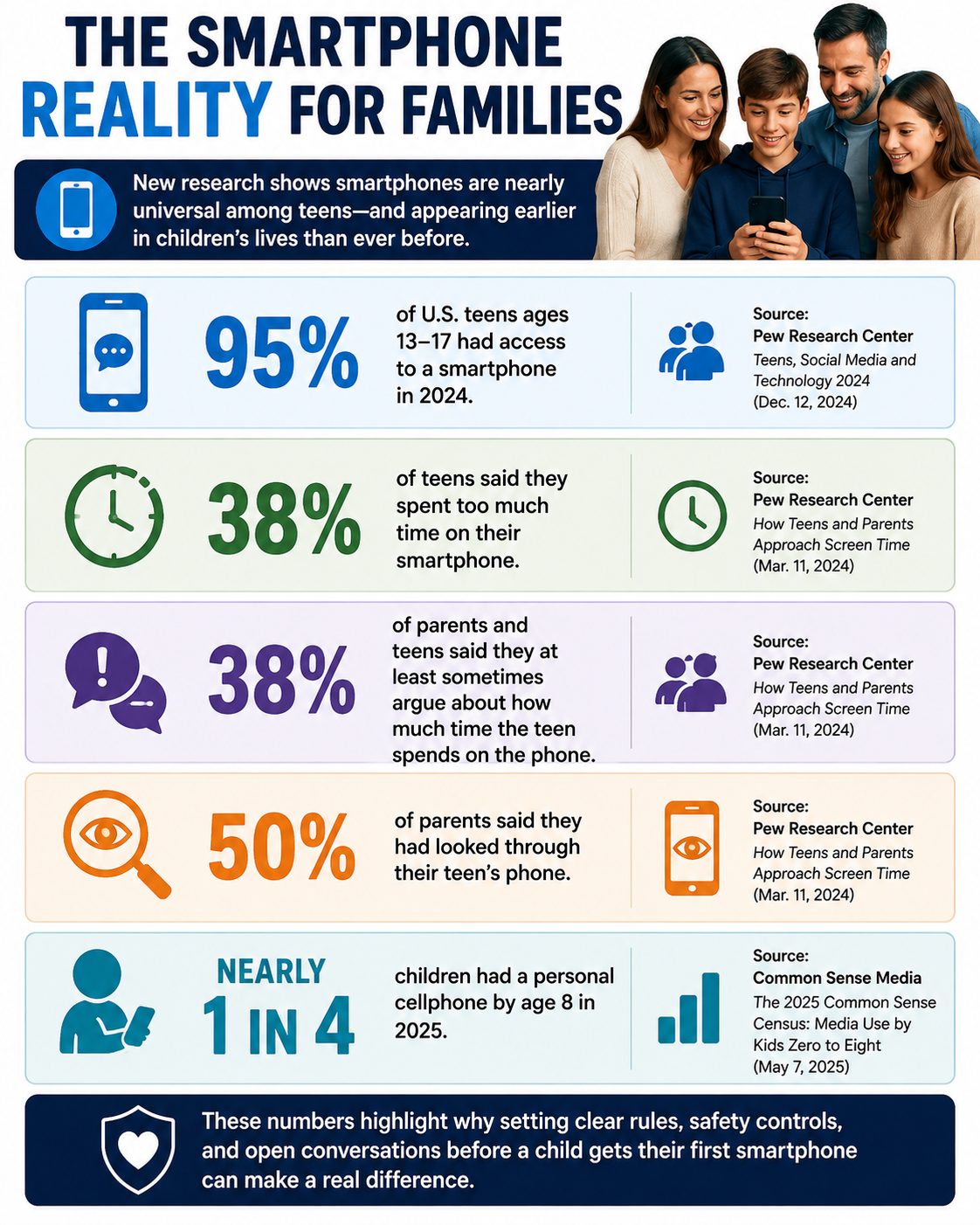
Giving a child their first smartphone can solve a practical problem—suddenly they can call after practice, text when plans change, and reach you in an emergency. But it also places apps, messaging, cameras, location sharing, purchases, strangers, and a nearly unlimited internet connection in their pocket. Smartphone access is nearly universal among teenagers: Pew Research Center found 95% of U.S. teens ages 13 to 17 had access to one in 2024. And the transition is beginning much earlier for some families, with Common Sense Media’s 2025 census finding nearly one in four children had a personal cellphone by age 8. Before activating a child’s first smartphone, parents can make six decisions that may prevent some of the biggest arguments and safety problems later.

1. Decide Whether Your Child Needs a Smartphone—or Just a Phone

There is no single age at which every child suddenly becomes ready for a smartphone. The American Academy of Pediatrics recommends considering the child’s maturity, how they plan to use the device, and whether they’re prepared for problems that can accompany internet access rather than relying solely on age. Start with the problem you’re actually trying to solve: Does your 10-year-old need to contact you after soccer practice, or do they need unrestricted access to social media, games, web browsers, and app stores? Those are very different needs, and a basic phone, calling-enabled watch, or more restricted device may solve the first without automatically providing the second. Think of smartphone access as something that can expand over time rather than a package of privileges that must all arrive on the child’s birthday.

Is Your Child Smartphone Ready?

QuestionWhy It Matters
Do they usually follow household rules?Phone limits require self-control
Can they keep track of belongings?Smartphones are expensive and portable
Will they tell you when something online feels wrong?Secrecy can make problems harder to address
Can they stop using screens when asked?Transitioning away from the device matters
Do they understand basic privacy?Phones collect and share substantial information
Do they actually need internet/app access?Communication may require only a basic device
Can they handle gradually increasing freedom?Controls can loosen as responsibility improves

The American Academy of Pediatrics actually offers families a PhoneReady questionnaire designed to assess behavior, developmental maturity and family values rather than declaring one universal “right age.”

2. Write the Smartphone Rules Before the Phone Arrives

Trying to establish limits after a child has spent three unrestricted weeks with a new smartphone can be much harder than agreeing on expectations beforehand. It is recommended that families create screen-free zones, use parental controls, turn off unnecessary notifications and autoplay, protect bedtime, and establish rules that apply to adults as well as children. Decide whether phones are allowed at dinner, during homework, after bedtime and behind closed bedroom doors, as well as who can approve new apps and purchases. Also establish consequences in advance—for example, downloading an unapproved app might temporarily remove app-store access rather than triggering an unpredictable punishment invented during an argument. Put the rules in writing, revisit them periodically, and loosen restrictions when your child demonstrates that they can handle additional independence.

A First-Phone Agreement Should Cover

  • Bedtime: Where does the phone charge overnight?
  • Apps: Who approves downloads?
  • Purchases: Are in-app purchases allowed?
  • Social media: Which platforms, if any, are permitted?
  • Location: Who can see the child’s location?
  • Privacy: What information should never be shared?
  • School: When must the phone stay away?
  • Monitoring: What are parents allowed to review?
  • Consequences: What happens when a rule is broken?
  • Emergency rule: When can the child come to a parent without fearing immediate loss of the phone?

3. Set Up Privacy, Purchases and Parental Controls Together

Don’t hand over a factory-fresh smartphone and assume the default settings are appropriate for a child. Before the device becomes everyday equipment, review app-download permissions, purchases, location sharing, contacts, web filtering, screen-time limits, camera and microphone permissions, account recovery information, and parental controls. For children under 13, the federal Children’s Online Privacy Protection Act provides protections involving how covered websites and online services collect personal information, including parental-consent requirements in applicable circumstances. Make app permissions a teaching exercise: if a simple game wants permanent access to contacts, photos, microphone and precise location, ask your child why the app might want those things and whether they’re necessary. Setting controls together makes the process less about secretly watching a child and more about teaching them the privacy questions they’ll eventually need to answer without you.

4. Teach the “Show Me, Don’t Hide It” Rule

A child’s first uncomfortable smartphone experience may not involve an obvious stranger asking suspicious questions. It could be a classmate sharing an embarrassing photo, a fake “free gift” text, a phishing link, sexual content appearing unexpectedly, pressure to send a private image, bullying in a group chat, or an adult pretending to be younger. The Federal Trade Commission recommends teaching children not to respond to unknown senders, click unexpected links or attachments, or provide personal or financial information in response to unsolicited messages. Parents should also establish one crucial rule: if something frightening, sexual, threatening, embarrassing or suspicious appears, the child can show an adult without automatically losing the phone simply for reporting it. A child who believes asking for help guarantees punishment has a powerful incentive to hide exactly the situation a parent most needs to know about.

5. Give the Phone a Bedtime—and a Place to Sleep

One of the easiest smartphone boundaries to understand is that the phone doesn’t need to sleep beside the child. You should aim for screen-free periods before bed and emphasize protecting sleep when families develop media plans. Choose a consistent charging location outside the bedroom—a kitchen counter, hallway charging station or parent’s room—and decide when the phone goes there each night. This removes the temptation to answer one more message, watch another video or respond to notifications after lights-out without requiring parents to police every minute of screen use. The rule will also be easier to defend if adults occasionally put their own phones away and demonstrate that being unreachable for part of the evening is normal.

6. Decide How Monitoring Will Change as Your Child Gets Older

Giving a child a smartphone should begin an ongoing conversation rather than end parental involvement. Pew Research Center found half of surveyed parents had looked through their teen’s phone, but monitoring was much more common among parents of 13- and 14-year-olds than parents of 15- to 17-year-olds. Tell your child upfront what you may review—apps, screen time, purchases, contacts or other activity—rather than secretly inventing surveillance rules after a problem occurs. Schedule brief check-ins during the first few months to talk about new apps, strange messages, social pressure, screen habits and anything online that has made the child uncomfortable. As judgment improves, parents can gradually loosen controls so that the smartphone becomes practice for independent digital decision-making rather than a device that remains permanently controlled by an adult.
Smartphone Reality

The 10-Minute First Smartphone Setup

Before your child starts using the phone:

  1. Turn on parental controls.
  2. Require approval for app downloads and purchases.
  3. Review location-sharing settings.
  4. Check camera, microphone, photo and contact permissions.
  5. Configure web/content restrictions appropriate for the child.
  6. Set screen-time or downtime schedules.
  7. Turn off unnecessary notifications and autoplay.
  8. Establish the overnight charging location.
  9. Add important family/emergency contacts.
  10. Review the family’s “show me, don’t hide it” rule.

The FTC specifically encourages parents to decide what children may do with the phone, who may contact them, what apps they can download and what parental-control features are appropriate.

A First Smartphone Should Come With Training Wheels

A child’s first smartphone does not have to arrive with unrestricted access to every feature the device offers. Parents can begin with communication and essential apps, add privileges gradually, and adjust controls as a child demonstrates responsibility. It’s a good idea to treat a first phone somewhat like an experiment, with independence increasing as children show they’re ready for it. The most important preparation may not be a particular parental-control setting at all, but establishing a relationship in which children know they can ask for help when something online goes wrong. The goal isn’t to control every tap forever; it’s to help a child eventually use the technology safely without needing you to do it for them.

How old was your child when they got their first phone, and what’s the one rule you wish you’d established from day one?

What to Read Next

Why Some Parents Are Delaying Smartphones Longer Than Ever

Should Your Child Really Have a Smartphone Before School Starts?

Phone-Free Schools Act: New Policies Limit Student Smartphone Use to Curb Distraction and Cyberbullying

Evan Morgan

Evan Morgan has been a full-time freelance writer and editor for 10+ years. When not working, he enjoys catching the latest true crime documentary or getting lost in a good book.


Filed Under: Parenting Tagged With: child safety, children and technology, digital parenting, first smartphone, Internet Safety, Online Safety, parental controls, Parenting, Screen Time, smartphones

Why Some Parents Are Delaying Smartphones Longer Than Ever

July 19, 2026 | Leave a Comment

Kid Using Smartphone
Parents are increasingly choosing to delay smartphones, opting for basic communication devices while helping children develop healthy digital habits before entering the online world. (Pexels).

Parents today are making a very different decision than they did just a few years ago. Instead of handing over a smartphone in elementary school, many families are choosing to wait until middle school or even high school. The shift reflects growing concerns about mental health, social media, online safety, and the long-term effects of constant screen exposure. While every family has different rules, the trend toward delaying smartphones is gaining momentum as parents seek a healthier balance between technology and childhood.

Parents Are More Aware of Digital Risks

The conversation around delaying smartphones has changed dramatically as new research and real-world experiences have emerged. Parents are no longer focused only on screen time but also on social media pressure, cyberbullying, sleep disruption, and exposure to inappropriate content. Organizations such as Wait Until 8th encourage families to postpone smartphones until at least the end of eighth grade, giving children more time to mature before navigating the online world independently. The movement has spread nationwide as parents discover they are not alone in wanting to slow down technology adoption. Instead of seeing delaying smartphones as restrictive, many now view it as giving children additional time to develop healthy habits before facing digital challenges.

Kids Are Growing Up in a Different Digital World

Today’s children encounter technology much earlier than previous generations. According to Common Sense Media’s 2025 research, nearly one in four children has a personal cellphone by age eight, while many also own tablets long before starting school. At the same time, short-form videos and gaming have become increasingly popular, creating more opportunities for extended daily screen use. These changing habits have prompted many parents to rethink when their children truly need a smartphone. Rather than rejecting technology altogether, many families are delaying smartphones until children demonstrate greater maturity and self-control.

Communication Doesn’t Always Require a Smartphone

One common misconception is that delaying smartphones means parents cannot stay connected with their children. In reality, many families choose basic phones, GPS-enabled watches, or devices that allow calling and texting without internet access or social media apps. For example, a child who walks home from school can still call a parent when they arrive safely without carrying a device filled with endless distractions. These alternatives provide peace of mind while avoiding many of the online risks associated with smartphones. This practical middle ground has become increasingly popular among parents who want safety without unnecessary digital exposure.

Peer Pressure Remains the Biggest Challenge

Even parents committed to delaying smartphones often admit that peer pressure is the hardest obstacle. Children naturally want what their classmates have, especially when group chats, games, and social media become part of everyday conversations. Parenting experts suggest that discussing expectations early and connecting with like-minded families can make those conversations much easier. Communities participating in initiatives like Wait Until 8th often report that delaying smartphones becomes more manageable when several families make the same commitment together. Instead of feeling isolated, children understand that many of their friends are following similar household rules.

A Slower Approach May Build Healthier Digital Habits

Delaying smartphones does not guarantee children will avoid every online challenge, but it can provide valuable time to build confidence, judgment, and emotional maturity before entering a highly connected digital world. Every child develops at a different pace, making flexibility more important than following a universal timeline. Many parents are finding that waiting reduces unnecessary pressure while creating more opportunities for face-to-face conversations, outdoor activities, and stronger family relationships. As technology continues evolving, thoughtful decisions often matter more than simply keeping up with the latest trends.

Are you delaying smartphones for your children, or do you believe early access better prepares them for today’s world? Share your thoughts and experiences in the comments because your perspective may help another parent make an informed decision.

What to Read Next

Phone-Free Schools Act: New Policies Limit Student Smartphone Use to Curb Distraction and Cyberbullying

How Your Child’s Cell Phone Could Now Ruin Them In School

7 Kids Apps That Can Silently Access Your Camera or Microphone

Evan Morgan

Evan Morgan has been a full-time freelance writer and editor for 10+ years. When not working, he enjoys catching the latest true crime documentary or getting lost in a good book.

Filed Under: Parenting Tagged With: child safety, delaying smartphones, digital parenting, family technology, Kids, Parenting, Screen Time, smartphones, Social Media

Should You Let Your Child Keep Their Smartphone Overnight?

September 4, 2025 | Leave a Comment

Should You Let Your Child Keep Their Smartphone Overnight?
Image source: 123rf.com

Smartphones have become part of nearly every child’s daily life, offering access to friends, schoolwork, and entertainment at the tap of a screen. But when bedtime rolls around, many parents wonder whether phones belong in the bedroom. The decision can influence sleep quality, mental health, and family dynamics in ways that aren’t always obvious. Asking yourself should you let your child keep their smartphone overnight is about more than convenience—it’s about setting healthy boundaries that support long-term well-being.

1. The Impact on Sleep Quality

Experts consistently warn that screen time before bed disrupts sleep patterns. The blue light from smartphones suppresses melatonin, the hormone that helps children fall asleep. Notifications buzzing throughout the night can also break up restful sleep, leaving kids groggy the next morning. Over time, chronic sleep deprivation affects school performance, mood, and overall health. This makes sleep one of the biggest concerns when deciding should you let your child keep their smartphone overnight.

2. Exposure to Online Risks

Smartphones offer a direct line to social media, messaging apps, and the wider internet. Overnight, kids may be more vulnerable to cyberbullying, unsafe conversations, or inappropriate content without a parent nearby. In some cases, children hide late-night activity from parents, increasing the chance of risky behavior. With fewer safeguards in place, the risks are greater after hours. This reality adds weight to the question of should you let your child keep their smartphone overnight.

3. Distraction from Homework and Responsibilities

When phones are always within reach, it’s easy for kids to get sidetracked. Even if they plan to do homework, a single notification can send them down a spiral of scrolling or chatting. If they keep the phone by their bed, the temptation extends beyond study time into late-night hours. Responsibilities like chores, reading, or simply winding down get pushed aside. Parents asking should you let your child keep their smartphone overnight should consider how it affects focus and accountability.

4. The Benefits of Independence and Trust

On the flip side, banning smartphones from bedrooms entirely can sometimes backfire. Older kids may feel trusted when allowed to manage their own screen habits, building responsibility and independence. For families with teens who use phones as alarm clocks or for safety check-ins, overnight access might be practical. Setting rules together can give children ownership of their choices, which fosters maturity. This shows that the answer should you let your child keep their smartphone overnight isn’t always one-size-fits-all.

5. Establishing Healthy Boundaries

Instead of an outright “yes” or “no,” many parents find success with balanced rules. Creating device curfews, charging stations outside the bedroom, or limits on certain apps at night can reduce risks. These approaches allow kids to enjoy their phones during the day without compromising sleep or safety. Consistent routines make it easier for children to understand why boundaries exist. These strategies can help answer should you let your child keep their smartphone overnight in a way that works for your household.

Finding the Right Answer for Your Family

Ultimately, there isn’t a universal rule for every child, but there are clear risks parents should weigh carefully. Smartphones offer connection and convenience, but they also interfere with rest, focus, and safety when used without limits. By combining awareness with reasonable boundaries, families can find a balance that preserves both trust and well-being. Asking should you let your child keep their smartphone overnight is less about control and more about guiding kids toward healthy lifelong habits. The choice you make today shapes how they use technology responsibly tomorrow.

Do you let your child keep their smartphone in the bedroom at night, or do you set limits? Share your approach in the comments below.

What to Read Next…

6 Parenting Tech Shortcuts That Can Expose Your Child to Strangers

How Much Screen Time Is Quietly Reshaping Childhood Behavior?

The Dark Side of Kids’ YouTube You Didn’t See Coming

12 Ways to Encourage Reading in a Digital Age

9 Childhood Milestones That Are Happening Later Than Ever

Catherine Reed
Catherine Reed

Catherine is a tech-savvy writer who has focused on the personal finance space for more than eight years. She has a Bachelor’s in Information Technology and enjoys showcasing how tech can simplify everyday personal finance tasks like budgeting, spending tracking, and planning for the future. Additionally, she’s explored the ins and outs of the world of side hustles and loves to share what she’s learned along the way. When she’s not working, you can find her relaxing at home in the Pacific Northwest with her two cats or enjoying a cup of coffee at her neighborhood cafe.

Filed Under: Parenting Tagged With: child safety, digital parenting, family rules, healthy habits, kids and technology, Parenting, Screen Time, smartphones

  • Facebook
  • Pinterest
  • RSS
  • Twitter

Basic Principles Of Good Parenting

Here some basic principles for good parenting:

  1. What You Do Matters: Your kids are watching you. So, be purposeful about what you want to accomplish.
  2. You Can’t be Too Loving: Don’t replace love with material possessions, lowered expectations or leniency.
  3. Be Involved Your Kids Life: Arrange your priorities to focus on what your kid’s needs. Be there mentally and physically.
  4. Adapt Your Parenting: Children grow quickly, so keep pace with your child’s development.
  5. Establish and Set Rules: The rules you set for children will establish the rules they set for themselves later.  Avoid harsh discipline and be consistent.
  6. Explain Your Decisions: What is obvious to you may not be evident to your child. They don’t have the experience you do.
  7. Be Respectful To Your Child: How you treat your child is how they will treat others.  Be polite, respectful and make an effort to pay attention.
Best Parenting Blogs

Most Popular

Baby

9 Unusual Baby Names That Sound Like They Belong to Future CEOs

Evan Morgan
Baby

10 Baby Names That Were Once Considered “Grandparent Names” but Feel Cool Again

Evan Morgan
Target Store

Choking Incident Prompts Recall of 49,000 Target Gigglescape “Under the Sea” Popping Toys

Evan Morgan
Frustrated Girl

Why Some Students on the Spectrum Are Labeled With ODD

Evan Morgan
Coke Bottles

12 Things Kids Took to School in the ’70s That Would Never Be Allowed Today

Evan Morgan

All content on Kids Ain’t Cheap is for entertainment purposes only. By reading this blog, you agree that Kids Ain’t Cheap is not responsible for any actions taken after reading this blog. For the full disclaimer, see our privacy policy.

Please note that Kids Ain’t Cheap has financial relationships with some of the merchants mentioned here. Kids Ain’t Cheap is funded by banner advertising, commission sales and search optimization consulting.

Copyright © 2006–2026 | District Media | All Rights Reserved | Privacy Policy

Copyright © 2026 Runway Pro Theme by Viva la Violette