• Home
  • About Us
  • Toolkit
  • Archives
  • Advertise
  • Privacy Policy

Kids Ain't Cheap

But They Sure Are Worth It

  • Parenting
    • Baby Stuff
    • Books and Reading
      • Aesops Fables
      • Comic Books
    • Education
    • Family Time
    • Green Living
    • Growing Up
    • Healthy Living & Eating
    • Holidays
    • Parenting
    • Random Musings
    • Shopping
    • Stuff to Do
  • Money
  • Product Reviews
    • Books and Magazines
    • Discount Sites
    • Furniture
    • House Keeping
    • Reviews News
    • Toys and Games
  • Contact Us
  • Our Editorial Commitment
  • Search

Why I Decided to Teach My Teen to Drive

March 10, 2022 | Leave a Comment

Why I Decided to Teach My Teen to Drive

When I was a teen, my high school offered driver’s ed as a four-week class during the summer. We sat in an air-conditioned classroom during the morning and watched driver’s training videos. Then, in the afternoon, we went out to the parking lot to practice driving a car. Later, we made our way onto the roads. The instructor had a car equipped with pedals on his side to override any mistakes we made when braking or accelerating. However, now, thanks to budget cuts, many schools no longer offer driver’s training. Instead, parents must choose between teaching their kids to drive or paying for a driving school. For our family, there were several reasons why I decided to teach my teen to drive.

Why I Decided to Teach My Teen to Drive

Our family picked this option for a few reasons.

Driving School Is Expensive!

In our area, driving school is expensive! The cheapest package includes two hours of driver’s ed and two one-hour driving sessions for $189. Their mid-level package includes 10 one-hour driving sessions for $699. Their elite package includes 30 one-hour driving sessions for $1799.

Why I Decided to Teach My Teen to Drive

If I picked the cheapest session, I would still have to go out with my teen for many hours of driving, so why not just do it myself?

We ended up buying a home-based driver’s ed program. We watch that for a few lessons. Then we hit the road. So far, our teen has about 10 hours of driving under his belt.

I Can Keep My Cool

Another reason why I decided to teach my teen to drive is that I can keep my cool. If he does something erratic like accidentally pushing the gas instead of the brake (it’s happened!) I can quickly and calmly tell him to hit the other pedal.

If you don’t think you can keep your cool with your teen, I don’t recommend teaching them to drive. My mom went out driving with me just twice before I got my license. Once, I was learning to drive stick shift, and I stalled the car in an intersection when I tried to go from a stop. My mom panicked and started saying, “Go, go! We’re going to get hit!” Let me tell you, that did not help me get the car moving.

We Have a Vehicle to Use

We have two vehicles, one we bought 17 years ago when our teen was just an infant. Of course, I don’t want my son to have an accident, but if he does have a fender bender, this vehicle can take it. If I had a brand-new car, I might not decide to teach my teen to drive.

Final Thoughts

Should you teach your teen to drive? As you can see, that depends on many factors. For our family, I decided to teach my teen to drive because we could save money, I stay calm, and we have a vehicle he can use. However, other families may have to consider other factors and make the decision that is right for their families.

Read More

What Should Teen Drivers Contribute to the Expense of a Vehicle?

4 Tips to Save on Car Insurance for Teens

Your Teen and Their First Car

Melissa Batai
Melissa Batai

Melissa is a writer and virtual assistant. She earned her Master’s from Southern Illinois University, and her Bachelor’s in English from the University of Michigan. When she’s not working, you can find her homeschooling her kids, reading a good book, or cooking. She resides in Arizona where she dislikes the summer heat but loves the natural beauty of the area.
Filed Under: Family Time, Growing Up, Money and Finances, Parenting, Parenting Blog at KidsAintCheap Tagged With: driving lessons, teen driver

Financial Benefits of Optimally Spacing Childbirth

January 6, 2022 | Leave a Comment

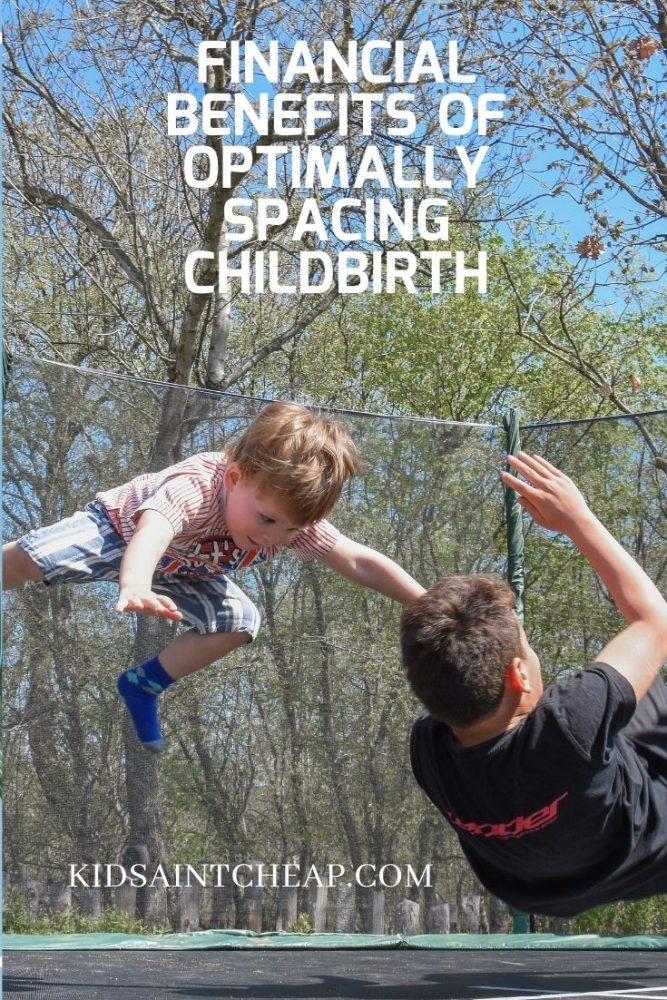
Financial Benefits of Optimally Spacing Children

The average American family has children spaced 2.5 years apart. But is that ideal? What are the financial benefits of optimally spacing childbirth?

Financial Benefits of Optimally Spacing Childbirth

People argue about what is the optimal time between children. Here are some of their arguments for having kids close together and having them four or more years apart.

The Financial Benefits of Having Kids Close Together

Proponents on this side have some good arguments as to why having your children spaced close together is good.

Initial Costs for the Second Child Are Minimal

Because your kids are so close together, you have everything you need for the second child. You don’t need to buy more baby clothes or baby gear because you already have everything you need from the first child.

Parental Careers Are Less Interrupted

If one parent chooses to stay home to care for the children, she doesn’t have to stay home as long if the children are spaced closely together. If your children are only 18 months apart and you want to stay home until they’re both in preschool at age 3, you are only out of the workforce for 4.5 years. However, if you have kids four years apart, in the same scenario, you’re out of the workforce for seven years.

You Get Discounts with Multiple Children

Proponents of having kids close together acknowledge that you may face large expenses at once, such as daycare and college. However, these parents note that you’ll get a discount. When you have two children at the same daycare, you likely get a percentage off the second child. If you have two kids in college at the same time, you’ll receive more financial aid to offset the added expense.

The Financial Benefits of Spacing Kids Four Years Apart

Others argue to reap the financial benefits of optimally spaced childbirth, children should be four years apart. These are some of the benefits you reap with larger spacing.

Only Pay One Large Expense at Once

Financial Benefits of Optimally Spaced Childbirth

The best benefit of having kids four years apart is that you pay big expenses one at a time. Some of the largest childhood expenses are daycare, braces, and college. Because your kids are four years apart, by the time your first child finishes daycare, your second begins. The same is true with braces and college. While these expenses remain constant for eight years since you’re paying them back-to-back, you never face the expense of having two in braces at once or two in college at once.

While those who have kids only two years apart argue that there are discounts for daycare and college when you have two children enrolled, you’re still paying more than if you only had one child enrolled. If you space your children four or more years apart, you avoid a few intense years of high expenses that those with kids close together experience.

My Experience

I have three kids. The first two are 4.4 years apart, and the second and third are just 17 months apart. If I look from a strictly financial standpoint, the first two are optimally spaced. The oldest was able to attend preschool while I worked full-time and my husband went to graduate school full-time. However, after we had the last two 17 months apart, we could no longer afford for me to work. The cost of two kids under two in daycare in one of the largest cities in the United States cost almost as much as my salary. I would have been working to pay for my younger two kids to be in daycare.

Likewise, my oldest was out of braces when my middle child started them, so we only had to pay for one child at a time. (Thankfully, my youngest doesn’t need braces!)

Other Factors to Consider When Spacing Children

However, our choices in life are rarely entirely about finances. When determining how to space your children, you also need to consider other factors besides money.

Non-Financial Benefits of Having Kids Two or Fewer Years Apart

Despite the added expense, there are good reasons to have kids two or fewer years apart.

Children Tend to Be Closer

While this isn’t always true, children who are closer in age tend to have a closer relationship. If you want your siblings to rely on one another and be friends, you have a better chance of that happening if your children are closer in age.

They Have Similar Interests

If your children are close in age, they are developmentally at the same stage. If you want to take them to see a movie, your pick is easy because they’re at the same developmental age. This isn’t true if their sibling is four or five years older. In that case, picking an activity that is age-appropriate for the younger child often means the older child is bored because he’s no longer at that developmental stage.

Non-Financial Benefits of Having Kids Four or More Years Apart

Financial Benefits of Optimally Spaced Childbirth

In my experience, having children closer together is better from a non-financial standpoint. My younger two have a close relationship.  However, my oldest and middle child, who are 4.4 years apart, only recently started developing a closer relationship as the middle one reached her teen years and started to share interests with her brother. My youngest still does not have a close relationship with the oldest.

However, there are some non-financial benefits to spacing kids further apart.

You Have More Time to Recover

When kids are spaced four or more years apart, you have more time to recover from pregnancy and the sleepless newborn days. Honestly, when I had two kids 17 months apart, the first two years are a blur because I was so exhausted. That didn’t happen when my second joined the family.

Easier to Give Each Child Attention

With this age gap, giving each child individual attention is easier. You can read and play with the older child while the younger one naps. You can play with the younger child while the older one plays independently.

Final Thoughts

If you space your kids four years apart, there are financial benefits of optimally spacing childbirth. However, your decision when to add to your family is rarely only a financial one. You should consider all factors to make the best decision for your family.

Read More

6 Frugal Activities for Kids During Winter Break

9 Important Values to Teach Children

Favorite Family Christmas Traditions, Modernized!

Melissa Batai
Melissa Batai

Melissa is a writer and virtual assistant. She earned her Master’s from Southern Illinois University, and her Bachelor’s in English from the University of Michigan. When she’s not working, you can find her homeschooling her kids, reading a good book, or cooking. She resides in Arizona where she dislikes the summer heat but loves the natural beauty of the area.

Filed Under: Education, Family Time, Money and Finances, Parenting Blog at KidsAintCheap Tagged With: braces, childbirth, college, family finances, spacing children

6 Frugal Activities for Kids During Winter Break

December 23, 2021 | Leave a Comment

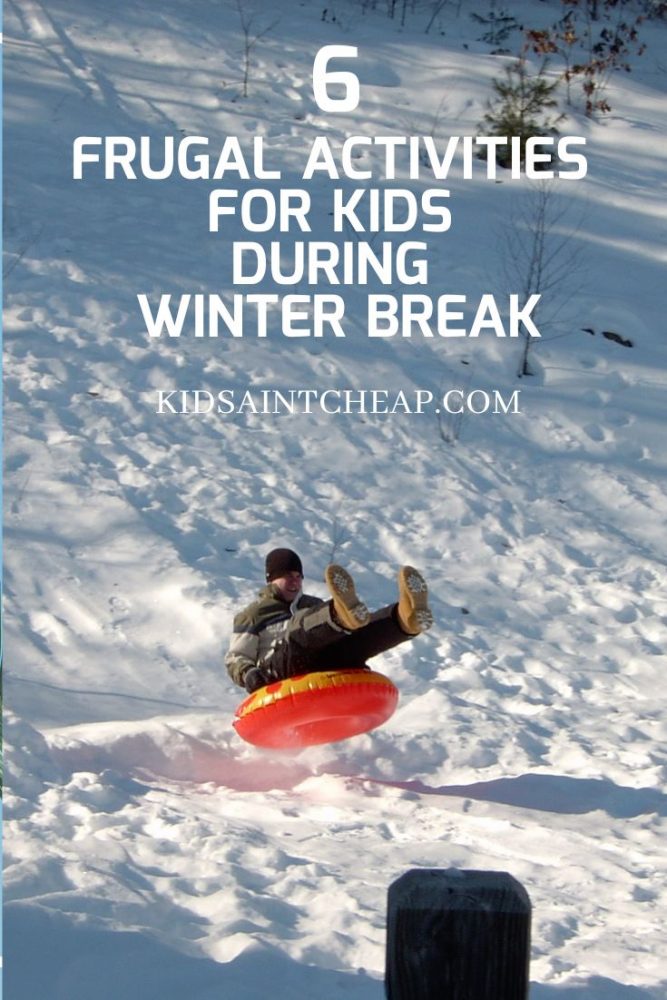
Frugal Activities for Kids During Winter Break

Kids around the country are enjoying winter break. While the early days of winter break are likely busy with holiday activities and preparations, the last week can be quiet and a bit boring. If you want to find frugal activities for kids during winter break, look no further than our list. These activities can help your kids relax, have fun, and spend time building memories with family.

Frugal Activities for Kids During Winter Break

Have a Movie Marathon

If your kids don’t get a lot of screen time during the school year, take one day this break and have a movie marathon. Pick two or three movies the family wants to watch, and then camp out on the couch with yummy snacks and the blinds closed. Have a great time watching and then discussing the movies.

Have a Chopped Challenge

Have your kids watched the cooking show, Chopped? If so, why not have a kids’ Chopped challenge at your house. Give the kids three or four items with which to create a meal. Then, you decide which of the kids wins the competition. (As a bonus with this activity, you have one less meal you have to cook this week!) If your kitchen is small, you may want to have one child cook one night with the ingredients and another child cook the next night.

Decorate Cookies

Who says Christmas cookies have to stop when Christmas is over? Have a fun afternoon making and decorating cookies. Make it extra fun by turning traditional cookie cutters into other objects. For instance, instead of making a gingerbread man with that cookie cutter shape, turn it into something else like a unicorn.

Go Sledding

Some of the best fun I’ve had with my kids is sledding with them. Bundle the family up, head out to the nearest large hill in the neighborhood, and go sledding. Stay out for an hour or two, and then come home and enjoy a nice mug of hot chocolate while you warm up.

Build a Snow Fort

Likewise, don’t send the kids out alone to play in the snow. Instead, go out with them and build a snow fort. You can even take a break for a snowball fight. The kids will love you spending time with them and being a kid again with them.

Play a Board Game

Frugal Activities for Kids
Photo by National Cancer Institute on Unsplash

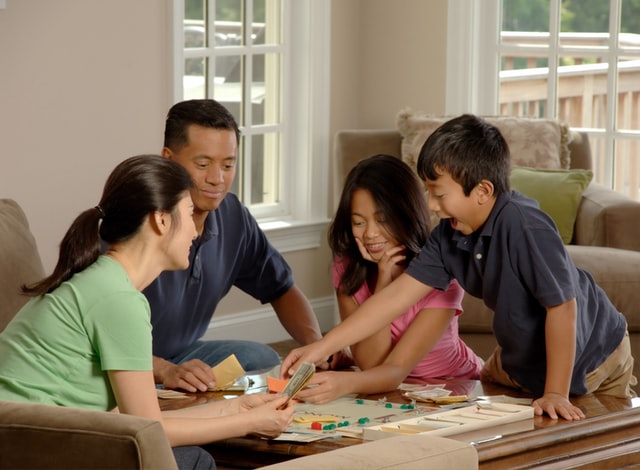
During the busy school week, you may not have time to play games with your kids. During winter break, set aside some time to play board games with your kids. Some of our favorites include 10 Days in the USA, Battleship, Yahtzee, and The 5-Second Rule.

Final Thoughts

While taking a family vacation during break is nice, don’t feel bad if you don’t have the money to do so. Your kids will appreciate you spending time with them and enjoying any of these frugal activities for kids during winter break.

Read More

Favorite Family Christmas Traditions Modernized

Stay Organized During the Holidays

How to Pay for Vacations and Holidays without Debt

Melissa Batai
Melissa Batai

Melissa is a writer and virtual assistant. She earned her Master’s from Southern Illinois University, and her Bachelor’s in English from the University of Michigan. When she’s not working, you can find her homeschooling her kids, reading a good book, or cooking. She resides in Arizona where she dislikes the summer heat but loves the natural beauty of the area.
Filed Under: Family Time, Holidays, Money and Finances, Parenting Tagged With: Activities For Family, Christmas break, holiday activities

Save Money on Entertainment with Reciprocal Museum Passes

November 25, 2021 | Leave a Comment

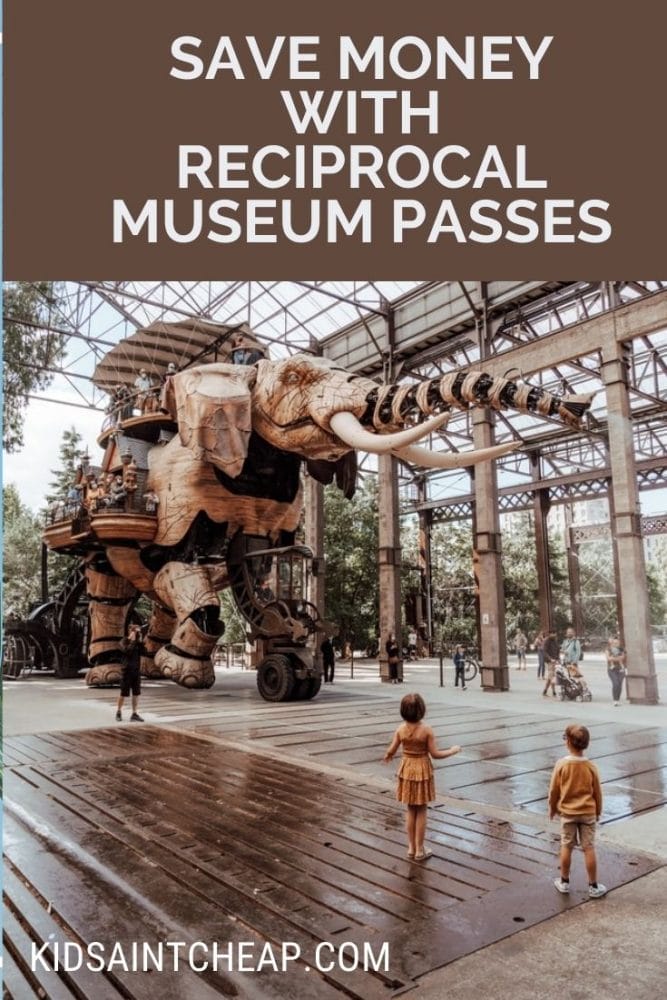
Save Money with Reciprocal Museum Passes

Recently, I took my children to our local art museum. It was the first time we went, and we enjoyed it. Buying a yearly pass was twice the cost of one-day admission, so we decided to upgrade. We knew we would be back, so the passes will pay for themselves after our next visit. But then, I found out the passes offer us reciprocal admission to many museums around the country! Those passes will save us a lot of money and give us an affordable entertainment option throughout the year.

What Museum Associations Offer Reciprocal Passes?

The museum we bought the yearly passes for is part of the North American Reciprocal Museum Association (NARM). There are over 1,175 museums in this network, all of which we have free access to with our museum pass. These museums are in the United States, Canada, Bermuda, El Salvador, and Mexico. In our state alone, there are 12 museums to which we will have access.

NARM is just one of many museum networks. You can also choose from the following organizations:

Art Museum Reciprocal Network (AMRN),

Association of Science and Technology Centers (ASTC) Travel Passport

Time Travelers (This pass offers free entry to some participating museums, but others only offer discounted entry with the pass.)

Smithsonian Affiliates, (Note that not all museums on this list choose to participate in the reciprocal agreement. While there are seven museums on this list in my state, only one participates in the reciprocal agreement.)

American Horticultural Society (AHS),

Association of Zoos and Aquariums (AZA), (Membership gives you 50% off at most zoos and aquariums on their reciprocal agreement.)

Reciprocal Organization of Associated Museums (ROAM),

Association of Children’s Museums (ACM), (Membership gives you 50% off the 200 children’s museums in the reciprocal agreement.)

Museum Alliance Reciprocal Program (MARP)

How to Save Money with Reciprocal Museum Passes

If you want to get the most for your money, choose the reciprocal program your family will use most frequently.

As mentioned above, read the fine details. Some reciprocal programs get you free admission to any of the participating programs. Others only offer discounted admission. Some have many participating museums in your state, others only have a few.

If you’re planning on taking a vacation during the year, check which programs have museums you’d be interested in visiting during your trip. Using a reciprocal pass can be an excellent way to reduce your vacation costs.

If You Can’t Afford a Museum Pass

Save Money with Reciprocal Museum Passes
Photo by Caroline Hernandez on Unsplash

Buying a season pass to just one museum in one of these reciprocal associations can make visiting museums throughout the year extremely affordable. However, some people cannot afford a season pass to even one museum. For those individuals, consider the Museum for All program.

Museums for All offers SNAP (Supplemental Nutrition Assistance Program) recipients free or discounted admission to 700 museums throughout the United States. Where I live, if I go to a local science museum with my three kids, I will pay $30 for admission. However, a SNAP recipient will just pay $12 for her and her three kids to enter, so the savings can be significant.

Final Thoughts

I hope these strategies help you save money on entertainment with reciprocal museum passes. We’re excited we’ll be able to visit our local museum several times this year AND visit other museums in our state that are part of the same group.

Read More

Save Money and Keep Kids Entertained By Rotating Streaming Services

Cheap, Fun Ways to Stay Cool This Summer

Ways to Whittle Down the Cost of Raising a Child

Melissa Batai
Melissa Batai

Melissa is a writer and virtual assistant. She earned her Master’s from Southern Illinois University, and her Bachelor’s in English from the University of Michigan. When she’s not working, you can find her homeschooling her kids, reading a good book, or cooking. She resides in Arizona where she dislikes the summer heat but loves the natural beauty of the area.
Filed Under: Family Time, Money and Finances, Stuff to Do Tagged With: entertaining kids, Entertainment, Frugal, Museum

Teach Your Child About Money – Free Savings Chart for Kids

November 12, 2020 | Leave a Comment

Free Savings Chart for Kids

One of the most wonderful gifts you can give your children is a healthy understanding of money. Not a craving for it or an assumption that it will lead to happiness. Instead, you have the privilege – the responsibility – to teach children about hard work, the power of saving, the dangers of debt, and the gift of giving. To help your children learn, we’ll also set you up with a free savings chart for kids.

How to Teach Your Child About Saving Money

Many people are in crisis mode, financially. It’s impossible to know what they learned or didn’t learn about money at home, but would America look different if more parents taught their children the principles I listed above? What if more parents led by example by communicating together about a budget, saying no more often to frivolous spending, and showing their children how to save up and pay cash instead of using credit cards?

It’s purely my speculation, but I’d go so far as to say we’d have less stress, less divorce, fewer addictions, more giving, and greater job satisfaction. Do you agree?

With the right steps, we can teach our children to live differently.

What About Student Loan Debt?

Free Savings Chart for Kids
Photo by Alexis Brown on Unsplash

You’re probably thinking, “What about student loans? I was just trying to further my education and now I’m overwhelmed by debt as a result.” Totally valid point. I remember approaching high school graduation and hearing everyone discuss their reasons for choosing one school over another. NOT ONCE did my friends and I stew over the debt load we’d receive from student loans. None of us saw what was coming.

In fact, according to StudentLoanHero.com, outstanding student loan debt reached more than $1.64 trillion in 2020.

How can we teach our children to save money in the face of such a burden of debt?

Start the Conversations

A great way to educate your young tribe about the dos and don’ts of spending is to create an open line of communication. Encourage them to ask questions. Show them the process of paying for your groceries or a meal at a restaurant. Take them to the bank and show them how you make a savings deposit.

Also, a conversation is a great way to tackle topics like:

  • Work ethic
  • Getting a job
  • Planning for the future
  • Saving for a major purchase
  • Saving for college (tell them about the ways you are saving for their college while they’re young)
  • Integrity
  • Greed
  • Envy
  • Contentment
  • Generosity

You don’t have to run down this list every night at the dinner table, but the more conversations you do have about these topics, the more seeds your planting in your child’s mind. You’re teaching her how to think about money, not what to think.

Put Them to Work

Free Savings Chart for Kids
Photo by NeONBRAND on Unsplash

We’ve covered the important step of talking about money. Next, it’s time to apply what your child has learned. If he’s old enough to hold a broom or to straighten up his room, your child is old enough to get paid for chores.

It’s important that he knows the money isn’t just for spending. Saving is a difficult concept for young minds, at first, unless they have something for which they’re saving. For example, if your daughter sees a Belle doll in the toy aisle and begs for you to buy it, you have some choices. You can purchase the doll, you can discuss the cost and why it’s not in the budget, or you can write down the dollar amount on a paper, head home, and help her calculate how many chores it’d take to save for the doll.

To aid in that endeavor, here are some free tools you can use with your child.

Free Savings Chart for Kids – and Other Great Savings Tools

Printable Savings Chart for Kids – via CouponsAreGreat.net

Downloadable “Share, Save, Spend” Chart for Kids – via iMom.com

Printable Savings Thermometer Chart – via Frugal-Mama.com

52-Week Money Challenge for Kids

Printable Play Money for Kids

Final Thoughts

Combine a free savings chart for kids with some great conversations and hard work around the house.  You’ll be setting the stage for great financial decisions, which will hopefully follow your children into adulthood!

Got some tips for teaching children to save money? Share one below!

Read More

5 Chores That Teach Work Ethic Principles to Toddlers

How Much, If Any, Should You Pay Your Kids for Chores?

Teach Them Young: 3 Key Tips to Help Your Child Learn about Money

Editors note:  This article has been brought to you by Dollar Dig.  Dollar Dig helps you save money at over 4,000 stores.  Open a Dollar Dig account today to start saving!

Melissa Batai
Melissa Batai

Melissa is a writer and virtual assistant. She earned her Master’s from Southern Illinois University, and her Bachelor’s in English from the University of Michigan. When she’s not working, you can find her homeschooling her kids, reading a good book, or cooking. She resides in Arizona where she dislikes the summer heat but loves the natural beauty of the area.
Filed Under: Education, Family Time, Home and Living, Money and Finances, Parenting Tagged With: 52 week money challenge, how to teach children to save money, kids and money, savings chart for kids, teach your child to save

Free Printable Kids Money for Download

October 29, 2020 | Leave a Comment

Getting ready to teach your children or students how to interact with money? That’s fantastic! Not only will this building block help them learn mathematics like counting by fives and tens, but it will also prepare them for the workplace. Let’s take a look at a variety of free printable kids money available on the Web and ways to teach kids about money.

play money for kids

Free Printable Kids Money for Download

Monopoly Money

One of the most recognizable currencies for children (or at least this 90s kid) is the brightly colored money from the Hasbro game, Monopoly. These bills differ from U.S. currency in appearance but offer your children a chance to practice their counting, sorting, and hand-eye coordination skills.

Download your free printable Monopoly money here.

U.S. Coins

Are your children ready to learn coin values? Making change? Let’s take a look at some printable coin sheets for you:

Customized printable sheets of play money – At StemSheets.com, you can customize the number and denomination of play coins you need on each sheet. For example, you can print off 20 coins of each value (up to a quarter) on a single piece of paper. That’s 80 coins – in color – on one sheet.

Printable coins and coloring pages – Head over to EnchantedLearning.com to view printable images of quarters, dimes, nickels, and pennies. Also, view a myriad of coloring pages for your child to enjoy as they educate her about U.S. coins.

Printable coin math worksheets – Ready to test your child’s knowledge of counting and making change? These free worksheets are great tools for just that.

Bonus Read: “6 Fun Money Games for Kids“

U.S. Dollars

Got a bank teller in the making? Help your children or students identify the correct face on each piece of currency and count them in quantities of fives, tens, twenties, or even hundreds with these options:

Fake Play Bills – Looking for fake $1, $5, $10, $20, $50, and $100 bills for your kids? Here is a complete list of free and printable play bills. These can engage your young child in a myriad of money lessons like counting, sorting, and even practicing good habits like using the envelope system.

Realistic Bills – Add a Face – A great way to quiz your child on whose face belongs to which bill is to show him this realistic play money with no face in the middle. After printing out these bills by denomination, he can color in his own face for some added fun. No worries. It’s only a federal crime to deface U.S. currency when it’s not play money. 😉

Games and Play to Teach Kids About Money

In the preschool years, kids are just beginning to learn that money has value and can be used to buy goods.  In early elementary, they learn to distinguish between the various bills and coins and their value.  You can help your child become money smart at an early age by playing money games with them.  Consider some of the following:

Buying Groceries

Print, cut, and laminate these terrific flash cards to quiz your child on prices at the grocery store. For example, she can use her fake money to pay for a $2 bag of popcorn or $1 bottle of water or do the math to pay for them both.

As your child gets older and masters this play game, you can take her with you to the grocery store.  Give her a certain amount of money and ask her to buy a few select things from your list.  This is a great time to teach her the difference between name brand and unbranded goods and the price difference between them.

Going to a Restaurant

Free Printable Kids Money
Photo by Annie Spratt on Unsplash

Take advantage of your child’s love of play to play a game of restaurant.  Present children with a menu using one of these realistic free menu downloads.  Then, let your child choose his food, pay for the meal, and leave a tip.  This is an excellent time to talk about budgeting and staying within a budget when dining out.  Don’t forget to let your child switch roles and practice being the waiter.

Using Printable Play Checks

Is your child old enough to write? Then he’s old enough to learn how to write a check. Paper checks may seem archaic in today’s digital world, but it’s still a foundational skill from which your child will build his financial knowledge upon.

For example, give him a set list of chores to complete, then pay with a check using these free printable checks. Teach him how to understand the information on the check, endorse it properly on the back, and cash it. This will help him understand the role banks and employers will play in his life later, even if his paychecks are directly deposited.

Practicing Estimation

Another fun activity is helping your children practice estimation.  Fill a glass jar with coins, and let your kids guess how much money is in there.  The person with the closest estimate wins a small prize.

Collecting Change

Another idea is to save all your coins in a jar as a family.  Decide together what you’ll use the money for.  Maybe you’ll use it for a fun day out or for a donation to a charity you all agree on.

Teaching about Interest

For older elementary kids, teach them how interest works.  They can deposit money with you for their savings, and every month you can give them interest, at a rate you’ve determined, on their savings.  Your kids will likely be excited by this “free” money they’ve earned and want to save even more.

Final Thoughts

We all want our kids to be savvy when it comes to saving and spending.  Those skills should start being developed early, when kids are three to ten, through printable money and games with the kids.  The earlier you can start them understanding the value of money, the longer you have to teach them how to use money responsibly.

Bonus Read: “How to Teach a Child to Count Money“

Got any favorite ways to teach kids about money? We’d love to hear about them in the comments below!

Read More

Parenting Win: Teaching Money Skills to Your Kids,

Games That Teach Kids About Money,

Free Apps that Help Kids Manage Their Pocket Money

Melissa Batai
Melissa Batai

Melissa is a writer and virtual assistant. She earned her Master’s from Southern Illinois University, and her Bachelor’s in English from the University of Michigan. When she’s not working, you can find her homeschooling her kids, reading a good book, or cooking. She resides in Arizona where she dislikes the summer heat but loves the natural beauty of the area.

Filed Under: Education, Family Time, Growing Up, Money and Finances, Stuff to Do Tagged With: free printable money for kids, Monopoly money, printable kids money, printable play money, teach kids to count

Rock Painting Ideas for Kids

August 14, 2020 | Leave a Comment

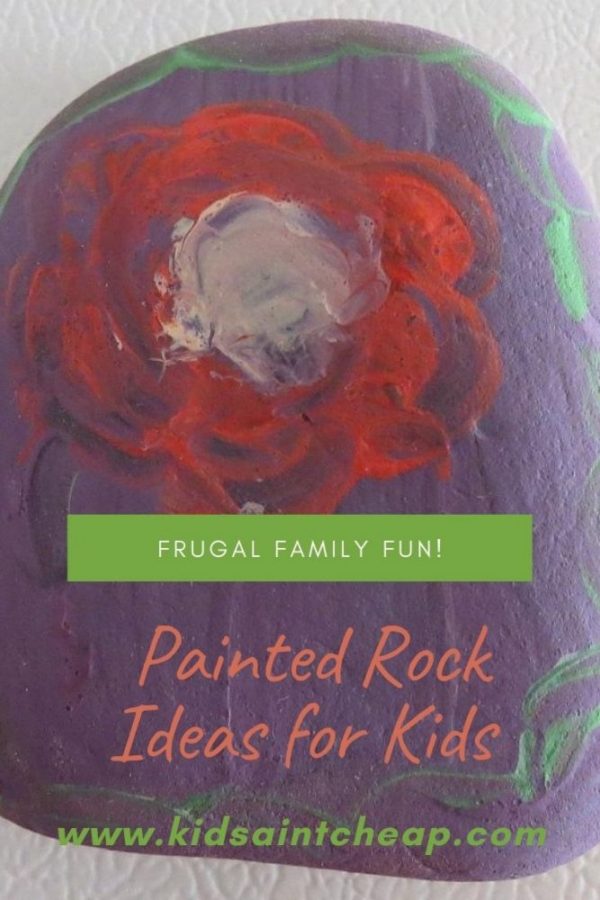
In our area, we’ve had the pleasure of stumbling upon a painted rock more than once, to the delight of whichever one of my kids finds it.  In fact, our city has its own Facebook page where people can share the rocks they’ve found around town as well as the rocks they have painted and placed around town.  There are over 13,000 members in the Facebook group!  If your family would like to get in on this fun hobby for kids, there are many easy rock painting ideas for kids.

Painted Rock Ideas for Kids

Rock Painting Ideas for Kids

If you’re looking at rock painting ideas, I’d encourage you to first see if your town has a Facebook group.  You can simply search the name of your town and rock painting; if there’s a group, you’ll find it that way.

However, Facebook rock painting groups can be a bit intimidating because there tend to be so many fabulous artists there.  If you or your kids’ skills are a bit more elementary, I’ve found YouTube to be a good place to search.

Ideas for Those 10 and Younger

To get kids excited about rock painting, try to pick designs that are easy enough for young kids.  The best ones seem to be designs that involve painting the entire rock as something like a ladybug or a strawberry, for instance.

There are so many tutorials on YouTube that will spark your children’s creativity!

For younger kids, Missy Maker has a tutorial showing kids how to make rock ladybugs, and giving examples of rock painting bees, minions, Shrek, and Nemo.

Ideas for Tweens and Teens

For older kids, rock painting can be an even more engrossing hobby.  Once kids’ artistic talents are a bit more developed, there are so many designs to pursue.

Tweens and teen can start using more advanced supplies like acrylic paint markers for more fine-detailed work like outlining and writing phrases on the rocks.

If your teen is a beginner, this video explains the whole rock painting process as well as designs for tweens and teens.

Rock Painting Ideas for the Whole Family

If you have children of varying ages and abilities, you can use a YouTube video like this one.

This video doesn’t show specifically how to paint the rocks, but it gives ideas for many different designs for all types of abilities.  I also enjoy tutorials with painting ideas for every season and holiday!  My kids who are 10 and under love painting simple flowers.

Final Thoughts

Rock painting can be a fun, low-cost hobby for everyone in the family, especially when you take the time to hide the rocks around your city.  It’s even more fun when you join a Facebook group and look to see if anyone has found your hidden rocks.  This hobby is also easy to start using some of these fun rock painting ideas for kids.

Melissa Batai
Melissa Batai

Melissa is a writer and virtual assistant. She earned her Master’s from Southern Illinois University, and her Bachelor’s in English from the University of Michigan. When she’s not working, you can find her homeschooling her kids, reading a good book, or cooking. She resides in Arizona where she dislikes the summer heat but loves the natural beauty of the area.

Filed Under: Family Time, Parenting Blog at KidsAintCheap Tagged With: Activities For Family, hobbies

Our Favorite Games to Teach Children Geography

July 23, 2020 | Leave a Comment

One of my favorite ways to sneak in extra education with my kids is to play games with them.  Kids seems to just absorb knowledge this way because they’re having fun.  I’ve shared some of our favorite geography games previously, but I’d like to share a few more of our favorite games to teach children geography.

Our Favorite Games to Teach Children Geography

Online Games

Kids will easily learn to play online geography games.  Here are two that are highly recommended.

Sheppard Software

Our Favorite Games to Teach Children Geography

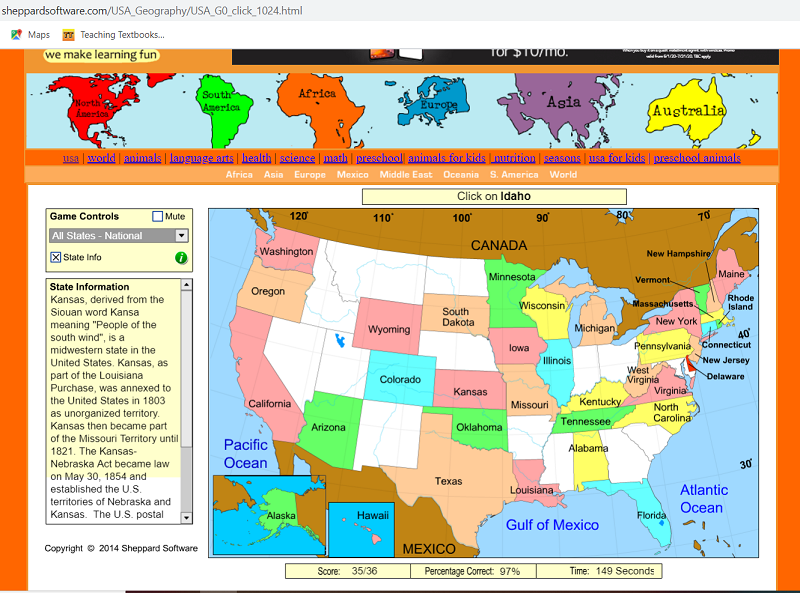
One of our favorite resources for learning geography is Sheppard Software.  Kids can learn the states of the United States or learn the countries of other continents.  My kids love this and play without complaint.  As soon as one of my daughters is done with the geography portion, she goes over to the Brain Games portion.

This site is a great resource as they also have history, animal, science, and health games, plus more.

Stack the States

We’ve not personally used this game because we don’t have an Apple device.  However, if you do, I’ve heard fabulous things about the app Stack the States.  This game teaches state capitals, shapes, geographic locations, and flags, to name a few.  Even better, it’s recommended for ages 4+, so it’s a fun way to help early elementary students learn their geography.

Board Games

10 Days in. . .Games

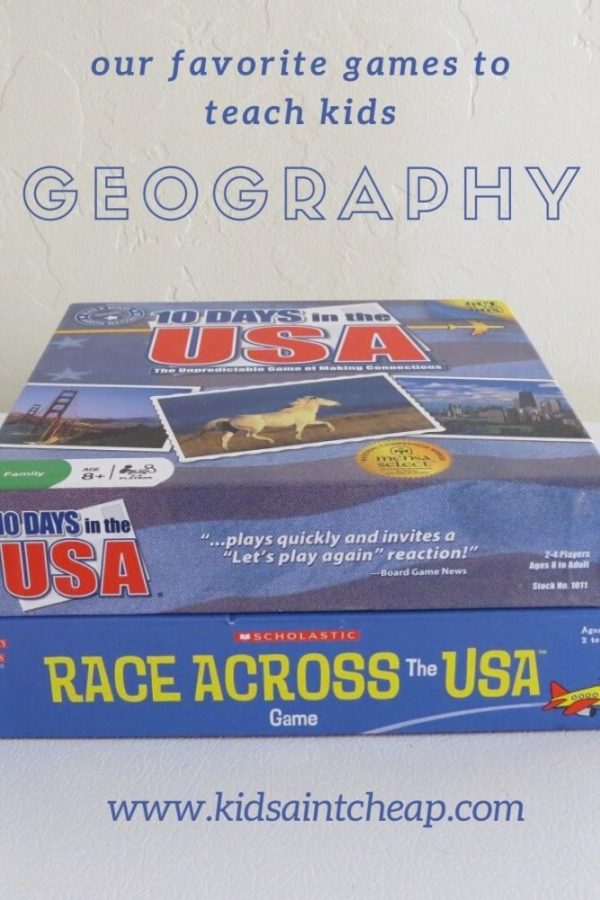
These games are perfect for family game night.  There are several versions of this game including 10 Days in the USA and 10 Days in Europe.  Players draw 10 cards.  The objective is to make a 10 card trail to your destination.  To make the trail, for instance, in 10 Days in the USA, you must either have a string of 10 cards that show a path through 10 states that connect, or you have a plane trip between to states that don’t touch.

Unfortunately, these games are a bit hard to find now.  You can find them on eBay and Amazon, but for now, production on new games doesn’t seem to be happening.

Explore the 50 States

This game is good for ages 7+.  Players spin a spinner and either land on the icon for a question card, flag card, travel card, or you choose.  If you get a question card, you can choose between answering a geography or history question.  The flag cards have three different questions.  You move forward once for each question you answer; if you can answer all three, you move forward three spaces.  The travel cards give fun facts about a state or attractions in that state.  Some make you do something before you move forward or some make you move back.

We find this to be a fun game to learn all sorts of things about the United States, from history, geography, trivia, and state flags.

Final Thoughts

Your kids are always learning, not just when they’re in school.  We find our favorite games to teach children about geography are a great way to have fun as a family and learn more together.  Luckily, there are many games available to help teach or reinforce knowledge for a variety of subjects.

Melissa Batai
Melissa Batai

Melissa is a writer and virtual assistant. She earned her Master’s from Southern Illinois University, and her Bachelor’s in English from the University of Michigan. When she’s not working, you can find her homeschooling her kids, reading a good book, or cooking. She resides in Arizona where she dislikes the summer heat but loves the natural beauty of the area.

Filed Under: Education, Family Time Tagged With: board games, education, geography games, online games

Best Games to Teach Elementary Students Geography

June 18, 2020 | Leave a Comment

For many of us, we learned geography in school through memorization.  We memorized capitals, populations, physical geography.  Oh, the tedium.  While I liked geography, learning it in school took all of the joy out of it.  However, it doesn’t have to be that way.  You can bring geography to life for your student by cooking food eaten in that country and playing games.

Games to Teach Elementary Students Geography

Best Games to Teach Elementary Students Geography

There are so many fun games to teach kids about geography!

The Professor Noggins Series

Games to Teach Elementary Students Geography

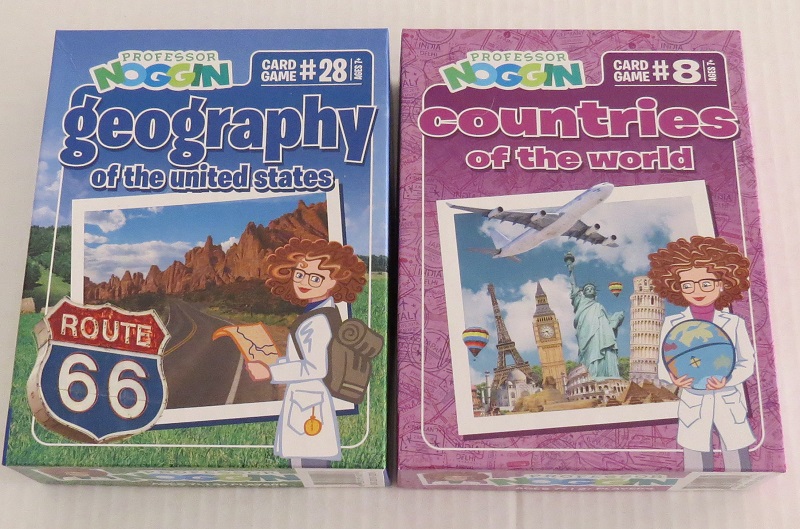
If you’re looking for a quick and educational game, try the various Professor Noggins games.  Popular geography titles include Wonders of the World, Countries of the World, Countries of the World II, and Geography of the United States.

These games are good for ages 7+.  To play the game, roll the dice.  Then, the next player will read you the question.  You can choose between student or scholar.  A student question might read, “The peninsula of Cape Cod juts into which ocean?”, while a scholar question will ask a more difficult question like, “Guadalupe Mountains National Park is located in which state?”  When you’ve gone through the entire deck, whoever has the most cards (correct answers) wins.  Because of the two different levels, this game is great for multiple ages.  I enjoy playing these games with my kids, especially because I usually learn something, too!

The Scrambled States of America

Games to Teach Elementary Students Geography

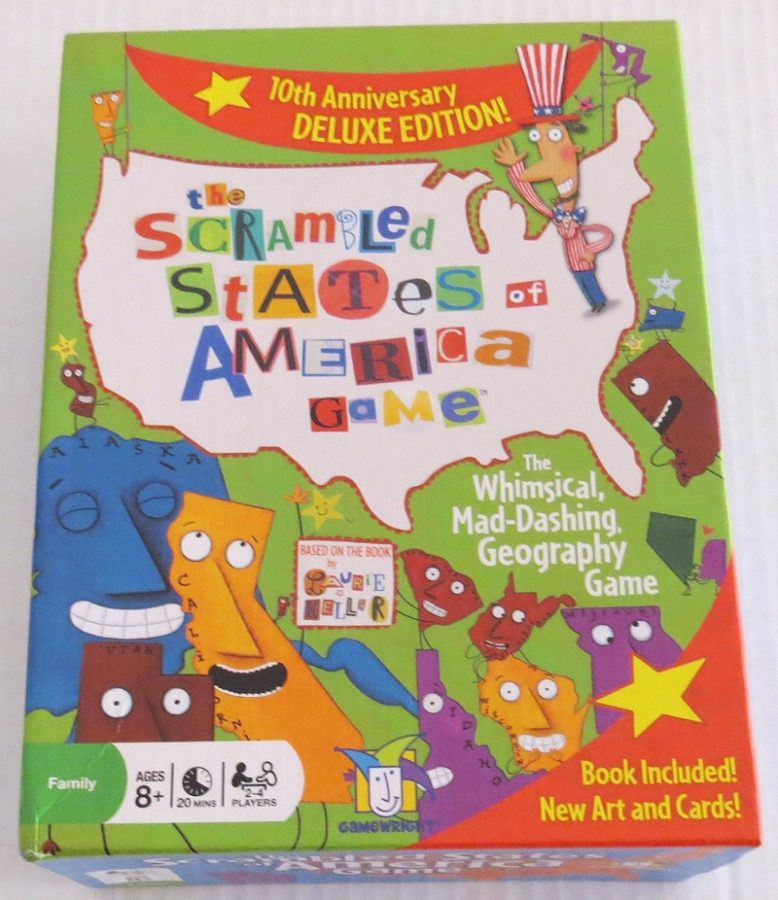
In this fun game, each player is given a U.S. map and five state cards.  Then, you read a playing card such as, “Capital starts with A or B.”  The player then looks at their five-state cards to see if they have a card that fits the criteria.  If they have one, they put that card aside and pick a new one.  The winner is the person who has the most state cards when the pile runs out.

I enjoy The Scrambled States of America because there are two options to play.  You can either race (the first person to answer correctly wins the round), or each player can answer and all the players that have it right win that round.  The latter version is perfect for younger kids or kids who have dyslexia and take more time to read.  The former is perfect for competitive older kids.

Ticket to Ride

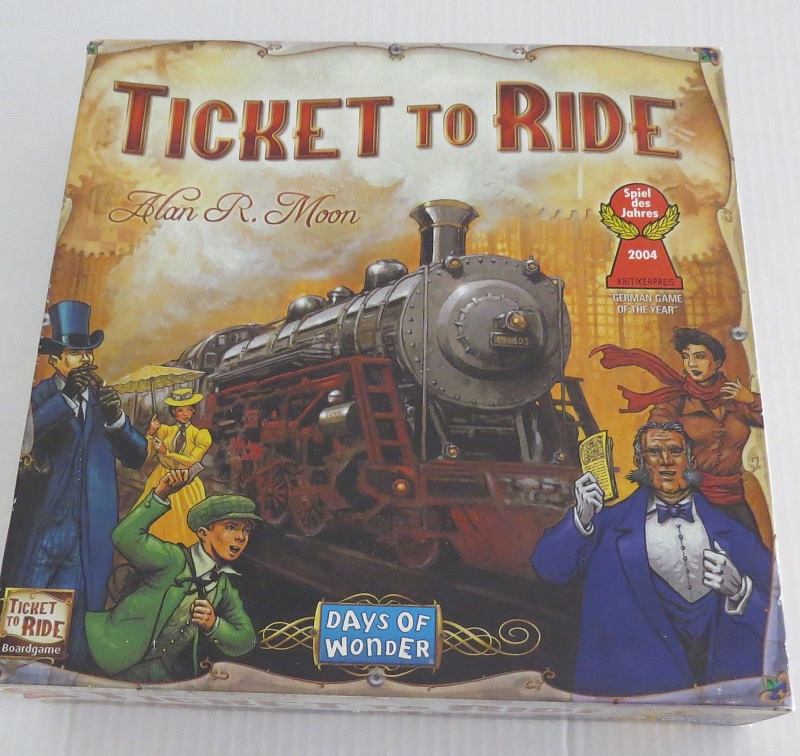
Ticket to Ride is often a long game.  Plan on playing for an hour or so, but it also makes a fun family game.  Players choose three cards that represent trips across America.  They can choose to keep all of the cards, only two, or only one.  If they complete the trip, they get the number of points on the card.  If they don’t complete the trip, the points on the card are deducted from their score.  The winner is the person who has the most points at the end.

Players learn where the states are as well as what the major cities are through regular play.  Our family really enjoys this game.

Final Thoughts

These are just three of the best games to teach elementary students geography.  There are many others available.  With so many fun resources, why settle for boring lessons?  Make learning geography fun instead!


Melissa Batai
Melissa Batai

Melissa is a writer and virtual assistant. She earned her Master’s from Southern Illinois University, and her Bachelor’s in English from the University of Michigan. When she’s not working, you can find her homeschooling her kids, reading a good book, or cooking. She resides in Arizona where she dislikes the summer heat but loves the natural beauty of the area.
Filed Under: Education, Family Time Tagged With: educational games, elementary students, geography, Homeschool

Fun Ways to Mark the End of Summer Vacation

August 28, 2019 | Leave a Comment

Summer is ending and school is beginning. Some kids have already started school. There is still time to celebrate the end of summer. Some people use Labor Day weekend as their end, but you do it when it feels right. I like to do it before school is back in session, that is before Labor Day here. There are all sorts of things to do to prepare for the weather changes. Here are some of my favorite ways to celebrate.

[Read more…]

Filed Under: Family Time

Can You Be Held Liable For Your Children’s Negligence?

June 20, 2019 | Leave a Comment

Having children is certainly a big change in any parent’s life. Clearly, new parents will have to undertake a lot more responsibilities. On thing that most parents don’t always consider is whether they can be held liable for their children’s negligent actions that harm other people.

From a parent’s perspective, he or she may believe that a child could be too young to be responsible for these kinds of mistakes. On the other hand, people that are injured from an unintentional or intentional child’s act will want to be compensated for any injuries that they may incur. The ultimate question becomes whether you, as a parent, can be held liable for your child’s actions that can harm other people.

Tort Law

Tort law is a field of law that includes intentional and unintentional acts that harm a person. Torts include intentional torts such as assault, battery, trespass, etc., as well as unintentional torts such as negligence. Negligence occurs when a person breaches a duty that he or she owes to another person and that person is injured (AKA damaged) by that breach.

Children have not had the time, growth, and brain development to understand what is right or wrong and whether their actions can risk harming someone else. While adults have a duty to behave as a reasonably prudent person to foreseeable victims, a child is held to a less burdensome standard of care. A child’s standard of care is that of a child of similar age, education, intelligence, and experience. If children fall below that standard and cause harm or damage to someone, intentional or not, they may be held liable.

Courts have typically held that children under seven cannot be negligent. From ages seven to fourteen, there is a rebuttable presumption that they cannot be negligent. As for children between the ages of fourteen and twenty-one, there is a rebuttable presumption that the child can be negligent.

Children commonly don’t have jobs or assets to pay for their lapse in judgment when they are liable, however. Parents can understandably worry whether they can be financially responsible for the harm that their children create and have to pay out of their own pockets. Usually, a parent will be financially responsible for the acts of their children that harm others, but some states have limited damage amounts. Regardless, being a parent means you obtain parental liability for your child’s actions.

Negligent Supervision

Although children can personally be negligent, parents can also be held liable for negligent supervision of a child. As a parent, you have legal responsibility for your child, so you have an additional duty to supervise him or her to make sure they don’t harm another person. Therefore, even when your child is negligent, you could also be liable for negligently supervising your child. This of course, varies from the state you live in but this additional responsibility can often be asserted in personal injury cases.

To avoid being required to pay for your children’s mistakes, you should always supervise them as well as you can. Children can be difficult to predict, but you have a duty to try to prevent foreseeable harms and dangers to other people. Failing to supervise them properly could lead to being held liable for negligent supervision in addition to having to pay for your child’s tort(s).

Filed Under: Family Time, KACURP, Money and Finances, Parenting Blog at KidsAintCheap

Free and Cheap Things to do This Summer

May 22, 2019 | Leave a Comment

cheap things to do this summer

Day camps are a summer staple, but sometimes our household needs more.  I found myself low on finances for one year, and I couldn’t even plan for a summer vacation. I had to do some quick digging around for free and nearly free things my kids could do so that they had some fun experiences without breaking the bank. Here are some free and cheap things to do this summer with the kids. [Read more…]

Filed Under: Family Time Tagged With: Summer Activities

« Previous Page
Next Page »
  • Facebook
  • Pinterest
  • RSS
  • Twitter
Best Parenting Blogs

Most Popular

Baby

10 Baby Names That Were Once Considered “Grandparent Names” but Feel Cool Again

Evan Morgan
Baby

9 Baby Names Inspired by Fall Without Naming Your Child Autumn

Evan Morgan
Baby

9 Baby Names That Sound Expensive Even Though Naming Your Baby Is Still Free

Evan Morgan
Baby names

Teachers Admit: These 6 Baby Names Create Instant Bias in the Classroom

Latrice Perez
6 Baby Names That Sound Cute Now but Cause Problems Later

6 Baby Names That Sound Cute Now but Cause Problems Later

Brandon Marcus

All content on Kids Ain’t Cheap is for entertainment purposes only. By reading this blog, you agree that Kids Ain’t Cheap is not responsible for any actions taken after reading this blog. For the full disclaimer, see our privacy policy.

Please note that Kids Ain’t Cheap has financial relationships with some of the merchants mentioned here. Kids Ain’t Cheap is funded by banner advertising, commission sales and search optimization consulting.

Copyright © 2006–2026 | District Media | All Rights Reserved | Privacy Policy

Copyright © 2026 Runway Pro Theme by Viva la Violette