• Home
  • About Us
  • Toolkit
  • Archives
  • Advertise
  • Privacy Policy

Kids Ain't Cheap

But They Sure Are Worth It

  • Parenting
    • Baby Stuff
    • Books and Reading
      • Aesops Fables
      • Comic Books
    • Education
    • Family Time
    • Green Living
    • Growing Up
    • Healthy Living & Eating
    • Holidays
    • Parenting
    • Random Musings
    • Shopping
    • Stuff to Do
  • Money
  • Product Reviews
    • Books and Magazines
    • Discount Sites
    • Furniture
    • House Keeping
    • Reviews News
    • Toys and Games
  • Contact Us
  • Our Editorial Commitment
  • Search

Financial Benefits of Optimally Spacing Childbirth

January 6, 2022 | Leave a Comment

Financial Benefits of Optimally Spacing Children

The average American family has children spaced 2.5 years apart. But is that ideal? What are the financial benefits of optimally spacing childbirth?

Financial Benefits of Optimally Spacing Childbirth

People argue about what is the optimal time between children. Here are some of their arguments for having kids close together and having them four or more years apart.

The Financial Benefits of Having Kids Close Together

Proponents on this side have some good arguments as to why having your children spaced close together is good.

Initial Costs for the Second Child Are Minimal

Because your kids are so close together, you have everything you need for the second child. You don’t need to buy more baby clothes or baby gear because you already have everything you need from the first child.

Parental Careers Are Less Interrupted

If one parent chooses to stay home to care for the children, she doesn’t have to stay home as long if the children are spaced closely together. If your children are only 18 months apart and you want to stay home until they’re both in preschool at age 3, you are only out of the workforce for 4.5 years. However, if you have kids four years apart, in the same scenario, you’re out of the workforce for seven years.

You Get Discounts with Multiple Children

Proponents of having kids close together acknowledge that you may face large expenses at once, such as daycare and college. However, these parents note that you’ll get a discount. When you have two children at the same daycare, you likely get a percentage off the second child. If you have two kids in college at the same time, you’ll receive more financial aid to offset the added expense.

The Financial Benefits of Spacing Kids Four Years Apart

Others argue to reap the financial benefits of optimally spaced childbirth, children should be four years apart. These are some of the benefits you reap with larger spacing.

Only Pay One Large Expense at Once

Financial Benefits of Optimally Spaced Childbirth

The best benefit of having kids four years apart is that you pay big expenses one at a time. Some of the largest childhood expenses are daycare, braces, and college. Because your kids are four years apart, by the time your first child finishes daycare, your second begins. The same is true with braces and college. While these expenses remain constant for eight years since you’re paying them back-to-back, you never face the expense of having two in braces at once or two in college at once.

While those who have kids only two years apart argue that there are discounts for daycare and college when you have two children enrolled, you’re still paying more than if you only had one child enrolled. If you space your children four or more years apart, you avoid a few intense years of high expenses that those with kids close together experience.

My Experience

I have three kids. The first two are 4.4 years apart, and the second and third are just 17 months apart. If I look from a strictly financial standpoint, the first two are optimally spaced. The oldest was able to attend preschool while I worked full-time and my husband went to graduate school full-time. However, after we had the last two 17 months apart, we could no longer afford for me to work. The cost of two kids under two in daycare in one of the largest cities in the United States cost almost as much as my salary. I would have been working to pay for my younger two kids to be in daycare.

Likewise, my oldest was out of braces when my middle child started them, so we only had to pay for one child at a time. (Thankfully, my youngest doesn’t need braces!)

Other Factors to Consider When Spacing Children

However, our choices in life are rarely entirely about finances. When determining how to space your children, you also need to consider other factors besides money.

Non-Financial Benefits of Having Kids Two or Fewer Years Apart

Despite the added expense, there are good reasons to have kids two or fewer years apart.

Children Tend to Be Closer

While this isn’t always true, children who are closer in age tend to have a closer relationship. If you want your siblings to rely on one another and be friends, you have a better chance of that happening if your children are closer in age.

They Have Similar Interests

If your children are close in age, they are developmentally at the same stage. If you want to take them to see a movie, your pick is easy because they’re at the same developmental age. This isn’t true if their sibling is four or five years older. In that case, picking an activity that is age-appropriate for the younger child often means the older child is bored because he’s no longer at that developmental stage.

Non-Financial Benefits of Having Kids Four or More Years Apart

Financial Benefits of Optimally Spaced Childbirth

In my experience, having children closer together is better from a non-financial standpoint. My younger two have a close relationship.  However, my oldest and middle child, who are 4.4 years apart, only recently started developing a closer relationship as the middle one reached her teen years and started to share interests with her brother. My youngest still does not have a close relationship with the oldest.

However, there are some non-financial benefits to spacing kids further apart.

You Have More Time to Recover

When kids are spaced four or more years apart, you have more time to recover from pregnancy and the sleepless newborn days. Honestly, when I had two kids 17 months apart, the first two years are a blur because I was so exhausted. That didn’t happen when my second joined the family.

Easier to Give Each Child Attention

With this age gap, giving each child individual attention is easier. You can read and play with the older child while the younger one naps. You can play with the younger child while the older one plays independently.

Final Thoughts

If you space your kids four years apart, there are financial benefits of optimally spacing childbirth. However, your decision when to add to your family is rarely only a financial one. You should consider all factors to make the best decision for your family.

Read More

6 Frugal Activities for Kids During Winter Break

9 Important Values to Teach Children

Favorite Family Christmas Traditions, Modernized!

Melissa Batai
Melissa Batai

Melissa is a writer and virtual assistant. She earned her Master’s from Southern Illinois University, and her Bachelor’s in English from the University of Michigan. When she’s not working, you can find her homeschooling her kids, reading a good book, or cooking. She resides in Arizona where she dislikes the summer heat but loves the natural beauty of the area.


Filed Under: Education, Family Time, Money and Finances, Parenting Blog at KidsAintCheap Tagged With: braces, childbirth, college, family finances, spacing children

7 Useful Tips When Shopping at Clearance Sales

December 28, 2021 | Leave a Comment

If you’re always on the lookout for ways to stretch your budget, shopping at a clearance sale is definitely a good idea. However, you need to be wise when raiding the shelves (whether online or in-store) or else you’ll end up overspending. [Read more…]

Filed Under: KACURP, Money and Finances

6 Frugal Activities for Kids During Winter Break

December 23, 2021 | Leave a Comment

Frugal Activities for Kids During Winter Break

Kids around the country are enjoying winter break. While the early days of winter break are likely busy with holiday activities and preparations, the last week can be quiet and a bit boring. If you want to find frugal activities for kids during winter break, look no further than our list. These activities can help your kids relax, have fun, and spend time building memories with family.

Frugal Activities for Kids During Winter Break

Have a Movie Marathon

If your kids don’t get a lot of screen time during the school year, take one day this break and have a movie marathon. Pick two or three movies the family wants to watch, and then camp out on the couch with yummy snacks and the blinds closed. Have a great time watching and then discussing the movies.

Have a Chopped Challenge

Have your kids watched the cooking show, Chopped? If so, why not have a kids’ Chopped challenge at your house. Give the kids three or four items with which to create a meal. Then, you decide which of the kids wins the competition. (As a bonus with this activity, you have one less meal you have to cook this week!) If your kitchen is small, you may want to have one child cook one night with the ingredients and another child cook the next night.

Decorate Cookies

Who says Christmas cookies have to stop when Christmas is over? Have a fun afternoon making and decorating cookies. Make it extra fun by turning traditional cookie cutters into other objects. For instance, instead of making a gingerbread man with that cookie cutter shape, turn it into something else like a unicorn.

Go Sledding

Some of the best fun I’ve had with my kids is sledding with them. Bundle the family up, head out to the nearest large hill in the neighborhood, and go sledding. Stay out for an hour or two, and then come home and enjoy a nice mug of hot chocolate while you warm up.

Build a Snow Fort

Likewise, don’t send the kids out alone to play in the snow. Instead, go out with them and build a snow fort. You can even take a break for a snowball fight. The kids will love you spending time with them and being a kid again with them.

Play a Board Game

Frugal Activities for Kids
Photo by National Cancer Institute on Unsplash

During the busy school week, you may not have time to play games with your kids. During winter break, set aside some time to play board games with your kids. Some of our favorites include 10 Days in the USA, Battleship, Yahtzee, and The 5-Second Rule.

Final Thoughts

While taking a family vacation during break is nice, don’t feel bad if you don’t have the money to do so. Your kids will appreciate you spending time with them and enjoying any of these frugal activities for kids during winter break.

Read More

Favorite Family Christmas Traditions Modernized

Stay Organized During the Holidays

How to Pay for Vacations and Holidays without Debt

Melissa Batai
Melissa Batai

Melissa is a writer and virtual assistant. She earned her Master’s from Southern Illinois University, and her Bachelor’s in English from the University of Michigan. When she’s not working, you can find her homeschooling her kids, reading a good book, or cooking. She resides in Arizona where she dislikes the summer heat but loves the natural beauty of the area.

Filed Under: Family Time, Holidays, Money and Finances, Parenting Tagged With: Activities For Family, Christmas break, holiday activities

How to Prepare Your Child for University Education in the United States

December 23, 2021 | Leave a Comment

It’s no surprise that students the world over dream of studying and earning degrees from American universities. The US has a globally recognized reputation for academic excellence, playing host to some of the world’s top-ranked institutions and the most brilliant minds in the arts, the sciences, business and other fields. On the strength of this reputation, the country welcomes up to a million international students at the university level each year.  [Read more…]

Filed Under: KACURP, Money and Finances

How to Save Money On Healthcare

December 21, 2021 | Leave a Comment

Seeking out medical care in the United States can be a complex and expensive endeavor. Even if you just need routine treatments or check-ups, you can end up spending a fortune just to see your doctor. For this reason, you’ll likely want to find every possible way to save on the ever-rising costs of healthcare. Fortunately, you’re not alone, and there are various methods and resources that can help you reduce costs. So, in today’s post, we are going to look at some of the best ways to save money on healthcare! [Read more…]

Filed Under: KACURP, Money and Finances

Free Games to Teach Kids About Coding

December 9, 2021 | Leave a Comment

Free Games to Teach Kids about Coding

My 11-year-old wanted to take a coding class this year. We signed up for one with a virtual school in our state. I have a long dislike of computer science, so I was happy to outsource this subject from our homeschool. To my surprise, she LOVED coding and is taking the second installment of the class next semester. However, she wants to do even more, so I searched for free games to teach kids about coding. Because coding is popular, there is no shortage of games available.

Scratch

My daughter’s teacher had the students spend some time on Scratch, a free coding community. Since then, she has spent several hours a week immersed in the Scratch world. Students can create games and animations and share them with others in the community.

This site is for kids ages 8 to 16 and is free.

Blocky Games

Blocky Games offers several games that teach programming. If your child has trouble with internet access, you can download the material, so he can work offline. Like Scratch, this site is for ages 8 to 16 and is perfect for beginners. It is also free.

Tynker

Tynker offers 20 games for free, which will give you and your kids a chance to try out this site. This site has a broad appeal for ages 5 to 18.

If you decide you like this site enough to pay, you can access all levels and 65 courses for around $10 a month. This popular site is used by more than 50,000 schools and 32 million students!

Code Combat

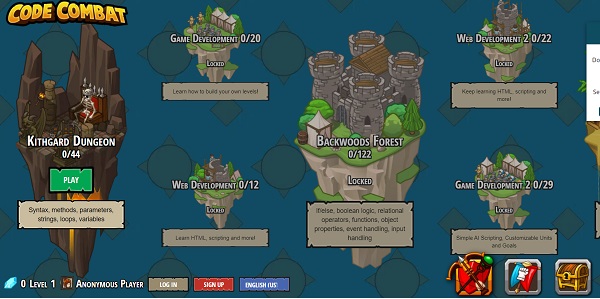
Your child can play in Code Combat for free with a class code from his teacher, or he can play as an individual. This game has several levels; you have to be proficient in one level before moving on to the next one. The first level, Kithgard Dungeon, teaches syntax, methods, parameters, strings, loops, and variables.

Code Combat is for ages 9 to 16. Kids can play alone or with others. Like Tynker, this is a popular site. It is used in 190 countries with 20 million kids!

Code Monster

This intuitive program helps teach your child Javascript. Perfect for ages 8 to 12, simply click on the monster to get instructions. The monster teaches your child coding through a variety of actions such as increasing the numbers in a code to see what happens next.

A nice feature of Code Monster is that you only need internet connection to load the website. After that, you can use it completely offline.

Final Thoughts

If your child wants to learn more about coding, encourage her! Then, help her get started with some of these free games to teach kids about coding. She may find a fun hobby, or she may have a passion that develops into a career like web design, computer programmer, or computer systems engineer. The demand for these jobs is expected to increase in the future, which makes coding an excellent skill to learn.

Read More

Free Apps that Help Kids Manage Their Pocket Money

Where to Get Free Cloth Diapers for Low-Income Families

Free Chore Chart Template for Kids

Free Printable Kids Money for Download

Melissa Batai
Melissa Batai

Melissa is a writer and virtual assistant. She earned her Master’s from Southern Illinois University, and her Bachelor’s in English from the University of Michigan. When she’s not working, you can find her homeschooling her kids, reading a good book, or cooking. She resides in Arizona where she dislikes the summer heat but loves the natural beauty of the area.
Filed Under: Money and Finances Tagged With: coding, computer science, free, free games, Games

Save Money on Entertainment with Reciprocal Museum Passes

November 25, 2021 | Leave a Comment

Save Money with Reciprocal Museum Passes

Recently, I took my children to our local art museum. It was the first time we went, and we enjoyed it. Buying a yearly pass was twice the cost of one-day admission, so we decided to upgrade. We knew we would be back, so the passes will pay for themselves after our next visit. But then, I found out the passes offer us reciprocal admission to many museums around the country! Those passes will save us a lot of money and give us an affordable entertainment option throughout the year.

What Museum Associations Offer Reciprocal Passes?

The museum we bought the yearly passes for is part of the North American Reciprocal Museum Association (NARM). There are over 1,175 museums in this network, all of which we have free access to with our museum pass. These museums are in the United States, Canada, Bermuda, El Salvador, and Mexico. In our state alone, there are 12 museums to which we will have access.

NARM is just one of many museum networks. You can also choose from the following organizations:

Art Museum Reciprocal Network (AMRN),

Association of Science and Technology Centers (ASTC) Travel Passport

Time Travelers (This pass offers free entry to some participating museums, but others only offer discounted entry with the pass.)

Smithsonian Affiliates, (Note that not all museums on this list choose to participate in the reciprocal agreement. While there are seven museums on this list in my state, only one participates in the reciprocal agreement.)

American Horticultural Society (AHS),

Association of Zoos and Aquariums (AZA), (Membership gives you 50% off at most zoos and aquariums on their reciprocal agreement.)

Reciprocal Organization of Associated Museums (ROAM),

Association of Children’s Museums (ACM), (Membership gives you 50% off the 200 children’s museums in the reciprocal agreement.)

Museum Alliance Reciprocal Program (MARP)

How to Save Money with Reciprocal Museum Passes

If you want to get the most for your money, choose the reciprocal program your family will use most frequently.

As mentioned above, read the fine details. Some reciprocal programs get you free admission to any of the participating programs. Others only offer discounted admission. Some have many participating museums in your state, others only have a few.

If you’re planning on taking a vacation during the year, check which programs have museums you’d be interested in visiting during your trip. Using a reciprocal pass can be an excellent way to reduce your vacation costs.

If You Can’t Afford a Museum Pass

Save Money with Reciprocal Museum Passes
Photo by Caroline Hernandez on Unsplash

Buying a season pass to just one museum in one of these reciprocal associations can make visiting museums throughout the year extremely affordable. However, some people cannot afford a season pass to even one museum. For those individuals, consider the Museum for All program.

Museums for All offers SNAP (Supplemental Nutrition Assistance Program) recipients free or discounted admission to 700 museums throughout the United States. Where I live, if I go to a local science museum with my three kids, I will pay $30 for admission. However, a SNAP recipient will just pay $12 for her and her three kids to enter, so the savings can be significant.

Final Thoughts

I hope these strategies help you save money on entertainment with reciprocal museum passes. We’re excited we’ll be able to visit our local museum several times this year AND visit other museums in our state that are part of the same group.

Read More

Save Money and Keep Kids Entertained By Rotating Streaming Services

Cheap, Fun Ways to Stay Cool This Summer

Ways to Whittle Down the Cost of Raising a Child

Melissa Batai
Melissa Batai

Melissa is a writer and virtual assistant. She earned her Master’s from Southern Illinois University, and her Bachelor’s in English from the University of Michigan. When she’s not working, you can find her homeschooling her kids, reading a good book, or cooking. She resides in Arizona where she dislikes the summer heat but loves the natural beauty of the area.

Filed Under: Family Time, Money and Finances, Stuff to Do Tagged With: entertaining kids, Entertainment, Frugal, Museum

5 Ways to Buy Legos at a Discount

October 21, 2021 | Leave a Comment

Buy Legos at a Discount

A few years ago, my daughter began a Lego obsession.  She asked for Lego Friends sets for her birthday, and she was surprisingly quick at putting the sets together.  Not long after, she advanced to Lego sets for teens like Lego Architecture sets with hundreds of pieces.  If your child is a fellow Lego enthusiast, I don’t need to tell you how quickly the prices for these sets add up.  Luckily, there are several ways to buy Legos at a discount.

How to Buy Legos at a Discount

You can buy Legos at a discount, but you have to be patient and use one or more of these methods.

Buy on Sale

Yes, Legos do sometimes go on sale.  Often, especially during the holiday season or when a Lego model is discontinued, you can find the sets for 20% off.  The best places to look are Target, Walmart, and Lego.com.

In addition, Lego.com sometimes offers free small Lego kits when you buy a set from them.  Last Easter my daughter got two free, small sets when she purchased a larger one.

Buy at Costco

Costco doesn’t always carry Legos, but they do during the holidays.  These sets are cheaper than you can buy them elsewhere, but they do sell out quickly.  Keep an eye out for Lego sets in October at Costco.

Join Buy Nothing Groups

Buy Legos at a Discount

If you’re not looking for a particular set but just pieces, consider joining a local Buy Nothing group.  People frequently sell large bags of miscellaneous Lego pieces at a low price.  This can be an excellent way to start a Lego collection.

Other Things to Consider

You can utilize two other strategies to lower the overall price of Lego sets.

Help Your Child Save for a Lego Set

One of my friend’s sons wanted to buy a Lego Star Wars Millennium Falcon kit.  These retail for about $130.  My friend didn’t want to spend that much on one set, so she made a deal with her eight-year-old son.  If he saved $65 for the set, she would chip in the other $65.  She was impressed with how hard he worked and how much he saved to afford the set.

If your child wants an expensive set and you have the money to split the cost with him, this agreement can be an excellent way to teach your child how to save.

Can Sell to Recoup Money

Remember, your child won’t always want to build Legos.  When she is 16, she may have outgrown Legos.  If she has kept all the pieces to her sets as well as kept the boxes in good condition, she should be able to sell the sets and recoup some of her money, unlike many other toys.

Final Thoughts

If your child wants some expensive Lego sets, try utilizing some of these strategies to save money.  But remember, start your search earlier.  You’ll likely need some time to buy the Lego set at a discount.  You’ll need to search the sales and perhaps offer your child a money matching proposition to be able to afford the larger sets.

Read More

5 Toys That Won’t Break the Bank

My #1 Brand of Choice for Long-Lasting Toys for Toddlers

My Favorite Toys for Kids Under 5 Years

Melissa Batai
Melissa Batai

Melissa is a writer and virtual assistant. She earned her Master’s from Southern Illinois University, and her Bachelor’s in English from the University of Michigan. When she’s not working, you can find her homeschooling her kids, reading a good book, or cooking. She resides in Arizona where she dislikes the summer heat but loves the natural beauty of the area.

Filed Under: holidays, Money and Finances Tagged With: Christmas, Holidays, legos, Saving Money, Toys

Save Money & Keep Kids Entertained by Rotating Streaming Services

September 23, 2021 | Leave a Comment

Rotating Streaming Services

If you’re a parent, you probably feel like your life is constantly juggling between caring for your family and working to make ends meet. It’s easy when it comes to entertainment because the options are endless, but this can add up in cost quickly. So if you want to save money and keep kids entertained at the same time, you can try rotating streaming services. With a variety of movies and TV shows, you’ll have something new every week without going over budget!

The Benefits of Rotating Streaming Services

Rotating streaming services offers three main benefits.

Save Money

If you have several streaming services, the costs can add up quickly. In our family, Netflix is approximately $15 a month, Hulu is $7 a month, Disney+ is $8 a month, and Peacock is $5 a month. Sure, each service is not unreasonably priced, but together, they add up to $35 a month. Keep in mind, we get the most basic of the basic services. If you want to pay more to avoid commercials or bundle streaming services, you’ll pay more.

Recently, we cut Netflix and Peacock, so our monthly streaming costs went down to $15 a month. The $20 savings doesn’t sound like a lot, but over the year, we’re saving $240.

Limit Boredom

How is this for irony? When my kids had all four streaming services, they constantly told me there was nothing to watch. Then, I cut Netflix and Peacock about four months ago. They dug around Hulu and Disney+ and found shows to watch. They were happy for about three months.

Once they started complaining, I cut Hulu and reinstated Netflix. They were so excited because during the time we weren’t paying for Netflix, several new seasons of their favorite episodes had dropped. Now, they are happily watching their favorite shows in the evening. However, my daughter is already planning when we should cut Netflix again and reinstate Hulu.

Maximize Your Usage

Rotate Streaming Services

When you have many streaming services, your kids can just gloss over what’s available. Because they have so many choices, sometimes they feel overwhelmed. I know as an adult, I used to feel overwhelmed by 200 cable channels when we had cable. Because there’s so much available, you don’t know where to start.

When you limit streaming services to two as we did, your kids have to dig deeper into each service to find shows they want to watch. This allows them to maximize what they get out of each streaming service.

Then, when it’s time to rotate, they can dig through the next streaming service. My kids have found shows they enjoy that they never would have tried if they continued to have so many streaming services available.

Final Thoughts

Streaming services are a luxury. Because each one is affordable, many people buy several streaming services at once. However, limiting and rotating streaming services can be better for your wallet and your kids. You limit their boredom, and they can maximize each streaming service. If you haven’t tried rotating streaming services yet, I highly recommend it.

Read More

Ways to Whittle Down the Cost of Raising a Child

Self-Isolation Into Family Bonding: 5 Awesome Activities for Bored Boys

Paying for Extracurriculars without Breaking the Bank

Melissa Batai
Melissa Batai

Melissa is a writer and virtual assistant. She earned her Master’s from Southern Illinois University, and her Bachelor’s in English from the University of Michigan. When she’s not working, you can find her homeschooling her kids, reading a good book, or cooking. She resides in Arizona where she dislikes the summer heat but loves the natural beauty of the area.

Filed Under: Money and Finances, Parenting Blog at KidsAintCheap Tagged With: DisneyPlus, Entertainment, Frugal, Netflix

Can You Refinance Student Loans? Yes. Here’s How…

August 13, 2021 | Leave a Comment


Are you feeling financially overwhelmed? Do you worry that you may not have the money you need to take care of your monthly expenses? 

If you are having these thoughts, you may want to consider refinancing. [Read more…]

Filed Under: KACURP, Money and Finances

How Much Does Unschooling Cost?

August 12, 2021 | Leave a Comment

Unschooling Costs

Homeschooling can take many different forms, from essentially recreating school at home by using workbooks and taking multiple tests to a Charlotte Mason method where children derive their education largely through reading living books. There is also the Classical Education philosophy based on learning the classics like Greek and Roman history and language. However, perhaps the most misunderstood homeschool philosophy is unschooling. While detractors say unschooling isn’t really schooling at all, unschoolers see it as a viable educational form. If you’re interested in unschooling, you first must understand what the philosophy is and how much unschooling costs.

What Is Unschooling

Unschooling is an educational philosophy. Unschoolers don’t typically have their children take standardized tests or any other test. They don’t use textbooks or follow a set curriculum. Instead, the child determines what he would like to study based on his interests.

Cooking, gardening, and raising animals can all be part of the school day for an unschooler. Unschoolers also may code a robot, research the Titanic, do a science experiment, or record a new YouTube video all in the name of school. The idea is that unschoolers will learn more deeply because they’re working on things that interest them and that they choose to pursue. Hopefully, this helps the child become a lifelong learner.

However, critics argue that unschooling does not lead to a well-rounded education necessary for adult life. If an unschooler is not interested in math, she may not study it, which could cause problems in adulthood. Similarly, one who is interested in science may not study writing because she’s not particularly strong in that area.

How Much Does Unschooling Cost?

Unschooling costs can vary widely depending on the amount of money the parent has to dedicate to unschooling and the child’s interests.

Ways to Unschool for Free

If you don’t have much money to dedicate to unschooling, that’s okay! You can still give your child a stellar education. Consider these opportunities:

The Library

The library offers many educational items for your child from library books to movies to foreign language learning programs. In addition, most libraries offer regular learning programs such as wildlife experts who bring animals to the library or scientists who teach astronomy. Most libraries also offer activities like chess club and teen time that your child can join.

The Outdoors

Unschooling Costs
Photo by David Clode on Unsplash

One of the greatest classrooms is the great outdoors. Give your child ample time to hike and take nature walks. Some children enjoy keeping a nature journal. They can search for animals, observe the seasonal changes, watch birds. . .the possibilities are endless.

The Internet

There are some high-quality educational services on the Internet.

EdX

EdX offers free online college classes from 160 universities including Harvard, MIT, Boston University, and the University of California, Berkeley, to name a few. You can study architecture, math, literature, engineering, food and nutrition, and many more subjects with some of the greatest minds in the United States.

YouTube

If you think of YouTube as a place to waste time, think again. You can find tutorials and even educational lessons. My daughter and I are studying Japanese, in part through YouTube lessons that we find.

If You Have Money to Spend

If you have more money to spend on unschooling, you can take advantage of other academic resources.

Camps

Educational camps offer your child a unique way to learn. There are science camps, sports camps, liberal arts/reading camps. You can find what you need for your child if you have the money to pay for it.

Subscriptions

Likewise, you can also take advantage of subscription services to help your child in her educational endeavors.

Magazine Subscriptions

Magazine subscriptions from National Geographic to LEGO Magazine to Architectural Digest may feed your child’s desire to learn more about their current unschooling interests.

Box Subscriptions

Likewise, box subscriptions can also help spark your child’s creativity. Some of the most popular educational subscription boxes include Kiwi Crate for science and art, Atlas Crate for geography and culture, Tinker Crate for science and engineering, and Eureka Crate for engineering and design.

If your child is more creative, there are I Create Art boxes for budding artists. Young chefs may enjoy Eat2Explore cooking boxes.

For most interests a child can have, you can find a subscription box.

Tools & Learning Aids

If you have a budding scientist, and you can afford to buy a student microscope, your child can spend time creating slides and looking under the microscope.

How Much Does Unschooling Cost?
Photo by Simon Delalande on Unsplash

You might buy a telescope for a child who is interested in astronomy or ample art supplies for a student who is interested in art.

A child who is interested in chemistry might benefit from a chemistry science kit. A history buff may want to take field trips to historic sites and museums to learn more.

If Money Is Available but Limited

Most of us aren’t independently wealthy. If you have some money to spend on your child’s education, but that money is limited, consider handing over control to your child. Let’s say you have $3,000 a year to spend on your child’s education. You can give your child $750 per quarter. Then, she can decide how to spend the money on her education each month.

If you feel comfortable letting her have this control, you are embracing the philosophy of unschooling as a child-lead schooling option. Plus, just letting her choose what to buy and deciding if the items were worth the money is an educational experience in itself. She’ll also learn how to budget the money. If she wants to attend an expensive camp in the summer, she’ll need to save the money from previous quarters to afford the camp.

Final Thoughts

Unschooling is a controversial form of homeschooling, but many unschoolers have gone on to be successful adults. If you opt for this form of homeschooling, know that unschooling costs as little or as much as you want it to.

Read More

What You Need to Know to Homeschool Your Child in the Age of Covid-19

How to Choose the Right Homeschooling Curriculum for Your Star Student

Where to Find Food If Your Children Are Going Hungry

What to Do if You Forgot to Cancel a Trial Subscription

Melissa Batai
Melissa Batai

Melissa is a writer and virtual assistant. She earned her Master’s from Southern Illinois University, and her Bachelor’s in English from the University of Michigan. When she’s not working, you can find her homeschooling her kids, reading a good book, or cooking. She resides in Arizona where she dislikes the summer heat but loves the natural beauty of the area.

Filed Under: Education, Money and Finances Tagged With: education, Homeschool, money, unschool

Where to Find Food If Your Children Are Going Hungry

July 22, 2021 | Leave a Comment

Find Food If Your Child Is Hungry

More than 10 million children a year go hungry in the United States. These hungry children have trouble focusing in school, which puts them at an academic disadvantage. In addition, summer is often a difficult time for them because they don’t get regular meals from the schools as they do during the school year. During the pandemic, more children struggled to get an adequate amount of food. If this is a problem your family is facing, several agencies can help you find food if your children are going hungry.

Where to Find Food If Your Children Are Going Hungry

Many different agencies offer programs that can help your children if you know where to look.

Local Food Bank

If you’re experiencing a temporary food shortage, consider visiting your local food bank. You should receive enough food for a week or two, which should be enough to get you by until your next paycheck. However, if you are facing long-term food scarcity, consider some of these other programs.

Supplemental Nutrition Assistance Program (SNAP)

The SNAP program (formerly food stamps) has rigid qualification requirements. Namely, your income cannot be more than 130% of the poverty level and your assets need to be limited. However, if you qualify, you can receive several hundred dollars a month to buy food, depending on your family size.

Special Supplemental Nutrition Program for Women, Infants, and Children (WIC)

The WIC program provides supplemental food to pregnant and nursing women as well as their children ages five and under. To qualify for WIC, you must meet several qualifications. However, you’re automatically qualified if you already receive SNAP benefits or if you’re on Medicaid.

National School Lunch Program (NSLP)

Find Food If Your Children Are Hungry
Young woman serving lunch to school girl at canteen

There are two tiers to qualify for the NSLP. If your family income is under 130% of the poverty level, your child qualifies for free school lunches. If your family income is between 130% and 185% of the poverty level, your child qualifies for reduced-price school lunches.

Summer Food Service Program

During the summer, your children can receive free food to make up for the food they are not receiving because school isn’t in session. The summer food service program requires no documentation of eligibility. You can call, text, or contact your local food bank to find locations distributing food during the summer.

Backpack Program

The Backpack Program fills the need for food on the weekend when kids aren’t getting free school meals. This food bank locator can help connect you with a local food bank that may be participating in the Backpack Program.

Final Thoughts

No child should go hungry. These programs can help ensure your children get enough food so they can grow strong and focus on their school work. In addition, if your money is stretched tight, these programs offer a bit of leeway so you can focus on other expenses such as housing and utility expenses.

Read More

Where to Get Free Cloth Diapers for Low-Income Families

Free Diapers for Low-Income Families

13 Healthy Snack Ideas for Kids (Help Them to Avoid the Snack Machine)

Cheap, Fun Ways to Stay Cool This Summer

Melissa Batai
Melissa Batai

Melissa is a writer and virtual assistant. She earned her Master’s from Southern Illinois University, and her Bachelor’s in English from the University of Michigan. When she’s not working, you can find her homeschooling her kids, reading a good book, or cooking. She resides in Arizona where she dislikes the summer heat but loves the natural beauty of the area.

Filed Under: Money and Finances, Parenting Tagged With: Food, save money on food, school lunches, SNAP, WIC

« Previous Page
Next Page »
  • Facebook
  • Pinterest
  • RSS
  • Twitter
Best Parenting Blogs

Most Popular

Baby

10 Baby Names That Were Once Considered “Grandparent Names” but Feel Cool Again

Evan Morgan
Baby

9 Baby Names Inspired by Fall Without Naming Your Child Autumn

Evan Morgan
Baby

9 Baby Names That Sound Expensive Even Though Naming Your Baby Is Still Free

Evan Morgan
Baby names

Teachers Admit: These 6 Baby Names Create Instant Bias in the Classroom

Latrice Perez
6 Baby Names That Sound Cute Now but Cause Problems Later

6 Baby Names That Sound Cute Now but Cause Problems Later

Brandon Marcus

All content on Kids Ain’t Cheap is for entertainment purposes only. By reading this blog, you agree that Kids Ain’t Cheap is not responsible for any actions taken after reading this blog. For the full disclaimer, see our privacy policy.

Please note that Kids Ain’t Cheap has financial relationships with some of the merchants mentioned here. Kids Ain’t Cheap is funded by banner advertising, commission sales and search optimization consulting.

Copyright © 2006–2026 | District Media | All Rights Reserved | Privacy Policy

Copyright © 2026 Runway Pro Theme by Viva la Violette