
• Home
  • About Us
  • Toolkit
  • Archives
  • Advertise
  • Privacy Policy

Kids Ain't Cheap

But They Sure Are Worth It

  • Parenting
    • Baby Stuff
    • Books and Reading
      • Aesops Fables
      • Comic Books
    • Education
    • Family Time
    • Green Living
    • Growing Up
    • Healthy Living & Eating
    • Holidays
    • Parenting
    • Random Musings
    • Shopping
    • Stuff to Do
  • Money
  • Product Reviews
    • Books and Magazines
    • Discount Sites
    • Furniture
    • House Keeping
    • Reviews News
    • Toys and Games
  • Contact Us
  • Our Editorial Commitment
  • Search

The $1,000 School Trip Question: When Should Parents Just Say No?

August 22, 2026 | Leave a Comment

Young students in uniforms boarding a white bus for a school trip
A $1,000 school trip can offer a memorable educational experience, but parents should consider the full cost, available financial assistance, and their household budget before signing the permission slip. Saying no may be the responsible choice when attending would require debt or jeopardize essential expenses. (Pexels).

A permission slip lands on the kitchen counter, and suddenly a parent is staring at a four-figure decision: Is a $1,000 school trip worth it? For many families, the answer is complicated because educational travel can offer memorable learning experiences while also putting serious pressure on a household budget. That pressure is especially relevant in 2026, when 37% of parents surveyed by NerdWallet said their children would likely miss at least one school activity because of cost. An expensive school trip may sound like a once-in-a-lifetime opportunity, but parents should not feel obligated to sacrifice financial stability to make it happen. Before saying yes, families need to separate the educational value from the fear that their child will be left out.

Start With What The Trip Actually Offers

Before paying for an expensive school trip, ask the school exactly what students will learn and experience that they cannot reasonably get closer to home. Educational trips can have real value, with research highlighted by Edutopia linking culturally enriching field trips to improved academic and behavioral outcomes. However, an overnight trip costing $1,000 should offer considerably more than sightseeing, restaurant meals, and time with friends. Ask for the itinerary, planned educational activities, supervision details, transportation arrangements, and a breakdown of what the fee covers. If the educational purpose sounds vague after those questions are answered, saying no becomes much easier to justify.

Decide Whether $1,000 Is Really $1,000

The advertised price may not represent the final cost of an expensive school trip, especially when families must separately pay for meals, luggage, spending money, clothing, insurance, or transportation to a departure point. A real-world example shows how quickly costs can climb: documents for one Massachusetts eighth-grade trip reported families paying $1,564 per student plus $160 for insurance during the 2024-2025 school year. Parents should therefore ask for a complete list of expected expenses before making a deposit. A trip advertised at $1,000 could realistically require another $100 or $200 once extras are included. Building a small cushion into the calculation prevents an exciting opportunity from turning into an unpleasant financial surprise.

Do Not Put The Trip On A Credit Card Without A Payoff Plan

A school trip becomes much harder to defend financially if the family must carry high-interest credit card debt to pay for it. Travel-related spending is already creating problems for some households, with a 2026 K12 survey finding that 46% of parents had taken on debt or charged more than they could afford for a family summer vacation. Although a school trip is different from a vacation, the budgeting principle is similar: memories should not create months of financial stress. If paying $1,000 means missing bills, draining emergency savings, or carrying a balance with no realistic repayment date, that is a strong reason to decline. Parents can acknowledge their child’s disappointment while explaining that protecting the family’s essential expenses comes first.

Ask About Financial Help Before Saying No

Before automatically rejecting an expensive school trip, parents should ask whether scholarships, fundraising opportunities, installment plans, or financial assistance are available. Some educational travel programs specifically provide scholarships, and Edutopia highlighted a high school study-abroad initiative that helped more than 100 students obtain over $300,000 in scholarships during the past decade. Families can ask the teacher or administrator privately whether the school has hardship funds or whether local organizations help cover student travel expenses. Payment plans may also turn a $1,000 lump sum into manageable monthly payments, although parents should confirm whether deposits are refundable. Asking about assistance is not embarrassing; it is a practical step before deciding an opportunity is unaffordable.

Consider What Saying No Actually Means

Parents often worry that declining a trip will leave their child socially isolated or permanently deprived of an important experience. That concern deserves consideration, particularly when most classmates are attending, but it should not automatically override financial reality. An expensive school trip is still optional if students can meet academic requirements without participating, so ask the school what alternative activities will be provided. Parents can also discuss the decision honestly in age-appropriate terms rather than simply saying, “We can’t afford it,” and ending the conversation. A teenager may be disappointed, but understanding how families weigh wants, opportunities, and financial limits can itself become a valuable lesson.

The Best Answer Protects Both Opportunity And Stability

There is nothing wrong with paying $1,000 for a genuinely valuable experience when the family can comfortably afford it, and there is equally nothing irresponsible about saying no. The best decision considers educational value, total costs, financial assistance, household priorities, and the consequences of taking on debt. Parents should ask questions rather than allowing urgency, guilt, or fear of their child missing out to make the decision for them. Sometimes the answer will be yes, while other families may decide that financial stability is worth more than one memorable weekend away.

Would you pay $1,000 for your child’s school trip, or is there a price where you would simply say no? Share your thoughts and experiences in the comments.

What to Read Next

5 School Field Trip Threads That Expose Emotional Trauma Risks

The Hidden Costs of After-School Care for Kids With Special Needs

When Parents Should Put a School-Lunch Accommodation Request in Writing

Evan Morgan

Evan Morgan has been a full-time freelance writer and editor for 10+ years. When not working, he enjoys catching the latest true crime documentary or getting lost in a good book.


Filed Under: Parenting Tagged With: Back to School, budgeting, education, family finances, Parenting, parenting decisions, Saving Money, school expenses, school trips, student travel

6 Money Rules Every Family Should Set Before a Teen Starts Driving

August 22, 2026 | Leave a Comment

Teen boy driving a car while his mother sits in the passenger seat
Before a teenager gets the keys, families should decide how insurance, gas, maintenance, deductibles, and driving-related expenses will be handled. Setting clear money rules early can make driving a practical lesson in financial responsibility. (Pexels).

Handing a teenager the car keys is a major milestone, but it can also reshape the family budget almost overnight. Insurance, gasoline, maintenance, parking, repairs, and unexpected mishaps mean teen driving costs can reach far beyond the price of the vehicle itself. Experian reported that adding a teenager to an auto policy increased premiums by an average of $3,512 annually based on its 2025 data. Families can avoid many arguments by deciding who pays for what before the teen begins driving independently. These six money rules can help parents teach financial responsibility while keeping transportation expenses manageable.

1. Decide Who Pays The Insurance Increase

Before a teen gets regular access to the family car, parents should find out exactly how much insurance will increase. Teen drivers generally cost more to insure because their limited experience creates greater accident risk, and adding them to an existing family policy is typically cheaper than purchasing a separate policy. Families should decide whether parents will absorb the increase, the teen will contribute, or both will split the bill. A teen with a part-time job might contribute $50 or $100 monthly rather than being expected to cover the entire premium. Making insurance part of teen driving costs helps young drivers understand that having access to a car carries ongoing financial obligations.

2. Set A Clear Rule For Gas Money

Gas can quietly become one of the biggest recurring teen driving costs, particularly when school, work, sports, and social trips pile up. AAA’s 2025 driving-cost analysis estimated fuel at about 13 cents per mile, although actual costs depend heavily on the vehicle and local gasoline prices. Parents might pay for fuel used for school and family errands while requiring teens to cover gas for recreational trips. Another option is giving the teen a fixed monthly fuel allowance, such as $75, with anything beyond that coming from their own earnings. Either approach encourages teenagers to think about whether an unnecessary 30-mile round trip is worth the expense.

3. Agree On Maintenance Responsibilities

Oil changes, tires, batteries, brakes, and routine servicing should be discussed before the first warning light appears. AAA estimated maintenance, repairs, and tires for vehicles in its 2025 study at roughly 11 cents per mile, showing why these expenses deserve their own place in the family budget. Parents who own the vehicle may reasonably handle major repairs while asking their teen to contribute toward routine maintenance. For example, a teenager could save $20 from each paycheck in a dedicated car fund rather than scrambling when a tire needs replacing. Building maintenance into teen driving costs also teaches an important lesson: owning or using a car requires planning beyond filling the tank.

4. Establish Who Pays The Deductible After An Accident

Families should discuss accidents before one happens because deciding responsibility while everyone is upset rarely produces the best financial decisions. An insurance deductible is the amount the policyholder must pay toward a covered claim before the insurer pays the remaining eligible costs, and choosing a higher deductible can reduce premiums while increasing potential out-of-pocket expenses. Parents might agree to cover the deductible for an unavoidable incident but require some contribution if reckless behavior or a broken family driving rule contributed to the crash. Whatever the arrangement, the amount should be realistic enough that a teenager can actually pay it without creating months of financial hardship. Clear expectations make the consequences understandable without turning an accident into an improvised punishment.

5. Make Tickets And Parking Costs The Teen’s Responsibility

Traffic tickets, school parking permits, tolls, and parking fees can quickly inflate teen driving costs if nobody has decided who pays them. A straightforward rule is that parents cover necessary family transportation expenses while teenagers pay costs created by their personal choices. If a teen receives a speeding or parking ticket, paying it from wages or savings connects the behavior directly with its financial consequence. Parents should also explain that driving violations can have longer-term implications, including potentially affecting insurance costs. The purpose is not to make driving financially intimidating but to show that convenience and independence come with accountability.

6. Create A Monthly Driving Budget Together

Instead of discussing each expense only when money is needed, families can create one simple monthly driving budget. List expected insurance contributions, gas, maintenance savings, tolls, parking, and any car payment, then decide which expenses belong to the teen. Families should also ask insurers about available discounts because some companies offer savings for good students, safe-driving programs, or other qualifying circumstances. Reviewing the budget every three months gives parents and teens an opportunity to adjust it as mileage, employment, or insurance expenses change. Most importantly, budgeting turns teen driving costs into a practical financial lesson rather than a recurring source of family conflict.

The Keys Should Come With A Financial Plan

Learning to drive gives teenagers independence, but learning to pay for some of that independence can be just as valuable. Families do not need to make teens shoulder every expense, especially when school or extracurricular commitments limit their ability to work. What matters is establishing expectations about insurance, gas, maintenance, deductibles, tickets, and monthly spending before disagreements occur. A written agreement can make those expectations easier to remember and revisit as circumstances change.

What driving expenses do you think teenagers should be responsible for, and which should parents continue covering? Share your thoughts and experiences in the comments.

What to Read Next

8 Things You Should NEVER Let Your Children Do While You’re Driving

10 Reasons Why Teenagers Need Driving Restrictions

How Much Should a Teen Contribute Toward Their First Car?

Evan Morgan

Evan Morgan has been a full-time freelance writer and editor for 10+ years. When not working, he enjoys catching the latest true crime documentary or getting lost in a good book.

Filed Under: Parenting Tagged With: budgeting, car insurance, Family Budgeting, family finances, financial responsibility, money rules, parenting teens, teen drivers, teen driving, teen driving costs

Should Parents Charge Adult Kids Rent When They Move Back Home?

August 21, 2026 | Leave a Comment

Cozy bedroom with a gray bedspread, orange pillows, and houseplants
As more adult children live with their parents, families are deciding whether charging rent can protect household finances while helping young adults build independence. A clear plan for rent, savings, expenses, and a move-out goal can help both generations know what to expect. (Unsplash).

Moving back home as an adult is no longer unusual. In 2023, 18% of Americans ages 25 to 34 lived in a parent’s home, according to Pew Research Center, and housing costs, job changes, student debt, divorce, and saving for a home can all make returning to the family home financially attractive. For parents, however, opening the door raises an uncomfortable question: Should you charge your adult child rent or give them a financial break? There is no universal dollar amount that works for every household, but there is a useful rule: The arrangement should improve the adult child’s financial position without damaging the parents’ financial security. Done thoughtfully, rent can create structure and independence without turning Mom and Dad into landlords.

Charging Rent Can Protect the Parents’ Finances

Before deciding that living at home will be free, calculate what another adult actually adds to groceries, utilities, transportation, insurance, subscriptions, and other household expenses. That is particularly important for parents approaching retirement, when there may be fewer working years available to replenish money spent supporting an adult child. A Bankrate survey of parents with adult children found 61% had made financial sacrifices to help their children, including 43% who sacrificed emergency savings, 41% who delayed paying down debt, and 37% who sacrificed retirement savings. If an employed 28-year-old is living rent-free while a 60-year-old parent reduces retirement contributions to cover the increased household costs, the arrangement deserves another look. Parents should establish what they can genuinely afford to contribute before deciding what their adult child should pay.

Rent Should Have a Purpose, Not Just a Price

Charging $500 because “$500 sounds fair” misses an important opportunity to decide what the living arrangement is supposed to accomplish. Is the adult child trying to eliminate $15,000 in credit-card debt, accumulate a $20,000 apartment or home fund, recover financially after divorce, or simply find cheaper housing indefinitely? A 26-year-old earning $3,500 a month might, for example, pay $500 toward household costs while automatically saving another $700 toward moving out. Pew found that financial contributions are already normal among young adults living with parents: 72% contribute financially in some way, including 65% who help with household expenses and 46% who contribute toward rent or the mortgage. A good rent arrangement should therefore answer two questions at once: What is fair to the parents, and how is this helping the adult child become more financially independent?

Sometimes Charging No Rent Is the Smarter Choice

There are circumstances when charging rent can actually slow the goal everyone is trying to achieve. Suppose your daughter can afford $800 a month, but she has $8,000 of high-interest credit-card debt and agrees to put that entire $800 toward the balance while living at home. Giving her a temporary rent-free window could potentially get her out of expensive debt faster than collecting household rent and leaving the card balance lingering. Pew found that 64% of young adults living with parents said doing so had a positive impact on their personal finances, suggesting that moving home can genuinely function as a financial reset. The key word is temporary: “Stay here free until you get back on your feet” is vague, while “Stay rent-free for six months while paying $800 monthly toward your credit card” creates a measurable plan.

Use a Simple Test to Decide What the Rent Should Be

Instead of automatically using the local market rent for a bedroom, start with the parents’ actual financial situation. Calculate the additional household costs created by another adult, determine whether the parents need a contribution to avoid subsidizing those expenses, and then consider the child’s income and financial objective. For example, parents spending an additional $350 a month because their son moved home might charge $400 or $500 rather than the $1,200 he would pay for an apartment, leaving him significant room to save while preventing his parents from absorbing the expense. Alternatively, financially secure parents might charge more and secretly save some of the rent to return later, although that strategy should not replace teaching the child to save independently. The right amount is not necessarily the highest amount the parents could charge; it is an amount that protects both generations while supporting the purpose of the move.

Don’t Let Helping Your Child Delay Your Own Retirement

This deserves more emphasis than the original draft gives it because parents can recover from many financial decisions more easily than they can recover lost retirement years. A 30-year-old moving home potentially has decades of earnings ahead, while parents in their late 50s or 60s may be approaching the end of their highest-earning years. Fidelity’s 2026 guidance for parents with adult children living at home specifically recommends understanding your own income, expenses, and retirement needs before deciding how much support you can provide. Parents should be especially cautious if supporting an adult child requires withdrawing from retirement accounts, stopping retirement contributions, carrying credit-card balances, draining emergency savings, or postponing debts they need to eliminate before retiring. Generosity makes considerably less financial sense when Mom and Dad may eventually need financial assistance from the same children they are supporting today.

What If Your Adult Child Can Afford Rent but Doesn’t Want to Pay It?

An employed adult living at home indefinitely presents a different situation from someone recovering from a layoff or trying to escape high-interest debt. If your child has enough disposable income for frequent travel, restaurant meals, expensive electronics, or a new vehicle but says contributing to household expenses is unaffordable, the disagreement may be about priorities rather than income. Parents do not have to subsidize discretionary spending simply because their child would rather use earnings elsewhere. A reasonable household contribution can help recreate one financial reality of independent adulthood: housing and utilities have to be paid before entertainment and lifestyle upgrades. That does not require charging market rent, but it does require both generations to agree that living at home is financial assistance rather than an unlimited entitlement.

Put the Agreement in Writing Before the Moving Boxes Arrive

Money is only one source of friction when an adult child returns home, so establish the entire arrangement beforehand. Fidelity recommends setting clear financial and nonfinancial expectations, including household contributions, chores, meals, savings goals, and how long the arrangement is expected to last. A simple agreement could say the child pays $500 on the first of every month, saves at least $750 monthly, buys groceries twice a month, handles certain chores, and sits down with the parents after six months to review progress. Privacy deserves similar clarity because an adult returning home should not automatically become the 16-year-old who once occupied the same bedroom. Discuss guests, overnight visitors, shared spaces, food, parking, chores, quiet hours, pets, and other predictable sources of conflict before everyone is irritated by them.

Add an Exit Goal, Not Just an Exit Date

“You’re moving out in one year” sounds clear, but financial milestones can make the arrangement more productive. A child might agree to move when she has eliminated $10,000 of debt and accumulated a $6,000 emergency fund, or when she has saved enough for a security deposit, moving expenses, and three months of basic expenses. Parents and adult children can then review progress every few months rather than waiting until month 11 to discover that little has changed. If circumstances change because of unemployment, illness, or another legitimate setback, the plan can change too. The goal is not to rush someone out of the house; it is to prevent temporary assistance from drifting into permanent dependence without anyone consciously choosing it.

Consider the “Rent Now, Gift Later” Strategy Carefully

Some parents choose to charge rent and quietly save the money, intending to return it when their child buys a home or moves out. Fidelity describes exactly this type of strategy in its discussion of adult children returning home, although the family featured ultimately chose another approach. It can create a useful forced-savings windfall, but there is also an argument for telling the adult child to build those savings personally so they learn to manage the money themselves. Parents who intend to return a significant amount should also consider whether there could be tax or estate-planning implications based on the amount and circumstances. Either approach can work, but it should fit the larger objective rather than becoming another financial secret between parents and their adult child.

The Best Arrangement Should Leave Both Generations Better Off

There is no universal answer to whether parents should charge adult kids rent because a struggling 22-year-old graduate, a 29-year-old saving for a first home, and an employed 38-year-old moving home indefinitely present very different situations. What matters is whether the arrangement protects the parents’ emergency savings and retirement while helping the child make measurable progress toward financial independence. Before anyone moves in, answer five questions: How much will the child contribute, what will they save or pay down, what household responsibilities will they assume, how long is the arrangement expected to last, and what does successful moving out look like? If nobody can answer those questions, deciding whether rent should be $0, $400, or $800 is probably premature.

If your adult child moved home tomorrow, would you charge rent, offer free housing with conditions, or create another arrangement—and why?

What to Read Next

43% of Parents Would Go Into Debt to Help Their Kids Fit In — 7 Money Traps to Avoid

Youth Sports Cost Families $1,016 a Year on Average — 8 Expenses New Parents Don’t Expect

Should Kids Get Paid for Good Grades? What Parents Should Consider Before Offering Cash

Evan Morgan

Evan Morgan has been a full-time freelance writer and editor for 10+ years. When not working, he enjoys catching the latest true crime documentary or getting lost in a good book.

Filed Under: Parenting Tagged With: adult children, family finances, financial independence, living at home, money management, multigenerational households, Parenting, personal finance, rent, Retirement

8 Things Grandparents Buy Kids That Parents Secretly Wish They Wouldn’t

August 21, 2026 | Leave a Comment

Black and tan puppy lying in green grass
Grandparents may love arriving with exciting presents, but oversized toys, noisy electronics, screens, and other well-intentioned gifts can create unexpected challenges for parents. Asking before buying can help ensure the gift works for both the child and the household. (Pexels).

Grandparents often love showing affection through gifts, and watching a grandchild tear into a new present can be irresistible. But even the most generous gift can create an unexpected headache when it clashes with household rules, available space, or a child’s age. That is why gifts grandparents buy kids can sometimes leave parents smiling politely while wondering where they will put everything. A quick conversation before shopping can keep gift-giving joyful without putting parents in an awkward position.

1. Oversized Toys That Take Over The House

That enormous dollhouse, indoor slide, or ride-on truck may earn an unforgettable reaction, but parents still have to find somewhere to keep it. In a smaller home or apartment, one oversized toy can consume valuable living space. These gifts grandparents buy kids can also become frustrating when children lose interest after a few weeks. Before buying anything bulky, grandparents should ask whether the family has room for it. Better yet, offer to keep the biggest toys at Grandma and Grandpa’s house.

2. Toys That Make Nonstop Noise

Electronic drums, talking animals, toy microphones, and siren-equipped vehicles can delight children while testing everyone else’s patience. Noise is more than an annoyance when a toy is exceptionally loud. The American Academy of Pediatrics warns that prolonged exposure to noise above 70 decibels may begin damaging hearing. Parents may therefore have legitimate reasons for limiting loud toys beyond simply wanting a quieter afternoon. Grandparents can look for toys with adjustable volume or choose quieter alternatives.

3. Another Mountain Of Stuffed Animals

One cuddly bear can become a treasured bedtime companion, but the twentieth stuffed animal may simply join an overflowing pile. Plush toys occupy surprising amounts of storage space, especially when birthdays and holidays keep adding more. Parents may also feel guilty getting rid of gifts associated with grandparents. Instead of automatically buying another stuffed animal, ask whether the child has a favorite character or genuinely wants one. Thoughtful gifts grandparents buy kids do not need to add clutter to every available shelf.

4. Age-Inappropriate Toys

A grandparent may see a sophisticated building set and think a bright three-year-old will grow into it. However, age labels are about safety and developmental abilities, not intelligence, according to The Toy Association. Toys intended for older children can contain small pieces that present choking risks to younger kids. This becomes particularly important in homes where younger siblings can reach an older child’s toys. Checking the manufacturer’s age recommendation takes seconds and can prevent a well-intentioned gift from becoming a problem.

5. Tablets And Other Screen-Based Gifts

A new tablet can make a grandparent an instant hero, but parents may already have carefully established technology boundaries. Giving a connected device without asking can suddenly introduce questions about apps, online access, screen habits, and parental controls. Updated guidance from HealthyChildren.org emphasizes balancing connected technology with quality offline activities. Traditional toys can encourage conversation, creativity, problem-solving, and interaction rather than solitary screen use. Before buying expensive technology, grandparents should make this one of those gifts grandparents buy kids only with parental approval.

6. Toys With Hundreds Of Tiny Pieces

Building sets, craft kits, beads, miniature accessories, and elaborate puzzles can provide hours of entertainment. They can also scatter hundreds of pieces across bedrooms, carpets, and hallways within minutes. The problem becomes more serious when babies or toddlers share the home because small components can present choking hazards. The Toy Association specifically recommends keeping toys containing small parts away from younger children who may put objects in their mouths. Grandparents can still buy creative sets, but choosing age-appropriate versions and including a storage container makes the gift far more parent-friendly.

7. Gifts That Require Expensive Extras

Some presents quietly create future expenses that grandparents may never see. A gaming device may need subscriptions and games, while certain toys require batteries, refills, accessories, or replacement parts. Parents can end up paying considerably more to keep a supposedly free present useful. This is especially frustrating when the family is deliberately controlling discretionary spending. When considering gifts grandparents buy kids, factor in the ongoing cost and consider including essential accessories.

8. Pets Given As Surprises

A puppy, kitten, rabbit, or other animal may produce the biggest reaction of all, but a pet is a family responsibility rather than an ordinary present. Feeding, training, veterinary care, cleaning, exercise, and supervision continue long after the excitement of gift day disappears. Even an older child promising to handle everything cannot realistically assume every responsibility. Parents should always make the final decision about whether their household has the money, time, space, and commitment required for an animal. Grandparents who love the idea can instead offer a zoo trip or another animal-focused experience.

The Best Gift Respects The Whole Family

Grandparents do not have to stop spoiling their grandchildren; a little communication simply makes their generosity easier to appreciate. The best gifts grandparents buy kids fit the child’s interests while respecting the parents’ rules, space, budget, and safety concerns. Experiences can also be wonderful alternatives, including tickets, museum visits, and zoo or aquarium memberships that families can enjoy together. Asking parents for two or three ideas before shopping can preserve the surprise without creating unwanted stress.

Which grandparent gift would you secretly love to ban from your house, and where should families draw the line between generosity and parental boundaries? Share your thoughts in the comments.

What to Read Next

Choking Incident Prompts Recall of 49,000 Target Gigglescape “Under the Sea” Popping Toys

6 Budgeting Hacks from Depression Era Grandmothers

8 Reasons Your Kids Prefer Staying with Grandma—And It’s Not Just the Snacks

Evan Morgan

Evan Morgan has been a full-time freelance writer and editor for 10+ years. When not working, he enjoys catching the latest true crime documentary or getting lost in a good book.

Filed Under: Parenting Tagged With: child safety, Family, family relationships, Gift Ideas, grandchildren, grandparents, Kids, Parenting, Screen Time, Toys

Youth Sports Cost Families $1,016 a Year on Average — 8 Expenses New Parents Don’t Expect

August 20, 2026 | Leave a Comment

Two kids playing one-on-one basketball on an outdoor court
Registration is only the beginning of youth sports costs, as families may also face equipment, uniforms, travel, food, training, and medical expenses. Planning for the full season can help parents avoid costly surprises. (Pexels).

Youth sports can look surprisingly affordable when the registration page says $150 or $300. Then come the cleats, second uniform, tournament hotel, concession-stand meals, private lessons, team fundraiser, and Friday afternoon you have to leave work early for an out-of-town game. Suddenly, that registration fee looks like the smallest part of the bill. The Aspen Institute’s Project Play found that the average U.S. sports family spent $1,016 on a child’s primary sport in 2024, up 46% from 2019. These rising costs have consequences beyond individual household budgets. Project Play has warned that the increasing commercialization of youth sports affects which families can access quality opportunities, making affordability part of the larger youth-sports participation problem. For parents signing up a child for the first time, knowing where those extra costs hide can make the difference between a manageable season and months of budget surprises.

1. Equipment That Needs Constant Replacing

Buying the first pair of cleats, shin guards, gloves, or pads may feel like a one-time investment. Then children grow, shoes wear out, and equipment requirements change between seasons. Some sports also require multiple items, including practice gear, protective equipment, bags, and specialized footwear. Before buying premium equipment, ask the coach which items truly affect safety or performance and which are optional. Used equipment, equipment swaps, and previous-season models can reduce youth sports costs considerably.

2. Uniforms Go Beyond One Jersey

Row of black sports duffel bags lined up on a grass field
Registration is only the beginning of the youth sports budget, with equipment, uniforms, travel, food and training potentially adding hundreds or thousands of dollars to a season. Michael Chamberlin/Shutterstock

Many first-time parents expect a jersey but discover that the uniform package can include much more. Teams may require home and away uniforms, matching socks, warm-ups, practice shirts, jackets, or branded bags. Replacement costs can appear unexpectedly when children grow midseason or an essential piece disappears before a tournament. Ask for the complete uniform list and replacement prices before registering, especially with club programs. Families can also ask whether uniforms are reused across seasons or redesigned annually.

3. Tournament Travel Can Transform The Budget

Travel is where manageable youth sports costs can suddenly become much larger. An out-of-town tournament may mean hotel rooms, gasoline or airfare, parking, tolls, meals, and several days away from home. NerdWallet notes that travel sports can cost families thousands annually once expenses beyond basic participation are included. Before joining, ask coaches how many overnight events are planned and whether attendance at every tournament is mandatory. A tournament calendar can help families estimate travel costs before committing.

What a $300 Registration Fee Could Really Cost

The number on the registration page is only useful if parents know what is included. Consider a hypothetical child joining a competitive soccer program with a $300 registration fee. Add $150 for cleats and equipment, $175 for uniforms, two tournament weekends costing $250 each for lodging, gas and meals, $150 for team fundraising and miscellaneous expenses, and $100 for extra training or a camp, and the family’s season has reached $1,375. That does not mean every family will spend that much, but it demonstrates why asking for the full-season cost matters more than looking only at registration. Before paying a deposit, parents should ask the organization for last season’s typical expenses so they can build a realistic budget.

ExpenseHypothetical Cost
Registration$300
Equipment$150
Uniforms$175
Two travel weekends$500
Fundraising/team expenses$150
Camp/extra training$100
Estimated season total$1,375

4. Private Lessons And Camps Create Pressure

Once children become competitive, parents may hear that teammates are taking private lessons, attending camps, or working with specialized trainers. These extras can make parents worry their child will fall behind without additional spending. Project Play identified camps and private instruction among the factors contributing to higher family spending. Parents should ask coaches what training is genuinely necessary rather than automatically purchasing every opportunity. More instruction is not always better, particularly when a young athlete already has a demanding schedule.

5. Food Becomes A Serious Expense

A long Saturday at a sports complex can quietly become an expensive day of eating. Breakfast on the road, concession-stand lunches, snacks, sports drinks, and dinner after the game quickly multiply across a season. The impact grows when siblings and another parent attend tournaments too. Packing sandwiches, fruit, refillable water bottles, and familiar snacks can significantly reduce youth sports costs. Planning food beforehand also prevents families from depending entirely on expensive venue concessions.

6. Fundraising May Still Cost Parents Money

Fundraising sounds like a way to reduce expenses, but parents should understand exactly how a team’s system works. Families may be expected to sell products, find sponsors, donate items, or meet minimum fundraising targets. Parents who cannot reach the required amount sometimes end up covering the difference themselves. There may also be additional team expenses for banquets, coach gifts, photos, or end-of-season celebrations. Asking for a written list of expected team obligations can prevent awkward financial surprises later.

7. Your Time May Be One of the Biggest Hidden Costs

Father driving with a smiling son holding a soccer ball in back
Parents pay for youth sports with more than money: Project Play found sports parents spend an average of more than three hours on sports-related activities on days their children participate. antoniodiaz/Shutterstock

Not every youth sports expense appears on a bank statement. Project Play found that parents spend an average of 3 hours and 23 minutes on sports-related activities on each day their child participates, including driving, attending practices or games, preparing meals, maintaining equipment, and communicating with coaches and other parents. A weekday practice that requires leaving work 30 minutes early twice a week can have a real financial impact for an hourly employee or someone with limited paid time off. Tournament weekends can also consume entire Fridays or Mondays once travel is included. Before committing to a program, parents should look at the schedule and ask themselves not only, “Can we afford the fees?” but also, “Can our jobs and family schedule afford the time?”

8. Injuries Can Bring Unexpected Bills

Medical expenses are different from the other costs on this list because health and safety—not saving money—should drive treatment decisions. Still, parents should understand what their insurance requires for urgent care, orthopedic visits, imaging, physical therapy, and sports-medicine specialists before an injury occurs. Depending on the family’s deductible and coinsurance, an injury can create a substantial unplanned expense. Parents should also know which nearby facilities are in-network and what the league’s accident or supplemental insurance covers, if anything. Financial preparation won’t prevent an injury, but it can prevent families from having to figure out insurance coverage while their child is hurt.

One Child’s Sports Budget Can Quickly Become a Family Sports Budget

The cost becomes even more complicated when two or three children participate at the same time. A $1,000 annual sports expense may be manageable for one child but considerably harder when siblings need registration fees, equipment, uniforms, transportation, and tournament travel during overlapping seasons. Scheduling can also create additional expenses when parents must split up for different games, arrange rides, or book separate travel. Families with multiple athletes should therefore budget youth sports at the household level, not just one registration at a time. Looking at the entire year’s sports calendar before committing to another team can prevent several individually affordable activities from collectively overwhelming the family budget.

Ask These 10 Questions Before Paying the Registration Fee

Before joining a team, parents should ask:

  1. What does the registration fee actually include?
  2. What equipment must families purchase?
  3. Are there separate home, away, or practice uniforms?
  4. How many overnight tournaments are scheduled?
  5. Is tournament attendance mandatory?
  6. Are camps or private lessons expected?
  7. Are there fundraising minimums?
  8. Are parents required to volunteer?
  9. What additional team fees were charged last season?
  10. What happens financially if my child quits or gets injured?

One particularly useful question is, “What did the average family actually spend last season after registration?” A coach or league administrator who can provide a realistic answer gives parents considerably more useful information than a registration page showing only the initial fee.

Know the Full-Season Price Before Saying Yes

A $250 registration fee doesn’t tell parents what a season will cost any more than a hotel room’s nightly rate tells you the total price of a vacation. Equipment, uniforms, tournament travel, food, fundraising, training, medical expenses, and lost work time can turn an affordable-looking activity into a four-figure commitment. The Aspen Institute’s findings show why asking about those costs matters: the average family was already spending $1,016 on a child’s primary sport in 2024. Before registering, ask the league what families typically spent in total during the previous season and build a small sports emergency fund for replacements, travel changes, and other surprises. Youth sports can be enormously valuable, but parents deserve to know the real price before the season—and the bills—begin.

What youth sports expense surprised your family the most? Was it travel, equipment, food, training, or something else? Share your experience in the comments.

What to Read Next

The New Pay-to-Play Rules in Youth Sports That Are Ruining the Game

The Winter Sports Swap-Up Plan That Saves on Gear Without Losing the Fun

7 Hidden Costs of Enrolling Your Kid in Travel Sports

Evan Morgan

Evan Morgan has been a full-time freelance writer and editor for 10+ years. When not working, he enjoys catching the latest true crime documentary or getting lost in a good book.

Filed Under: Parenting Tagged With: budgeting, family finances, kids’ sports, Parenting, sports parents, travel sports, youth sports, youth sports costs

Before You Give Your Child Their First Smartphone, Do These 6 Things

August 19, 2026 | Leave a Comment

Girl sitting cross-legged on the floor looking at a smartphone
A child’s first smartphone brings new independence along with responsibilities involving privacy, screen time, online safety, and healthy digital habits. Setting clear expectations before handing over the device can help families avoid problems later. (Unsplash).

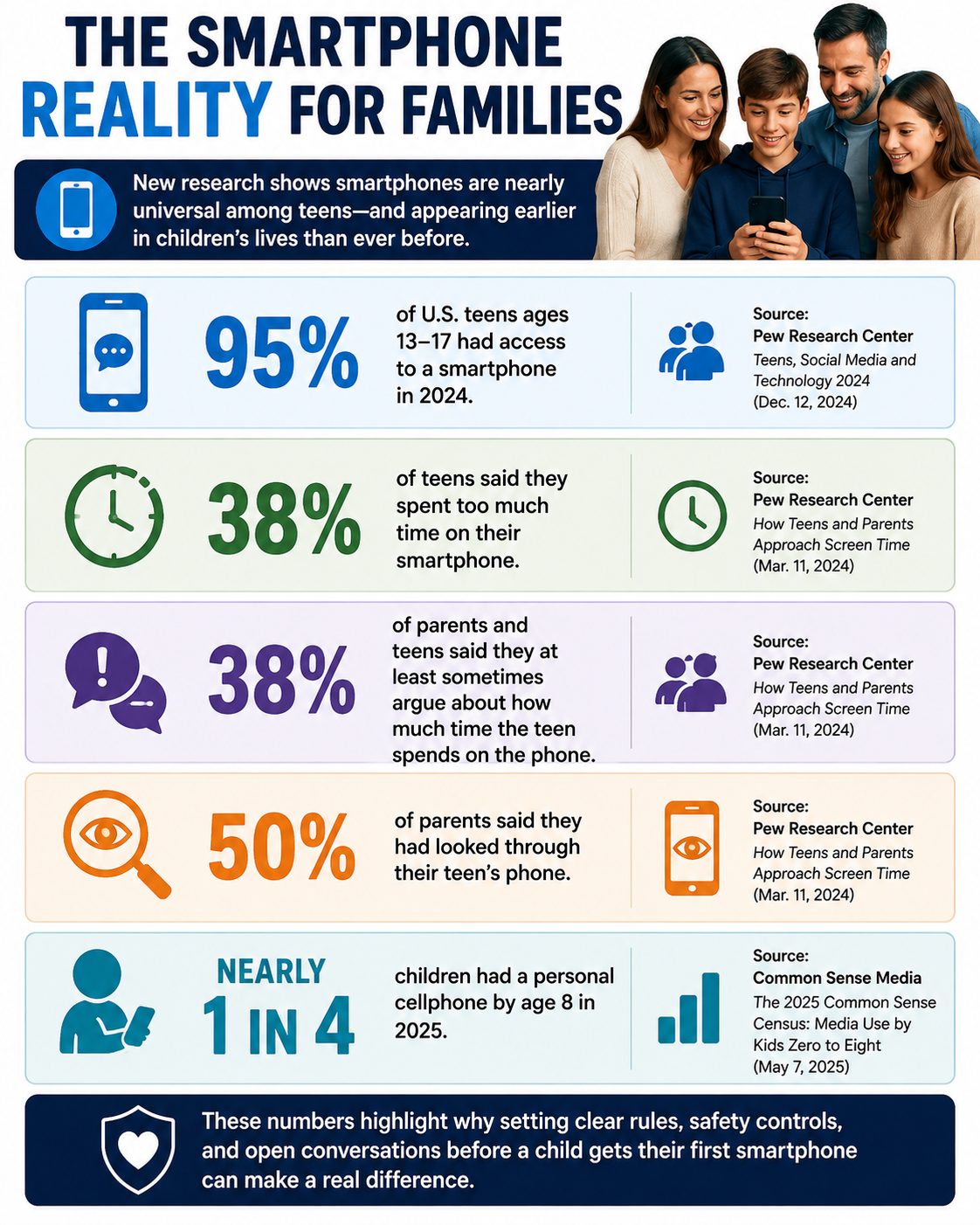
Giving a child their first smartphone can solve a practical problem—suddenly they can call after practice, text when plans change, and reach you in an emergency. But it also places apps, messaging, cameras, location sharing, purchases, strangers, and a nearly unlimited internet connection in their pocket. Smartphone access is nearly universal among teenagers: Pew Research Center found 95% of U.S. teens ages 13 to 17 had access to one in 2024. And the transition is beginning much earlier for some families, with Common Sense Media’s 2025 census finding nearly one in four children had a personal cellphone by age 8. Before activating a child’s first smartphone, parents can make six decisions that may prevent some of the biggest arguments and safety problems later.

1. Decide Whether Your Child Needs a Smartphone—or Just a Phone

There is no single age at which every child suddenly becomes ready for a smartphone. The American Academy of Pediatrics recommends considering the child’s maturity, how they plan to use the device, and whether they’re prepared for problems that can accompany internet access rather than relying solely on age. Start with the problem you’re actually trying to solve: Does your 10-year-old need to contact you after soccer practice, or do they need unrestricted access to social media, games, web browsers, and app stores? Those are very different needs, and a basic phone, calling-enabled watch, or more restricted device may solve the first without automatically providing the second. Think of smartphone access as something that can expand over time rather than a package of privileges that must all arrive on the child’s birthday.

Is Your Child Smartphone Ready?

QuestionWhy It Matters
Do they usually follow household rules?Phone limits require self-control
Can they keep track of belongings?Smartphones are expensive and portable
Will they tell you when something online feels wrong?Secrecy can make problems harder to address
Can they stop using screens when asked?Transitioning away from the device matters
Do they understand basic privacy?Phones collect and share substantial information
Do they actually need internet/app access?Communication may require only a basic device
Can they handle gradually increasing freedom?Controls can loosen as responsibility improves

The American Academy of Pediatrics actually offers families a PhoneReady questionnaire designed to assess behavior, developmental maturity and family values rather than declaring one universal “right age.”

2. Write the Smartphone Rules Before the Phone Arrives

Trying to establish limits after a child has spent three unrestricted weeks with a new smartphone can be much harder than agreeing on expectations beforehand. It is recommended that families create screen-free zones, use parental controls, turn off unnecessary notifications and autoplay, protect bedtime, and establish rules that apply to adults as well as children. Decide whether phones are allowed at dinner, during homework, after bedtime and behind closed bedroom doors, as well as who can approve new apps and purchases. Also establish consequences in advance—for example, downloading an unapproved app might temporarily remove app-store access rather than triggering an unpredictable punishment invented during an argument. Put the rules in writing, revisit them periodically, and loosen restrictions when your child demonstrates that they can handle additional independence.

A First-Phone Agreement Should Cover

  • Bedtime: Where does the phone charge overnight?
  • Apps: Who approves downloads?
  • Purchases: Are in-app purchases allowed?
  • Social media: Which platforms, if any, are permitted?
  • Location: Who can see the child’s location?
  • Privacy: What information should never be shared?
  • School: When must the phone stay away?
  • Monitoring: What are parents allowed to review?
  • Consequences: What happens when a rule is broken?
  • Emergency rule: When can the child come to a parent without fearing immediate loss of the phone?

3. Set Up Privacy, Purchases and Parental Controls Together

Don’t hand over a factory-fresh smartphone and assume the default settings are appropriate for a child. Before the device becomes everyday equipment, review app-download permissions, purchases, location sharing, contacts, web filtering, screen-time limits, camera and microphone permissions, account recovery information, and parental controls. For children under 13, the federal Children’s Online Privacy Protection Act provides protections involving how covered websites and online services collect personal information, including parental-consent requirements in applicable circumstances. Make app permissions a teaching exercise: if a simple game wants permanent access to contacts, photos, microphone and precise location, ask your child why the app might want those things and whether they’re necessary. Setting controls together makes the process less about secretly watching a child and more about teaching them the privacy questions they’ll eventually need to answer without you.

4. Teach the “Show Me, Don’t Hide It” Rule

A child’s first uncomfortable smartphone experience may not involve an obvious stranger asking suspicious questions. It could be a classmate sharing an embarrassing photo, a fake “free gift” text, a phishing link, sexual content appearing unexpectedly, pressure to send a private image, bullying in a group chat, or an adult pretending to be younger. The Federal Trade Commission recommends teaching children not to respond to unknown senders, click unexpected links or attachments, or provide personal or financial information in response to unsolicited messages. Parents should also establish one crucial rule: if something frightening, sexual, threatening, embarrassing or suspicious appears, the child can show an adult without automatically losing the phone simply for reporting it. A child who believes asking for help guarantees punishment has a powerful incentive to hide exactly the situation a parent most needs to know about.

5. Give the Phone a Bedtime—and a Place to Sleep

One of the easiest smartphone boundaries to understand is that the phone doesn’t need to sleep beside the child. You should aim for screen-free periods before bed and emphasize protecting sleep when families develop media plans. Choose a consistent charging location outside the bedroom—a kitchen counter, hallway charging station or parent’s room—and decide when the phone goes there each night. This removes the temptation to answer one more message, watch another video or respond to notifications after lights-out without requiring parents to police every minute of screen use. The rule will also be easier to defend if adults occasionally put their own phones away and demonstrate that being unreachable for part of the evening is normal.

6. Decide How Monitoring Will Change as Your Child Gets Older

Giving a child a smartphone should begin an ongoing conversation rather than end parental involvement. Pew Research Center found half of surveyed parents had looked through their teen’s phone, but monitoring was much more common among parents of 13- and 14-year-olds than parents of 15- to 17-year-olds. Tell your child upfront what you may review—apps, screen time, purchases, contacts or other activity—rather than secretly inventing surveillance rules after a problem occurs. Schedule brief check-ins during the first few months to talk about new apps, strange messages, social pressure, screen habits and anything online that has made the child uncomfortable. As judgment improves, parents can gradually loosen controls so that the smartphone becomes practice for independent digital decision-making rather than a device that remains permanently controlled by an adult.

Infographic showing teen smartphone access and screen time statistics for families

The 10-Minute First Smartphone Setup

Before your child starts using the phone:

  1. Turn on parental controls.
  2. Require approval for app downloads and purchases.
  3. Review location-sharing settings.
  4. Check camera, microphone, photo and contact permissions.
  5. Configure web/content restrictions appropriate for the child.
  6. Set screen-time or downtime schedules.
  7. Turn off unnecessary notifications and autoplay.
  8. Establish the overnight charging location.
  9. Add important family/emergency contacts.
  10. Review the family’s “show me, don’t hide it” rule.

The FTC specifically encourages parents to decide what children may do with the phone, who may contact them, what apps they can download and what parental-control features are appropriate.

A First Smartphone Should Come With Training Wheels

A child’s first smartphone does not have to arrive with unrestricted access to every feature the device offers. Parents can begin with communication and essential apps, add privileges gradually, and adjust controls as a child demonstrates responsibility. It’s a good idea to treat a first phone somewhat like an experiment, with independence increasing as children show they’re ready for it. The most important preparation may not be a particular parental-control setting at all, but establishing a relationship in which children know they can ask for help when something online goes wrong. The goal isn’t to control every tap forever; it’s to help a child eventually use the technology safely without needing you to do it for them.

How old was your child when they got their first phone, and what’s the one rule you wish you’d established from day one?

What to Read Next

Why Some Parents Are Delaying Smartphones Longer Than Ever

Should Your Child Really Have a Smartphone Before School Starts?

Phone-Free Schools Act: New Policies Limit Student Smartphone Use to Curb Distraction and Cyberbullying

Evan Morgan

Evan Morgan has been a full-time freelance writer and editor for 10+ years. When not working, he enjoys catching the latest true crime documentary or getting lost in a good book.

Filed Under: Parenting Tagged With: child safety, children and technology, digital parenting, first smartphone, Internet Safety, Online Safety, parental controls, Parenting, Screen Time, smartphones

8 Money Skills Kids Should Know Before They Get Their First Debit Card

August 18, 2026 | Leave a Comment

Person holding a debit card while shopping online on a laptop
A first debit card can give kids hands-on practice with budgeting, saving, checking balances, and making thoughtful spending decisions. Parents can also use the experience to teach children how to protect their card information and recognize suspicious transactions. (Pexels).

A first debit card can feel like a major step toward independence for a child, but tapping a card is much easier than understanding what happens to the money behind it. Before handing over that plastic, parents can use the moment to teach money skills for kids that will matter long after allowances and lunch purchases disappear. A debit card generally draws money directly from an account, meaning every purchase reduces the amount available for something else. Teaching a few practical habits beforehand can turn that first card into a valuable financial lesson rather than simply another way to spend.

1. Understand Where Debit Card Money Comes From

Kids should understand that a debit card is not a source of unlimited money. Unlike borrowing with a credit card, a typical debit purchase takes money from funds already available in the linked account. If a child has $40 and spends $12 on lunch, only $28 remains for future purchases. Encourage kids to check their available balance before buying rather than assuming the card will work. This is one of the most fundamental money skills for kids because it connects digital spending with real dollars.

2. Create A Simple Spending Plan

A child does not need a complicated spreadsheet to learn budgeting. Suppose your child receives $30 each week and decides to save $10, spend $15, and keep $5 available for unexpected expenses. That simple division teaches them that money usually has competing purposes. Parents can encourage kids to decide how money will be used before it lands in their account instead of figuring it out after most of it disappears. Practicing this routinely can make budgeting feel normal rather than restrictive.

3. Know The Difference Between Needs And Wants

One of the most useful money skills for kids is learning to distinguish a genuine need from something they simply want right now. School supplies might be necessary, while another game download or after-school smoothie is generally optional. The distinction does not mean kids should never buy fun things, but it encourages them to recognize trade-offs. Ask, “Would you still want this tomorrow?” before an impulse purchase. That short waiting period can help children develop stronger spending judgment.

4. Learn To Save Before Spending

Saving works better when it becomes part of the routine instead of something kids attempt with leftover money. A child saving for $80 headphones, for example, could put $10 from every allowance payment toward the goal. Watching the balance grow provides a visible connection between patience and reaching something they value. Many youth-focused financial apps now include savings goals or separate spending and saving categories, making the process easier to visualize. Developing this habit early is among the money skills for kids that can carry into adulthood.

5. Check Transactions And Account Balances

Kids should learn that managing a debit card includes reviewing what happens after they tap, swipe, or shop online. Have your child look through recent transactions regularly and compare purchases with the current balance. A forgotten $6 snack or subscription can suddenly explain why there is less money available than expected. Reviewing activity can also help families spot purchases a child does not recognize. The goal is not constant parental surveillance but teaching children that responsible account holders pay attention to their money.

6. Understand Fees And Declined Purchases

Kids may assume a declined card means something is wrong with the card itself, when the problem could simply be insufficient funds or an account restriction. Depending on the account, consumers can also encounter charges involving ATMs, foreign transactions, subscriptions, or other services. Parents should review the specific fee schedule for their child’s account because policies vary considerably among providers. Consider showing your child an example of how paying a $3 fee to access $20 would immediately make that transaction more expensive. Understanding fees helps kids recognize that how they use financial services can affect how much money they keep.

7. Protect Card And Account Information

Security belongs on every list of essential money skills for kids because debit cards can expose real money to fraud. Children should never share their PIN, card number, security code, password, or verification codes with friends or strangers. They should also know that unexpected messages claiming there is an urgent account problem can be attempts to steal information. Parents should encourage children to monitor account activity and avoid payment terminals that appear altered or suspicious. Make one family rule especially clear: if the card disappears or an unfamiliar transaction appears, tell a parent immediately rather than waiting.

8. Think Before Making Digital Purchases

Online spending can feel less real because kids never physically hand over cash. A few $2 or $5 in-app purchases can quickly become a surprisingly large total when repeated throughout the month. Before confirming an online purchase, kids should check the price, their available balance, and whether the purchase is recurring. Parents can also use available spending limits, alerts, and merchant controls as temporary guardrails while children develop good judgment. These tools work best when paired with conversations, because the long-term goal is responsible decision-making without constant supervision.

A Debit Card Should Be A Learning Tool

A child’s first debit card can provide a low-stakes opportunity to practice financial decisions before adult expenses become much larger. The strongest money skills for kids are built through everyday choices involving earning, saving, spending, security, and trade-offs. Parents do not need children to make perfect decisions; even an impulsive $15 purchase can become a useful lesson when discussed constructively afterward. Giving kids gradually increasing responsibility can help them understand that financial independence comes with accountability.

Which money skill do you think children struggle with most before receiving their first debit card, and what are you doing to prepare yours? Share your experience in the comments.

What to Read Next

Money Lessons Kids Should Learn Before School Starts

Why Giving Your Kids a Debit Card Might Be the Smartest Move You Make

Here’s What You Should Do Before Letting Your Teen Get a Debit Card

Evan Morgan

Evan Morgan has been a full-time freelance writer and editor for 10+ years. When not working, he enjoys catching the latest true crime documentary or getting lost in a good book.
Filed Under: Parenting Tagged With: budgeting, debit cards, family finances, Financial Education, financial literacy, kids and money, money management, money skills for kids, Parenting, Saving Money

How Much Should a Teen Contribute Toward Their First Car?

August 18, 2026 | Leave a Comment

Teen Driving First Car
A teen’s first car should fit the family’s budget without sacrificing safety or leaving the young driver unable to cover ongoing expenses. Agreeing on the purchase contribution, insurance, fuel, and repair responsibilities before buying can turn the experience into a valuable financial lesson. (Pexels).

Buying a first car is one of those milestones that can feel exciting for a teenager and financially complicated for a parent. Families have to balance independence, safety, affordability, and the valuable lesson that a vehicle costs more than the number on the windshield. There is no universal teen car contribution that works for every household, but having a teen pay something can give them meaningful ownership in the decision. The right amount depends on income, savings, family finances, and who will cover expenses after the keys change hands. Before shopping, parents and teens should agree on those numbers together.

Start With What The Teen Can Realistically Afford

A reasonable teen car contribution should challenge a young driver without draining every dollar they have saved. For example, a teenager who has accumulated $3,000 from a summer job might contribute $1,500 toward an $8,000 vehicle while keeping the rest for insurance, fuel, and emergencies. Asking that teen to surrender the entire $3,000 could leave no financial cushion when the battery dies or the car needs tires. Families with fewer resources may need a larger contribution, while others may comfortably match what their teen saves. The goal is financial responsibility rather than making the purchase unnecessarily difficult.

Consider A Percentage Instead Of A Fixed Dollar Amount

Some families find that dividing the purchase price creates clearer expectations than choosing an arbitrary dollar figure. A teen car contribution of 25% to 50% can be a practical starting range when parents have the ability and desire to cover the remainder. On an $8,000 car, that would put the teenager’s share between $2,000 and $4,000, making the connection between work, saving, and purchasing tangible. Another option is a dollar-for-dollar match, such as parents contributing $3,000 after their teenager saves $3,000. Whatever formula you choose, establish it before visiting dealerships so emotion does not suddenly expand the budget.

Remember That The Purchase Price Is Only The Beginning

A first-time driver needs to understand that buying a car creates recurring expenses long after the initial payment. AAA’s 2025 analysis estimated that owning and operating a new vehicle averaged $11,577 annually, although an older, inexpensive used car can cost considerably less. Insurance can be particularly painful because young drivers present greater risk to insurers, and Bankrate reported an average full-coverage rate of about $5,740 annually for a 16-year-old on a parent’s policy as of November 2025. Actual premiums vary dramatically by location, vehicle, insurer, coverage, and household circumstances, so families should obtain quotes before purchasing. A teen car contribution therefore might include paying part of the insurance or fuel instead of putting every available dollar toward the purchase.

Do Not Sacrifice Safety To Make The Teen Pay More

Parents may understandably want their child to experience the satisfaction of buying a car independently, but safety should not become the price of that lesson. The Insurance Institute for Highway Safety and Consumer Reports updated their teen recommendations in May 2026 with 45 used vehicles starting below $10,000 that meet their safety criteria. Some recommended models have estimated starting prices below $5,000, demonstrating that families can find relatively affordable choices without automatically settling for the oldest vehicle available. A pre-purchase inspection by an independent mechanic is also worth considering before handing over money for a used vehicle. If increasing the parents’ contribution provides access to a substantially safer and more reliable car, that can be money well spent.

Decide Who Pays The Ongoing Bills

The fairest arrangement may depend less on the initial teen car contribution and more on what happens afterward. One family might buy the vehicle but require the teen to pay for gasoline, while another might split insurance and maintenance costs. A teen earning $600 monthly from a part-time job, for example, could reasonably set aside $100 or $150 for transportation without making saving for other goals impossible. Parents should also decide in advance who handles registration, repairs, deductibles after an accident, parking, and unexpected expenses. Writing down the arrangement can prevent disagreements when the first $700 repair bill unexpectedly arrives.

Make The Contribution A Lesson That Lasts

Ultimately, a teen car contribution should teach responsibility without turning a first vehicle into a financial burden that crowds out every other priority. For many households, asking the teenager to cover roughly 25% to 50% of an affordable used vehicle, or matching the teenager’s savings, offers a workable framework rather than an inflexible rule. Parents should factor safety, insurance, maintenance, emergency savings, and the teen’s actual earnings into the final decision. The best arrangement is one everyone understands before anyone starts scrolling through car listings or walking onto a dealer’s lot.

How much would you expect a teenager to contribute toward a first car, and which expenses should parents continue covering afterward? Share your approach in the comments.

What to Read Next

10 Reasons Why Teenagers Need Driving Restrictions

6 Things Parents Should Stop Automatically Paying For Once Their Teen Has a Job

The 3 Financial Conversations Every Parent Needs to Have with Their Teen

Evan Morgan

Evan Morgan has been a full-time freelance writer and editor for 10+ years. When not working, he enjoys catching the latest true crime documentary or getting lost in a good book.

Filed Under: Parenting Tagged With: car buying, family finances, financial literacy, first car, parenting teens, Saving Money, teen car contribution, teen car insurance, teen drivers, used cars

Your Child Wants to Quit an Expensive Activity — Should You Make Them Finish the Season?

August 17, 2026 | Leave a Comment

Boy in glasses kicking a soccer ball on a grassy field
An expensive activity can teach perseverance, but forcing a child to continue through burnout, pain, bullying, or serious distress may do more harm than good. Parents should understand why their child wants to quit before allowing money already spent to drive the decision. (Pexels).

Your child begged to join the travel soccer team, dance company, gymnastics program, or music lessons, and you paid hundreds—or even thousands—of dollars to make it happen. Now, halfway through the commitment, your child wants to quit, leaving you frustrated about the money, the commitment, and the lesson quitting might teach. The financial stakes are increasingly significant: the Aspen Institute’s Project Play found that the average U.S. sports family spent $1,016 on a child’s primary sport in 2024, up 46% from 2019. When a child wants to quit, however, the amount you paid should be only one factor in deciding what happens next.

Find Out What “I Quit” Really Means

Before announcing that your child must finish the season, find out why the child wants to quit. A 10-year-old who dislikes running drills is in a different situation from one experiencing bullying, persistent anxiety, pain, or humiliating treatment from a coach. Experts recommend asking open-ended questions and distinguishing a temporary setback from ongoing stress or burnout. Try asking what changed, when the problem started, and what would need to improve for the activity to become enjoyable again. When a child wants to quit, listening first can reveal a problem that simply demanding perseverance would miss.

Don’t Let The Money Make The Decision

It is understandable to think about the $700 registration fee, $300 uniform, or nonrefundable tournament costs already sitting on your credit card. Yet money already spent cannot make an unhealthy or genuinely unsuitable activity suddenly worthwhile, especially if continuing creates bigger problems. Project Play estimates families collectively spend more than $40 billion annually on children’s sports, illustrating how financially significant these decisions have become. Parents can explain that activities cost real money without making children feel responsible for protecting the family budget at all costs. Instead, use the experience to establish clearer rules before paying for the next expensive commitment.

There Is Value In Finishing A Reasonable Commitment

Sometimes the best answer when your child wants to quit is still, “You need to finish this season.” A child who is merely disappointed about losing, sitting on the bench, struggling with a new skill, or discovering that practice requires effort may benefit from sticking it out. Sports psychologist Frank Smoll recommends considering the commitment made to teammates while still recognizing that sufficiently serious problems can justify leaving. Finishing can teach children that frustration does not automatically mean something is wrong and that improvement often requires working through uncomfortable stretches. The important distinction is teaching perseverance rather than teaching children that they must tolerate every situation indefinitely.

Know When Quitting Is The Healthier Choice

Parents should reconsider a finish-the-season rule when a child shows persistent distress, physical pain, burnout, bullying concerns, or significant changes in behavior. Johns Hopkins notes that warning signs of excessive sports-related stress can include dread about practice, avoidance, sleep difficulties, feeling overwhelmed, and physical complaints such as stomach problems. The American Academy of Pediatrics also warns that overtraining and excessive specialization can contribute to physical and mental exhaustion and loss of enjoyment. If symptoms persist, talk with the coach and, when appropriate, a pediatrician or qualified mental health professional rather than assuming your child simply lacks grit. Walking away from a damaging environment can demonstrate good judgment rather than weakness.

Look For A Middle Ground Before Walking Away

The decision does not always have to be either quitting tomorrow or miserably attending every remaining practice. Perhaps your child can move to a recreational team, reduce optional training, switch instructors, take a short break, or complete only the performances or games already promised. Understood recommends establishing trial periods and predetermined exit strategies when children begin activities, giving families a natural point to evaluate whether something remains a good fit. Parents can also talk privately with the coach about playing time, teammate conflicts, workload, or expectations before withdrawing altogether. When a child wants to quit because of one solvable problem, a reasonable adjustment may preserve both the commitment and the enjoyment.

The Best Lesson May Be Knowing When To Stay And When To Leave

Parents understandably want children to develop resilience, responsibility, and respect for commitments, but none of those qualities requires blindly finishing everything they start. When your child wants to quit, consider the reason, the seriousness of the problem, the remaining commitment, and whether realistic solutions have been attempted. Money matters, particularly when families are spending substantial amounts on extracurricular activities, but sunk costs should not outweigh a child’s physical or emotional well-being. A thoughtful decision can teach something more sophisticated than “never quit”: commitments matter, difficult moments can be overcome, and changing course is sometimes responsible.

Would you make your child finish an expensive season they no longer enjoyed, or are there circumstances where you would let them walk away? Tell us what you think in the comments.

What to Read Next

The Free School Trap: Why Your Child’s 2026 Extracurriculars Are Secretly Affecting Your Credit Score

Free Library Benefits That Replace Costly Children’s Activities

6 After-School Activities Parents Regret Paying For (Because the “Benefits” Don’t Show Up)

Evan Morgan

Evan Morgan has been a full-time freelance writer and editor for 10+ years. When not working, he enjoys catching the latest true crime documentary or getting lost in a good book.

Filed Under: Parenting Tagged With: burnout, child development, extracurricular activities, family finances, Kids, Parenting, parenting advice, sports parenting, youth sports

Should Kids Get Paid for Good Grades? What Parents Should Consider Before Offering Cash

August 17, 2026 | Leave a Comment

Parent Giving Kid Money
Cash rewards for good grades can motivate some students, but parents should consider rewarding consistent effort, study habits, and improvement too. The goal is to encourage academic success without making every achievement depend on a paycheck. (Pexels).

Paying a child $10 for every A can sound like a simple way to turn report-card day into motivation day. For some families, paying kids for good grades provides a concrete goal and even creates an opportunity to teach saving, spending, and budgeting. But research on academic incentives suggests the results depend heavily on what parents reward and whether children understand how to reach the goal. A child who studies diligently and earns a B, for example, may deserve more recognition than a child who earns an effortless A. Before opening your wallet, it is worth considering what lesson the money may teach beyond the grade itself.

Understand What The Research Actually Shows

Research does not provide a simple yes-or-no answer on paying kids for good grades. In randomized trials involving more than 250 urban schools, economist Roland Fryer found that financial incentives were more effective when students were rewarded for educational inputs, such as reading books, rather than outputs such as test scores. Another experiment involving elementary students in Ohio found incentives improved math scores by about 0.15 standard deviations but produced no significant improvement in reading, science, or social science. That matters because a report-card grade is an outcome influenced by assignments, tests, classroom expectations, and sometimes factors a child cannot fully control. Parents considering cash incentives should therefore think carefully about whether they are rewarding something their child knows how to improve.

Consider Rewarding Effort Instead Of The Letter Grade

A more practical approach may be rewarding behaviors that contribute to academic success. Child Mind Institute advises parents to recognize sustained effort, following through when work becomes difficult, and attempting challenging tasks rather than focusing exclusively on grades. For example, instead of promising $20 for an A in algebra, a parent might recognize a teenager for consistently completing assignments, attending tutoring, or following a study schedule for an entire grading period. This gives children achievable steps and acknowledges progress even when the final grade falls short of an A. If paying kids for good grades creates pressure to produce a particular letter, rewarding productive habits may offer a healthier alternative.

Watch For A Transactional Attitude Toward Learning

One concern with paying kids for good grades is that children may begin asking, “What do I get?” whenever schoolwork requires extra effort. Psychology Today notes concerns that excessive reliance on material rewards can weaken the development of intrinsic motivation and encourage children to expect incentives for behaviors they should eventually manage independently. That does not mean an occasional reward will automatically destroy a child’s desire to learn, but parents should watch how the child responds when no reward is available. A student who once read science books out of curiosity but now studies only when money is offered may be sending an important signal. The long-term goal is for children to connect learning with competence, independence, opportunity, and personal satisfaction rather than only a payday.

Make The System Fair For The Child You Have

A one-size-fits-all reward system can create problems, particularly in families with multiple children. One child may earn straight A’s with relatively little studying, while a sibling may work for hours and earn B’s because a particular subject is harder. Understood recommends focusing praise on effort and helping children recognize the actions that contributed to their progress. Parents could therefore reward measurable improvement, consistent homework completion, asking a teacher for help, or meeting an individualized academic goal. Paying kids for good grades should never send the message that one sibling’s hard work matters less simply because the final letters on the report card are different.

Use Money As A Financial Lesson If You Decide To Pay

Parents who choose cash rewards can turn the experience into more than a transaction. Suppose a middle-schooler earns $30 after meeting an agreed-upon academic goal; parents might encourage the child to save $15, spend $10, and set aside $5 toward a longer-term goal or charitable cause. The exact amounts matter less than having the child make deliberate decisions about the money. Parents should also establish the rules beforehand, including which achievements qualify, how much can be earned, and whether improvement counts alongside high grades. When paying kids for good grades is connected to money management, the reward can become an opportunity to practice financial decision-making.

The Best Reward Builds Skills Beyond Report Card Day

There is nothing inherently wrong with celebrating academic success, and different children respond to different forms of encouragement. Still, paying kids for good grades works best when parents avoid making cash the sole definition of achievement and focus on behaviors children can control. A modest, clearly defined incentive for consistent studying or meaningful improvement may teach more than a large payout reserved only for perfect grades. Parents can also celebrate progress through privileges, family activities, recognition, or simply an attentive conversation about what their child accomplished.

Would paying for grades motivate your child to work harder, or would it turn learning into another financial transaction—and how does your family handle report-card rewards? Share your experience and thoughts in the comments.

What to Read Next

5 Reasons Why Allowance is a Waste of Money

This Seemingly Smart Allowance Trend Is Leaving Teens Financially Unprepared

What Are “Emotional Allowances” and Should Your Kids Get One?

Evan Morgan

Evan Morgan has been a full-time freelance writer and editor for 10+ years. When not working, he enjoys catching the latest true crime documentary or getting lost in a good book.

Filed Under: Parenting Tagged With: academic success, education, family finances, financial literacy, good grades, kids and money, Parenting, Raising Children, school, student motivation

6 Things Parents Should Stop Automatically Paying For Once Their Teen Has a Job

August 16, 2026 | Leave a Comment

Smiling young woman in an apron using a cash register touchscreen
A teen’s first paycheck creates an opportunity to practice budgeting by taking responsibility for manageable expenses such as entertainment, takeout, gas, and personal purchases. Gradually shifting these costs can teach financial independence without removing essential parental support. (Pexels).

Getting a first job is a major milestone for a teenager, but the paycheck can teach far more than how quickly money disappears at the mall. For parents, it is also an opportunity to introduce teen financial responsibility while the consequences of mistakes are still relatively small. That does not mean suddenly making a 16-year-old pay rent, groceries, and every household expense. Instead, gradually transferring a few reasonable costs can help teens learn budgeting, saving, and the difference between wants and needs before adulthood makes those lessons considerably more expensive.

1. Everyday Entertainment And Outings

Once teens receive regular paychecks, parents do not necessarily need to keep funding every movie, coffee run, concert, or night out with friends. Having a minor entertainment budget feels very different when the teenager knows those dollars represent several hours of work. If they spend everything on Friday and cannot afford Saturday’s plans, the natural consequence provides a valuable budgeting lesson without threatening an essential need. Parents can still pay for family outings, birthdays, and special occasions rather than turning every activity into a financial negotiation. This approach makes teen financial responsibility practical instead of something discussed only around the kitchen table.

2. Nonessential Clothing And Fashion Upgrades

Parents should generally continue providing necessary clothing, but trendy sneakers, designer labels, and extra outfits can become a teen’s responsibility after employment begins. Imagine a teenager choosing between $120 sneakers and putting that same money toward a future car; suddenly, comparison shopping matters. Giving teens ownership over discretionary clothing purchases also helps them recognize how quickly impulse buys can consume a paycheck. Parents can establish a clear boundary, such as covering school basics and replacing genuinely worn-out necessities while the teen pays for upgrades. The goal is not deprivation but teaching that having income requires making choices.

3. Takeout And Convenience Food

A family grocery budget should not disappear simply because a teenager starts working, but parents can stop automatically paying for every drive-through meal or food-delivery order. A small lunch purchased three times a week can add up over four weeks, which can be eye-opening for a new worker. Paying for these extras encourages teens to compare convenience with alternatives such as eating at home or packing lunch. This is an especially useful lesson because small recurring purchases are easy to overlook when creating a budget. Teen financial responsibility develops when young workers understand that frequent small expenses can compete with bigger savings goals.

4. Gas For Personal Driving

If a teen regularly drives to work, school, and social activities, contributing toward gasoline can be a reasonable next step. Parents might continue covering transportation required for school while asking the teen to pay for gas used for weekend trips and recreational driving. This creates a direct connection between driving choices and their real cost without handing a young worker an unaffordable insurance bill overnight. Families should decide expectations in advance so teenagers are not surprised when payday arrives. The arrangement can also encourage teens to combine trips, share rides appropriately, and think before making unnecessary drives.

5. Part Of Their Cellphone Costs

A smartphone is often necessary for communicating with parents, school, and employers, so requiring a teen to assume the entire family-plan bill may not make sense. However, extras such as device upgrades, premium accessories, additional storage, or replacing a carelessly damaged phone are reasonable expenses for an employed teenager. Parents could also ask for a modest monthly contribution, if that amount fits the teen’s earnings. A predictable recurring bill introduces teen financial responsibility because the money must be available every month rather than only when the teen feels like saving it. Parents should keep the amount manageable enough that work still provides an opportunity to build savings.

6. Impulse Purchases And Personal Wants

The simplest category to transfer may be all those spontaneous requests that begin with, “Can you buy me this?” Once a teen earns money, gaming purchases, cosmetics, collectibles, subscriptions, and similar wants can usually come from their paycheck. Fidelity advises parents to use everyday spending situations as opportunities to teach young people the distinction between wants and needs. Parents can help by asking teens to wait 24 or 48 hours before buying something expensive rather than immediately rescuing them from buyer’s remorse. That small habit can turn teen financial responsibility into thoughtful decision-making instead of merely paying bills.

A Paycheck Should Build Independence, Not End Parental Support

The purpose of shifting expenses is not to save parents money at their teenager’s expense; it is to provide supervised practice before adult financial obligations arrive. A teen earning a modest part-time income still needs parental support, particularly for essentials that would consume most of a paycheck. Gradually paying for discretionary expenses allows teens to make manageable mistakes, adjust their priorities, and develop teen financial responsibility while parents remain available for guidance. Families can revisit the arrangement as earnings, school demands, transportation needs, or savings goals change.

Which expenses do you think teenagers should start paying once they have a job, and which should remain a parent’s responsibility? Share your perspective in the comments.

What to Read Next

The Hidden Costs of After-School Care for Kids With Special Needs

6 Common Money Mistakes Kids Make When They Get Their First Job

10 Ways to Get Your Child Their First Paying Job This Summer

Evan Morgan

Evan Morgan has been a full-time freelance writer and editor for 10+ years. When not working, he enjoys catching the latest true crime documentary or getting lost in a good book.

Filed Under: Parenting Tagged With: budgeting, family finances, financial literacy, Parenting, parenting teens, personal finance, Saving Money, teen financial responsibility, teen jobs, teenagers

7 August Advocacy Tasks That Can Make the School Year Easier to Navigate

August 16, 2026 | Leave a Comment

Parent and child with a colorful backpack walking toward a school
August preparation can go beyond buying school supplies: reviewing support plans, organizing records, and connecting with educators can give families a clearer path into the new school year. Early school advocacy also helps children understand when and how to ask for the support they need. (Pexels).

August can feel like one long checklist of school supplies, forms, schedules, and last-minute appointments, but it is also an ideal time for school advocacy. A few proactive steps before classes settle into full speed can prevent small communication gaps from becoming bigger problems later. This is especially important for families whose children use an IEP, 504 plan, classroom accommodations, or other learning supports. These seven school advocacy tasks can help parents enter the new year organized, informed, and ready to collaborate.

1. Review Your Child’s Current Support Plan

Start your August school advocacy by rereading your child’s IEP, 504 plan, or other documented support plan from beginning to end. Check accommodations, services, goals, testing supports, and anything that may have changed since spring. Accommodations change how students learn or demonstrate knowledge, while modifications change what students are expected to learn. If your child received extra testing time last year, for example, confirm whether that support is still documented rather than assuming it automatically continues. Write down questions now so you can raise them calmly and specifically with the appropriate school staff.

2. Create A One-Page Student Snapshot

Teachers receive a tremendous amount of information at the beginning of a school year, so make yours easy to use. Create a one-page summary describing your child’s strengths, challenges, effective strategies, interests, and important accommodations without trying to replace official documentation. For example, a parent might explain that a sixth grader understands math concepts well but needs written directions broken into smaller steps. Understood offers a similar IEP or 504 snapshot designed to help students understand their own services and accommodations. Keep the document brief enough that a busy teacher can absorb the essential information in a few minutes.

3. Establish A Communication Plan Early

Strong school advocacy does not mean contacting teachers every day; it means knowing how and when communication should happen. Ask whether teachers prefer email, a school portal, phone calls, messaging apps, or scheduled conferences for different types of concerns. The National Education Association recommends establishing regular two-way communication and learning about planned opportunities such as conferences, family nights, and open houses. Agreeing on expectations early can prevent frustration when an urgent question appears in October. It also helps parents distinguish between an issue requiring immediate attention and one that can wait for a routine check-in.

4. Organize Your School Records

August is a good time to create one dependable location for evaluations, report cards, IEPs, 504 plans, emails, meeting notices, and progress reports. Reading Rockets specifically recommends keeping special education paperwork organized sequentially and maintaining a calendar of meetings and school events. Digital folders work well, but use clear file names such as “2026 IEP” or “Fall Reading Evaluation” instead of leaving documents buried in downloads. Keep notes from important conversations too, including the date, participants, and any agreed-upon next steps. Organized records make school advocacy more fact-based when questions arise months later.

5. Identify Your Child’s Key Contacts

Do not wait for a problem to discover who handles academic concerns, accommodations, transportation, attendance, counseling, or special education services. Make a short contact list containing the classroom teacher, counselor, case manager, administrator, and other staff members relevant to your child. This does not mean copying five people on every email, which can make straightforward communication unnecessarily complicated. Instead, knowing each person’s role helps you direct questions efficiently and escalate concerns appropriately when needed. Reading Rockets also encourages families to attend open houses and back-to-school events to meet educators and share relevant information.

6. Talk With Your Child About Self-Advocacy

One of the most valuable school advocacy tasks is helping children gradually speak up for what they need. Explain accommodations in age-appropriate language so your child understands that receiving support is not the same as getting an unfair advantage. A student with extended testing time, for instance, should know how to politely ask what to do if that accommodation is unexpectedly unavailable. Understood recommends reviewing accommodations with children and using a one-page snapshot to help them recognize their strengths, challenges, and supports. Even young students can practice simple phrases such as asking a teacher to repeat directions or requesting an approved quiet workspace.

7. Set A First-Month Checkpoint

Do not assume everything is working simply because the first week passes without a phone call. Schedule a personal checkpoint about three or four weeks into school to review grades, attendance, homework patterns, stress levels, and whether promised supports appear to be happening. Child Mind Institute notes that returning to structured school routines can be particularly challenging for children with learning or mental health difficulties. Look for patterns rather than overreacting to one difficult assignment, forgotten worksheet, or rough morning. If concerns persist, bring specific examples to the school and ask what adjustments or additional information might help.

Start Early, Then Keep The Conversation Going

The goal of August school advocacy is not to guarantee a trouble-free year but to create a stronger foundation for handling challenges when they appear. Reviewing documents, organizing records, establishing communication, and involving your child can make future conversations more productive and less reactive. Families should remember that informal classroom supports can be useful, but they do not carry the same requirements as accommodations formally documented in an IEP or 504 plan. This is general planning guidance, and families facing significant disputes may need individualized professional advice.

Which school advocacy task could make the biggest difference for your family this year, and what would you add to this list? Share your experience in the comments.

What to Read Next

Back-to-School Costs Are Climbing Again: Which Expenses Do Parents Forget Until August?

Special-Education Terms Parents Should Know Before the School Year Begins

529 Plans Usually Don’t Cover These Back-to-School Expenses

Evan Morgan

Evan Morgan has been a full-time freelance writer and editor for 10+ years. When not working, he enjoys catching the latest true crime documentary or getting lost in a good book.

Filed Under: Parenting Tagged With: 504 plan, Back to School, education, IEP, parent advocacy, Parenting, school advocacy, school communication, special education, student support

« Previous Page
Next Page »
  • Facebook
  • Pinterest
  • RSS
  • Twitter
Best Parenting Blogs

Most Popular

Baby

9 Baby Names That Sound Rare Without Being Hard to Spell

Evan Morgan
Baby

9 Unusual Baby Names That Sound Like They Belong to Future CEOs

Evan Morgan
Target Store

Choking Incident Prompts Recall of 49,000 Target Gigglescape “Under the Sea” Popping Toys

Evan Morgan
Frustrated Girl

Why Some Students on the Spectrum Are Labeled With ODD

Evan Morgan
Coke Bottles

12 Things Kids Took to School in the ’70s That Would Never Be Allowed Today

Evan Morgan

All content on Kids Ain’t Cheap is for entertainment purposes only. By reading this blog, you agree that Kids Ain’t Cheap is not responsible for any actions taken after reading this blog. For the full disclaimer, see our privacy policy.

Please note that Kids Ain’t Cheap has financial relationships with some of the merchants mentioned here. Kids Ain’t Cheap is funded by banner advertising, commission sales and search optimization consulting.

Copyright © 2006–2026 | District Media | All Rights Reserved | Privacy Policy

Copyright © 2026 Runway Pro Theme by Viva la Violette